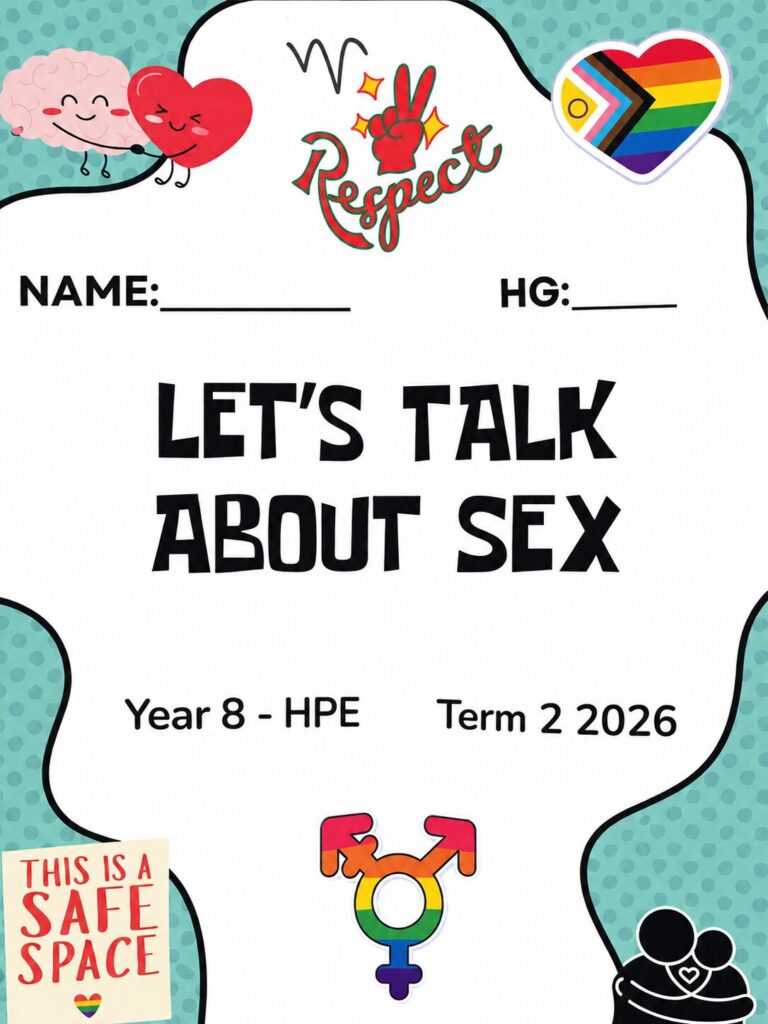
A concerned parent recently provided Women Speak Tasmania with a copy of the Year 8 Health and Physical Education (HPE) workbook currently being used at Montrose Bay High School in Tasmania.
The booklet, titled Let’s Talk About Sex, forms part of the school’s Term 2 2026 curriculum. It covers gender identity, sexuality, consent, contraception and sexually transmitted infections. While later lessons address practical health and safety topics, a substantial portion of the unit is devoted to gender identity theory, the rejection of the sex binary, non-binary identities, and training students in political allyship.
This material is not optional enrichment. Under the Tasmanian Department for Education, Children and Young People (DECYP) Supporting Sexuality, Sex and Gender Diversity in Schools Policy and its accompanying Procedure, content of this nature is treated as core curriculum. Official DECYP guidance states that students are expected to participate in Respectful Relationships and Consent Education. Concerns are directed to individual schools rather than addressed through any general right of withdrawal.
The workbook therefore offers a clear window into how departmental policy is being implemented in Tasmanian classrooms.
A “Safe Space” for One Viewpoint Only
The workbook opens with rainbow imagery, gender symbols, and a prominent “THIS IS A SAFE SPACE” sticker. Students are instructed to:
“Be respectful of all genders, identities, and beliefs”
and
“Use correct and respectful terminology”
The unit overview shows that the first four lessons focus on gender identity, gender expression, stereotypes, sexuality and inclusion before any sustained attention is given to consent, contraception or sexual health.
Respect and the rejection of bullying are important classroom values. What is at issue is that the material presents students with a single, contested ideological framework for understanding sex and gender, while alternative scientific and philosophical perspectives are entirely absent.
“Assigned Sex” – Ideological Language, Not Science
In Lesson 1, the entire class participates in a choral reading exercise. Students must read aloud together:
“Gender and assigned sex are not the same thing. Assigned sex refers to the biological label — male, female, or intersex — given to a person at birth. Gender, on the other hand, is how a person experiences and expresses themselves in the world. It exists on a spectrum.”
Students are then required to define “assigned sex,” “intersex” and “gender identity.”
The language is not neutral. Sex is not “assigned.” It is observed and recorded on the basis of reproductive anatomy. In biological terms, sex in humans (as in all mammals) is defined by the type of gamete an organism is organised to produce: small gametes (sperm) = male; large gametes (ova) = female. This is binary. Disorders of sexual development (sometimes called intersex conditions) are medical variations or disorders of this binary developmental pathway. They are not a third sex, nor evidence that sex itself exists on a spectrum.
By teaching children that sex is a “label given at birth,” the workbook replaces a material biological reality with a political formulation. No scientific counter-view is offered. Students are not invited to consider the biological definition of sex at all.
Rejecting the Sex Binary as Official Doctrine
Lesson 2 continues and intensifies the same approach. Students again read aloud as a class:
“Gender is not simply male or female — it is a rich and complex part of every person’s identity. The gender binary suggests there are only two genders, but many people experience gender outside of this.”
They are then required to define binary, non-binary, cisgender and transgender identities. Success criteria assess whether students can explain these concepts according to the framework presented in the lesson.
The claim that the binary is merely a “suggestion” is taught as established fact. The possibility that biological sex is binary, and that “gender identity” is a psychological or social concept rather than an alternative sex category, is never raised. Students are not asked to evaluate the claim; they are asked to reproduce it.
Sexuality, Conflation and Compulsory Allyship
Lesson 4 states that sexual orientation “exists on a broad spectrum” and that every identity is “valid and deserving of respect.” Students must learn a list of orientation categories and complete activities on homophobia, transphobia and allyship. One stated success criterion is the ability to “identify ways to be an LGBTQIA+ ally.”
Two serious problems arise here.
First, the lesson conflates fundamentally different phenomena. Sexual orientation concerns patterns of attraction to male or female bodies. Transgender identity is a claim about identity that may conflict with biological sex. Intersex conditions are disorders of sexual development. These are not the same things, yet the workbook places them under one political acronym and treats scepticism toward any of them as a form of “phobia.”
Second, requiring students to demonstrate “allyship” moves the lesson from education into political formation. Teaching children to treat others with basic dignity is uncontroversial. Requiring them to adopt and perform a specific ideological stance is a different matter.
Have We Put the Cart Before the Horse?
Perhaps the most striking feature of the unit is the order in which topics are taught.
Students spend the first four lessons learning about gender identity, non-binary identities, gender expression, sexuality as a spectrum, homophobia, transphobia and allyship. Only after this extended focus on identity concepts do they reach lessons on consent, contraception and sexually transmitted infections.
This sequence is educationally incoherent.
Human sexuality begins with biological reality. The reason sexual reproduction exists, why there are males and females, why pregnancy occurs, and why contraception is necessary are all rooted in basic reproductive biology. Yet the workbook does not begin with reproductive anatomy, puberty, fertility, conception or the differences between the sexes. Instead, students spend multiple lessons exploring identity-based concepts before they are taught the biological foundations of human reproduction.
How can students properly understand sexual relationships, consent, contraception, fertility or sexual health if they have not first been taught what sex is in the biological sense and how human reproduction actually works?
A biology-first approach would begin with the material realities of human reproduction and only then move to questions of relationships, social expectations and individual experience. In this workbook, that sequence has been reversed.
Consent – And a Return to Gender Ideology
Lesson 7 introduces the FRIES model of consent (Freely given, Reversible, Informed, Enthusiastic, Specific). Teaching young people about consent, personal boundaries and respectful communication is valuable and enjoys broad community support.
Yet before students begin the consent activities, they are first asked:
“What is one way you could support gender diversity?”
Even a lesson devoted to consent is used to reinforce the gender identity framework that has dominated the earlier part of the unit.
The Method Is Part of the Message
The content is not the only concern. The teaching method itself matters.
Across multiple lessons, students participate in choral reading and echo reading exercises in which they repeat approved statements aloud together as a class. This is not discussion, inquiry or critical evaluation of competing ideas. It is repetition and reinforcement of a single perspective.
Students are assessed on their ability to define concepts and explain them according to the framework presented. They are not invited to examine whether alternative interpretations may exist, nor are they given the biological or philosophical tools to do so.
When a contested ideological claim is presented as settled fact, when no counter-view is offered, and when students are required to recite the claim in unison, the process begins to resemble indoctrination more than education.
Questions That Need Answers
Women Speak Tasmania supports teaching respect, the rejection of bullying, and clear, accurate information about consent and sexual health. These are not the points of contention.
The questions that require answers are:
- Why is a contested ideological framework about sex and gender presented to Year 8 students as settled fact?
- Why is the biological reality of sex — that humans are a sexually dimorphic species organised around two gametes — never presented as a legitimate alternative perspective?
- Why are students required to recite these claims aloud together as a class?
- Why are sexual orientation, gender identity and intersex conditions repeatedly grouped together as though they are the same phenomenon?
- Why does even a lesson on consent begin with a requirement to support gender diversity?
- Are parents being given full transparency about the content of this unit and the philosophical assumptions embedded within it?
These are reasonable questions in a democratic society. Parents, teachers, policymakers and the wider community are entitled to examine the material being taught in schools and to ask whether it reflects genuine educational inquiry — or whether it presents one contested worldview as the only acceptable framework through which young people are expected to understand sex, gender and human relationships.