
On 12 July 2026, The Examiner published an article calling Tasmania’s sex work laws “outdated and dangerous” and urging reform to allow commercial brothels. The piece followed a Change.org petition by Phillip Cox. Mr Cox argues that legal brothels would improve safety and reduce exploitation.

The Tasmanian Government and Labor Opposition have both stated they have no plans to change the Sex Industry Offences Act 2005. Tasmanian Greens leader Dr Rosalie Woodruff has described a review as “significantly overdue” and stated that “Sex work is work. All workers deserve equal rights and protection in the workplace.”
Women Speak Tasmania agrees that Tasmania’s sex industry laws deserve proper, independent examination. However, we strongly disagree with the direction being promoted by those calling for legal brothels and full decriminalisation.
What Tasmania’s Current Law Already Does
Tasmania’s Sex Industry Offences Act 2005 is not a blanket ban on sex work. It permits self-employed sex workers to operate legally (either alone or with one other non-managing worker). At the same time, it criminalises:
- The purchase of sexual services in commercial settings (Section 5)
- Commercial operators and brothel-style businesses (Section 4)
- Coercion, violence, and exploitation of sex workers (Section 7)
- Involvement of children (Sections 9 and 11)
The Act already targets buyers and third-party profiteers while allowing independent workers to operate. This places Tasmania closer to a Nordic-style approach than is often acknowledged.
The Problems with Legal Brothels
Advocates for reform frequently point to Victoria as a successful model. However, legal brothels in Victoria have not eliminated violence or exploitation.
One of Melbourne’s largest legal brothels, Gotham City, which was used as an example in the Examiner article, has faced repeated serious issues. These include a 2019 police raid involving drug-related offences, allegations of coercive practices against workers, multiple breaches of advertising standards for highly sexualised and demeaning billboard campaigns, a drive-by shooting at the premises in April 2026, and its owner publicly admitting to helping fund the controversial “Ditch the Witch” advertising campaign targeting Victorian Premier Jacinta Allan in June 2026.
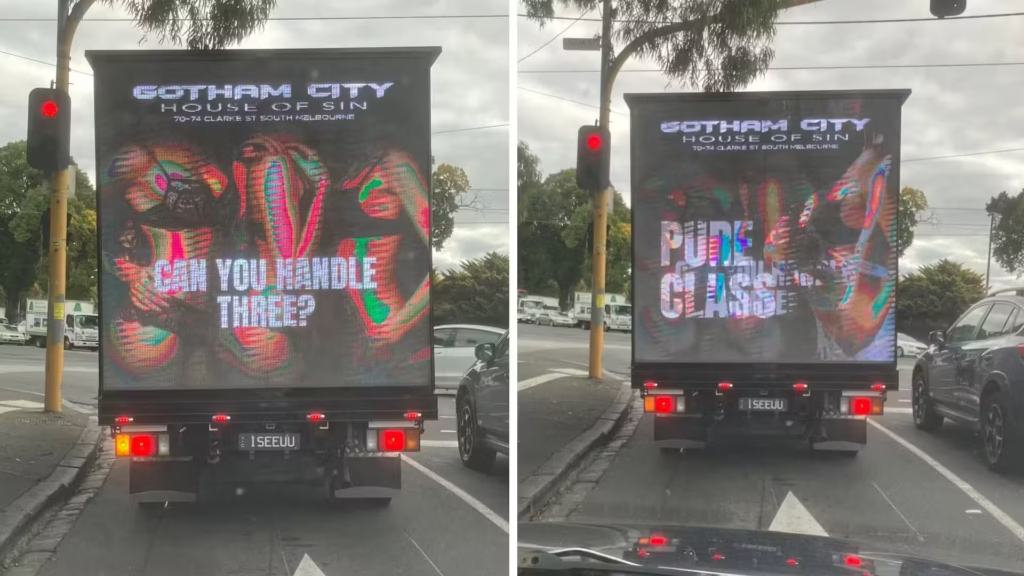
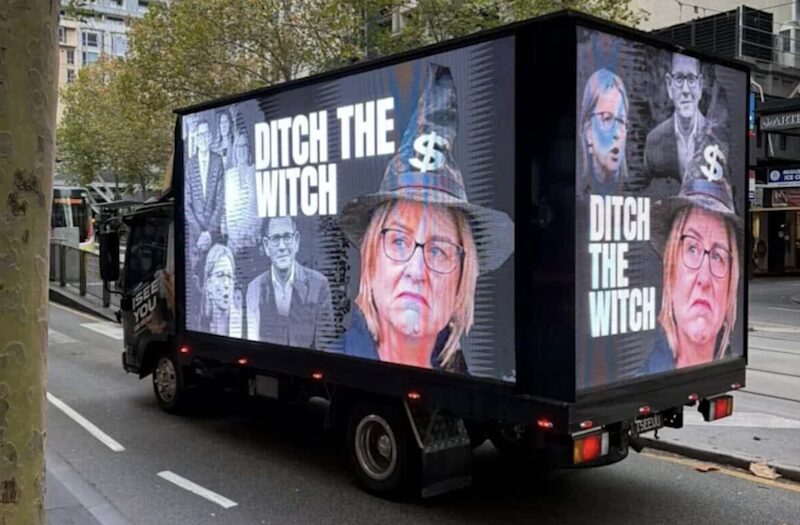
More recently, in late 2024, a 62-year-old woman was found dead inside a legal brothel in Footscray. In March 2026, a man was committed to stand trial in the Victorian Supreme Court charged with her murder. These incidents occurred under Victoria’s decriminalised framework.
Legalising commercial brothels has not removed harm — it has expanded the industry and normalised violence within it.
The Reality Inside the Sex Trade: Ella’s Testimony
Women Speak Tasmania recently received a detailed, anonymised statement from a woman currently working in the sex trade. We have called her Ella (not her real name).
Ella is clear that money is the only real reason most women remain in the sex trade — particularly single mothers and women with disabilities. She describes the routine normalisation of violence:
“The number of times I’ve been smacked, slapped, choked, punched, spat on… I’ve lost count.”
She also details coercion from brothel management when she attempted to refuse certain clients, particularly trans-identified males:
“In one case, I was told I was being given a ‘first and final warning’ when I refused to serve a transgender customer… On one occasion, after I refused to serve a transgender customer, the manager on duty told me I would not be paid unless I complied.”
Ella eventually left one workplace due to what she described as a “rapey” workplace culture. Like many women in the sex trade, she lives with significant trauma. Her psychologist told her it is “hard to treat Post Traumatic Stress Disorder when it’s not yet ‘post’.”
She also highlights the institutional barriers — difficulties accessing banking, business accounts, and mortgages — that trap women in the trade.
Our Request to the Attorney General
While Tasmania’s current laws already contain significant protections, we believe a proper independent review is necessary to bring the legislation into line with the Nordic/Equality Model.
We have written to Attorney General Guy Barnett requesting such a review and attached Ella’s full statement as evidence.
Our position is clear:
- The sex trade is inherently harmful and functions as a form of violence against women.
- Legal brothels and full decriminalisation do not solve the problem — they institutionalise exploitation and expand the market.
- Tasmania should strengthen its laws in line with the Nordic Model, which has been shown to reduce demand and give women genuine pathways out of the sex trade.
Specifically, we are calling for:
- Government-funded exit programs — trauma-informed mental health support, housing, education, and employment pathways for women who want to leave.
- A dedicated Tasmanian Police unit focused on sex trade exploitation, with annual public reporting.
- A full, independent review of the Sex Industry Offences Act 2005 that examines the outcomes of decriminalisation in other jurisdictions and considers stronger demand-reduction measures.
As the UN Special Rapporteur on violence against women and girls, Reem Alsalem, stated in her 2024 report:
“States must avoid becoming ‘pimp States’ by legalizing or profiting from prostitution; instead they must adopt laws that suppress exploitation and expand protections for victims.”
Tasmanian women deserve laws grounded in evidence and the lived experiences of those in the sex trade — not industry lobbying or ideological slogans.
Note: “Ella” is a pseudonym used to protect the identity of the woman who provided this testimony to Women Speak Tasmania.
Attachment:
Testimony from a prostituted woman