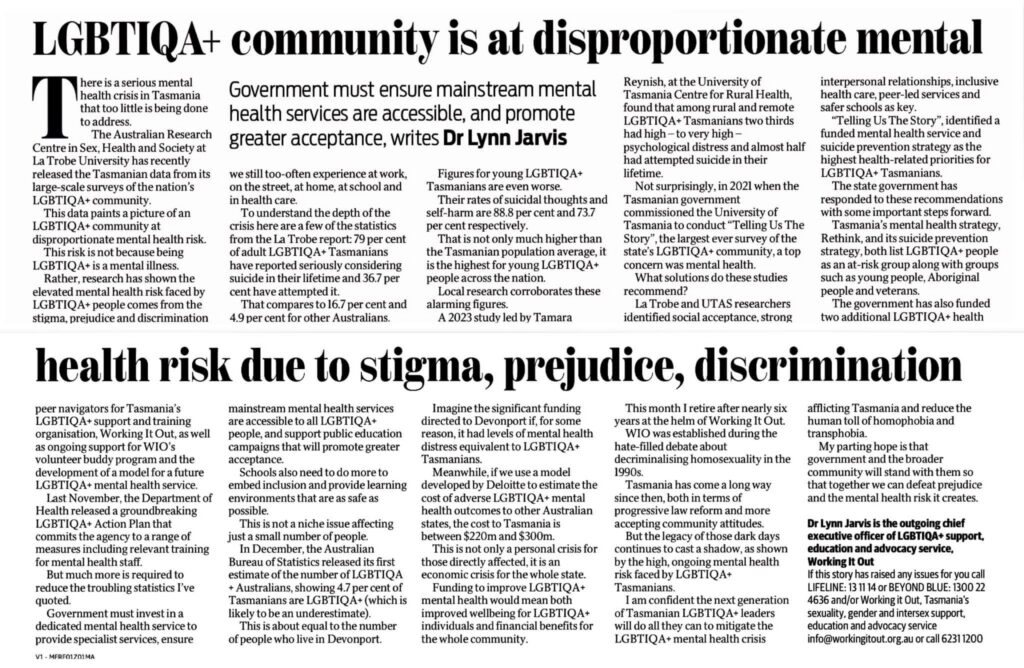
In her opinion piece, outgoing Working it Out CEO Lynn Jarvis (Mercury 23 January 2025) outlines what appear to be alarming statistics on suicidality in the so-called LGBTIQA+ community. However, if the survey referred to was conducted online and the participants were self-selected and self-identifying into this group, then it has little to no scientific validity. The sensationalist reporting on youth suicidality also appears to fall foul of Lifeline’s guidelines to alert and not alarm when speaking publicly on suicide.
Working it Out supports social transitioning of ‘trans’ children in Tasmanian schools, including primary schools, and claims that social transitioning does not lead to medical transitioning. This is simply not true; social transitioning is not a neutral intervention and often leads to persistence of gender dysphoria, worsening mental health outcomes for children. Thankfully, trans activist lawyer Chase Strangio admitted under oath in the US Supreme Court that suicide in this youth cohort is extremely rare, and medical intervention in the form of gender affirming care does not reduce the risk of suicide.
Working it Out started out as an organisation advocating for the rights of same-sex attracted people (lesbians, gay men and bisexuals) but which now spends the majority of its time on the latter letters of the acronym, that is, anything to the right of the ‘B’. This is evident in the focus on gender affirmation and transition plans in schools. In taking attention and focus away from those adolescents coming to terms with their same-sex attraction and introducing gender identity concepts to all children at inappropriately young ages, Working it Out seems to be working at counter-purposes to supporting lesbian, gay and bisexual youth to enjoy good mental health.
Dr. Elizabeth Caballero (retired GP)
Women Speak Tasmania
Letter to The Mercury
Here is the full transcript of the opinion piece by Dr Lynn Jarvis which appeared in The Mercury 23 January 2025
OPINION: LGBTIQA+ community is at disproportionate mental health risk due to stigma, prejudice, discrimination
There is a serious mental health crisis in Tasmania that too little is being done to address.
The Australian Research Centre in Sex, Health and Society at La Trobe University has recently released the Tasmanian data from its large-scale surveys of the nation’s LGBTIQA+ community.
This data paints a picture of an LGBTIQA+ community at disproportionate mental health risk. This risk is not because being LGBTIQA+ is a mental illness. Rather, research has shown the elevated mental health risk faced by LGBTIQA+ people comes from the stigma, prejudice and discrimination we still too-often experience at work, on the street, at home, at school and in health care.
To understand the depth of the crisis here are a few of the statistics from the La Trobe report: 79 per cent of adult LGBTIQA+ Tasmanians have reported seriously considering suicide in their lifetime and 36.7 per cent have attempted it. That compares to 16.7 per cent and 4.9 per cent for other Australians.
Figures for young LGBTIQA+ Tasmanians are even worse. Their rates of suicidal thoughts and self-harm are 88.8 per cent and 73.7 per cent respectively. That is not only much higher than the Tasmanian population average, it is the highest for young LGBTIQA+ people across the nation. Local research corroborates these alarming figures.
A 2023 study led by Tamara Reynish, at the University of Tasmania Centre for Rural Health, found that among rural and remote LGBTIQA+ Tasmanians two thirds had high – to very high – psychological distress and almost half had attempted suicide in their lifetime.
Not surprisingly, in 2021 when the Tasmanian government commissioned the University of Tasmania to conduct “Telling Us The Story”, the largest ever survey of the state’s LGBTIQA+ community, a top concern was mental health.
What solutions do these studies recommend? La Trobe and UTAS researchers identified social acceptance, strong interpersonal relationships, inclusive health care, peer-led services and safer schools as key.
“Telling Us The Story”, identified a funded mental health service and suicide prevention strategy as the highest health-related priorities for LGBTIQA+ Tasmanians.
The state government has responded to these recommendations with some important steps forward. Tasmania’s mental health strategy, Rethink, and its suicide prevention strategy, both list LGBTIQA+ people as an at-risk group along with groups such as young people, Aboriginal people and veterans. The government has also funded two additional LGBTIQA+ health peer navigators for Tasmania’s LGBTIQA+ support and training organisation, Working It Out, as well as ongoing support for WIO’s volunteer buddy program and the development of a model for a future LGBTIQA+ mental health service.
Last November, the Department of Health released a groundbreaking LGBTIQA+ Action Plan that commits the agency to a range of measures including relevant training for mental health staff.
But much more is required to reduce the troubling statistics I’ve quoted. Government must invest in a dedicated mental health service to provide specialist services, ensure mainstream mental health services are accessible to all LGBTIQA+ people, and support public education campaigns that will promote greater acceptance.
Schools also need to do more to embed inclusion and provide learning environments that are as safe as possible.
This is not a niche issue affecting just a small number of people. In December, the Australian Bureau of Statistics released its first estimate of the number of LGBTIQA+ Australians, showing 4.7 per cent of Tasmanians are LGBTIQA+ (which is likely to be an underestimate). This is about equal to the number of people who live in Devonport.
Imagine the significant funding directed to Devonport if, for some reason, it had levels of mental health distress equivalent to LGBTIQA+ Tasmanians. Meanwhile, if we use a model developed by Deloitte to estimate the cost of adverse LGBTIQA+ mental health outcomes to other Australian states, the cost to Tasmania is between $220m and $300m. This is not only a personal crisis for those directly affected, it is an economic crisis for the whole state. Funding to improve LGBTIQA+ mental health would mean both improved wellbeing for LGBTIQA+ individuals and financial benefits for the whole community.
This month I retire after nearly six years at the helm of Working It Out. WIO was established during the hate-filled debate about decriminalising homosexuality in the 1990s. Tasmania has come a long way since then, both in terms of progressive law reform and more accepting community attitudes. But the legacy of those dark days continues to cast a shadow, as shown by the high, ongoing mental health risk faced by LGBTIQA+ Tasmanians.
I am confident the next generation of Tasmanian LGBTIQA+ leaders will do all they can to mitigate the LGBTIQA+ mental health crisis afflicting Tasmania and reduce the human toll of homophobia and transphobia.
My parting hope is that government and the broader community will stand with them so that together we can defeat prejudice and the mental health risk it creates.
Dr Lynn Jarvis is the outgoing chief executive officer of LGBTIQA+ support, education and advocacy service, Working It Out.
Printed version: