
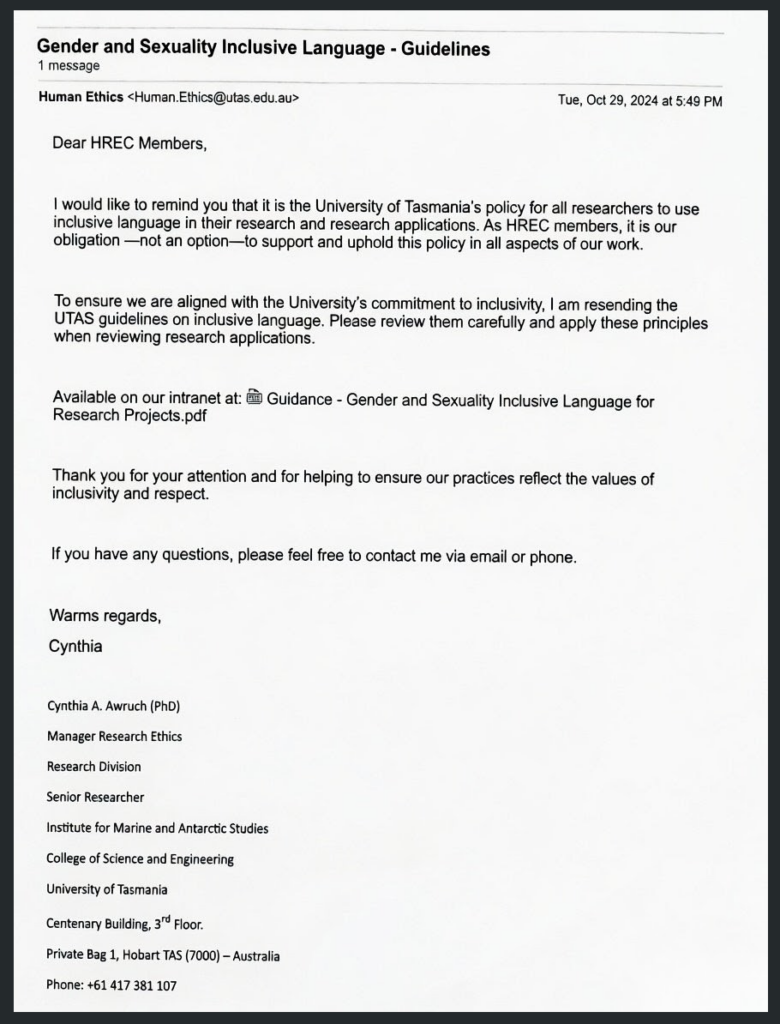
In October 2024, members of the University of Tasmania’s Human Research Ethics Committee (HREC) received an email titled “Gender and Sexuality Inclusive Language – Guidelines.”
The email, sent by Cynthia A. Awruch (Manager Research Ethics), was blunt:
“It is the University of Tasmania’s policy for all researchers to use inclusive language in their research and research applications. As HREC members, it is our obligation — not an option — to support and uphold this policy in all aspects of our work.”
This directive goes beyond guidance. By compelling members to adopt specific language and ideological positions, it infringes on freedom of thought, conscience, and expression. Academic and professional integrity cannot thrive under policies that force compliance with contested beliefs at the expense of open inquiry and individual rights.
The Full Code of Conduct
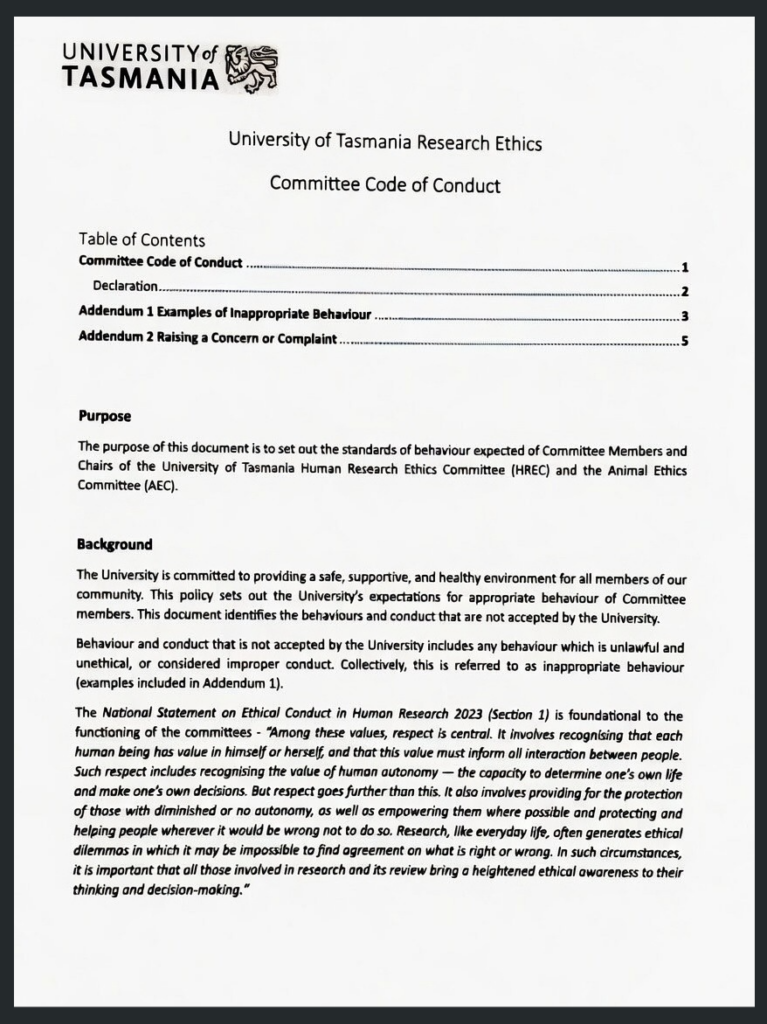
This email was not an isolated reminder. It sits alongside the university’s official University of Tasmania Research Ethics Committee Code of Conduct (dated 1 August 2023). The document, which all HREC and Animal Ethics Committee members must sign, contains several deeply concerning provisions:
- Mandatory “inclusive behaviours” and language Under the section “Codes”, committee members must “Demonstrate inclusive behaviours and use inclusive language.” This is presented as a formal duty alongside honesty, integrity, and respect.
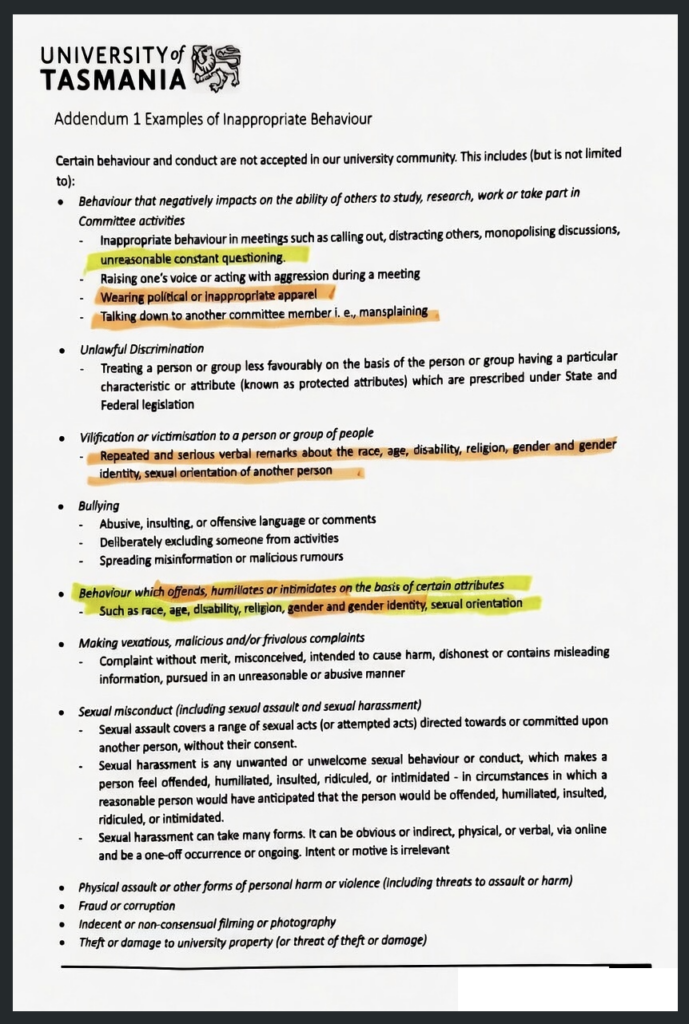
- “Unreasonable constant questioning” listed as inappropriate behaviour In Addendum 1 – Examples of Inappropriate Behaviour, the university explicitly includes “unreasonable constant questioning” as an example of conduct that negatively impacts committee activities. Persistent, rigorous questioning — the very foundation of the scientific method — is now framed as misconduct.
- Broad, subjective speech restrictions The same addendum lists as “inappropriate”:
- Repeated and serious verbal remarks about “gender and gender identity, sexual orientation”
- Behaviour which “offends, humiliates or intimidates” on the basis of gender and gender identity
- “Mansplaining”, wearing “political or inappropriate apparel”, and talking down to others
- Complaints process Addendum 2 encourages members to report concerns about the conduct of studies or committee functioning, with complaints directed to the Safe and Fair Community Unit. This creates a formal mechanism to investigate and potentially discipline members for breaching these speech and language rules.
What This Actually Means
The University of Tasmania has transformed its Research Ethics Committees from guardians of research integrity into enforcers of a specific ideological position on gender and sexuality. Researchers and ethics reviewers are now required to use university-approved language (such as treating “gender identity” as equivalent to or more important than biological sex) even when their data, clinical evidence, or philosophical position suggests otherwise.
This is not neutral “inclusivity.” It is compelled speech that demands academics set aside evidence-based terminology in favour of contested gender-identity theory.
Serious Repercussions
- Chilling effect on research Academics working in psychology, medicine, sociology, law, or women’s studies may now self-censor to avoid being accused of “offending” on gender issues, asking “too many questions,” or failing to use approved language.
- Undermining research ethics True ethical review requires independence, objectivity, and the courage to scrutinise proposals — even controversial ones. Labelling rigorous questioning as inappropriate behaviour directly contradicts the National Statement on Ethical Conduct in Human Research 2023, which the university itself quotes.
- Threat to academic freedom By making “inclusive language” compulsory, UTAS is effectively requiring committee members to affirm contested beliefs as a condition of participation. This is incompatible with the university’s duty to protect free inquiry.
- Particular risk to sex-based rights research Given recent public debates in Tasmania around women’s single-sex spaces, sports, and youth gender medicine, these rules could deter or punish research that prioritises biological sex as a key variable.
A Deeper Concern
When an institution’s research ethics body — the very mechanism designed to uphold truth-seeking and participant protection — becomes an ideological gatekeeper, the entire research enterprise is compromised. Science advances through disagreement, rigorous questioning, and the freedom to follow evidence wherever it leads. Policies that punish dissent or mandate belief do the opposite.
The University of Tasmania should immediately review these sections of the Code of Conduct. Mandatory ideological language and the pathologising of robust questioning have no place in a serious research institution.