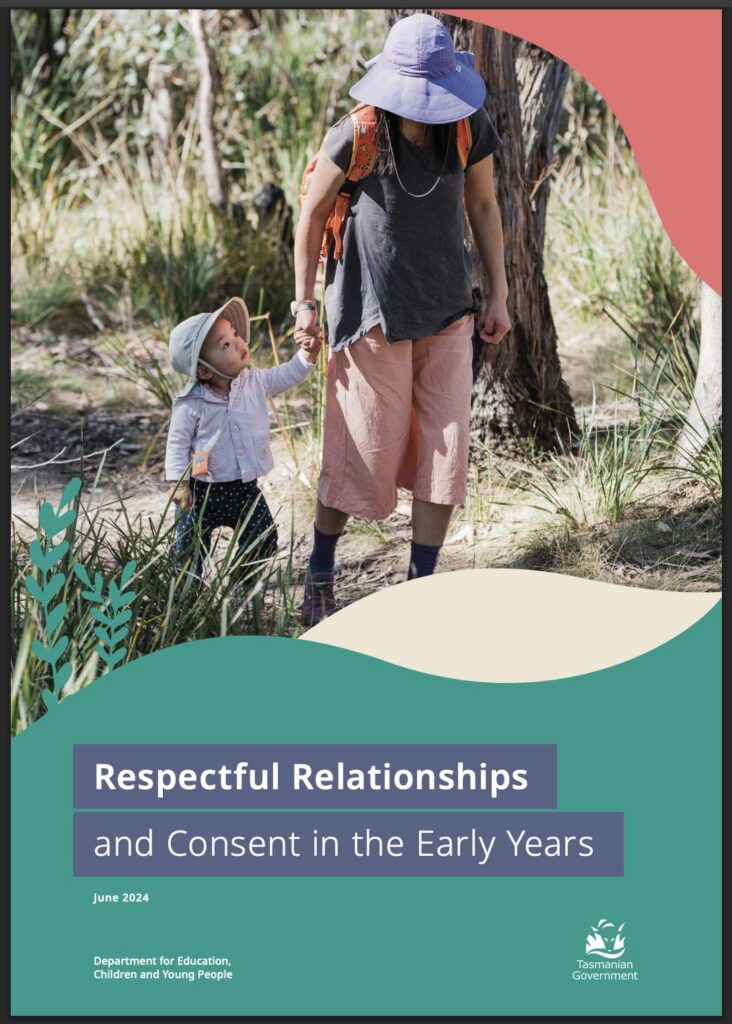
Analysis and summary of the “Respectful Relationships and Consent In the Early Years Package”, with a focus on gender ideology content, where it conflicts with established child development theory (like Piaget), and the use of neutral or scientifically inaccurate language.
Summary of Content
- The resource is designed for educators in early childhood (birth–5 years), promoting “respectful relationships” and “consent education.”
- It includes lesson prompts, scenarios, stories, and language guides to encourage teachers to frame everyday play and interactions in ways that are inclusive of “different identities.”
- A key theme is introducing children to concepts of gender as separate from sex, encouraging open-ended role play, and using neutral language about bodies, families, and reproduction.
Analysis of Gender Ideology in the Resource
1. Gender identity as fact
- The document introduces gender as a matter of self-identity and explicitly distinguishes it from biological sex.
- Statements imply that a child may be “male, female, both, or neither,” even at a very young age (pre-school years).
- This approach presents a contested ideological position as fact, ignoring scientific consensus that biological sex is binary and observable.
2. Neutral / de-sexed language
- Consistent use of terms like “people with vulvas,” “people with penises,” instead of “boys” and “girls,” “mothers” and “fathers.”
- Explanations of reproduction avoid reference to women or mothers, instead using phrases like “babies grow inside a special place in the tummy.”
- This deliberate avoidance of sexed language is framed as inclusivity but has the effect of erasing biological realities and confusing children at a stage where clarity is developmentally important.
3. Incorrect or misleading scientific information
- Claims such as “genitals don’t determine whether you are a boy or girl” contradict biological science.
- Teaching that “some boys have vulvas” or “some girls have penises” presents ideological belief as scientific fact.
- References to organisations such as Planned Parenthood and the Australian Psychological Society embed the affirmation-only model, which is itself contested in clinical and psychological fields.
Conflict with Developmental Theory (e.g., Piaget)
- Piaget’s theory of cognitive development (preoperational stage: ages 2–7) emphasises that children at this age are concrete thinkers who cannot grasp abstract, fluid, or relativist concepts.
- Teaching toddlers that gender identity is different from sex introduces abstract and contradictory ideas that are beyond their developmental capacity.
- Instead of supporting healthy identity formation, such teaching risks confusing children, who are only beginning to understand stable categories like male/female, mother/father.
- This undermines safeguarding by blurring boundaries of reality, fact, and fantasy at a stage when children are especially vulnerable.
Safeguarding Concerns
- Premature sexualisation and identity labelling – Encouraging children as young as 3–4 to consider themselves as “boy, girl, both or neither” risks imposing adult ideological frameworks on children too young to critically assess them.
- Confusion over bodies and reproduction – Avoiding clear references to mothers, women, and biological sex removes a foundation of factual learning about the human body, replacing it with contested ideas.
- Authority bias – Presenting ideology as fact under the authority of teachers risks children internalising contested claims as unquestionable truth.
- External links – The document directs teachers to advocacy-based resources (e.g., Planned Parenthood, APS materials) without acknowledging debate, exposing children and teachers to one-sided ideological content.
Conclusion
The “Respectful Relationships and Consent In the Early Years Package”, embeds gender ideology throughout, often presenting it as scientific fact. Its use of neutral/de-sexed language, incorrect claims about sex and gender, and references to contested external organisations pose safeguarding concerns.
It conflicts with accepted developmental theory (such as Piaget’s), which shows that children in early years require clear, concrete, and reality-based categories to make sense of the world. Introducing abstract identity theories at this stage risks confusion, undermines trust in scientific fact, and pressures teachers to affirm contested ideas rather than safeguard children’s healthy development.
Access the Guideline in the link below
https://publicdocumentcentre.education.tas.gov.au/library/Shared%20Documents/RR_B-K_Interactive.pdf