Recently, the important public debate about reforming Tasmania’s Anti-Discrimination Act 1998 to add biological sex as a protected attribute reached Tasmania Parliament and then mainstream media.
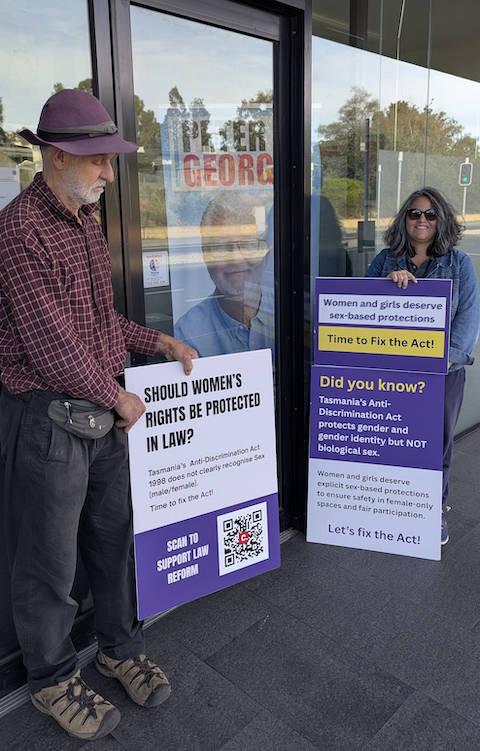
Women Speak Tasmania has been campaigning for this change to better protect single-sex spaces, services, and fair sport for women and girls. However, when ABC Hobart Breakfast covered the issue on 21 May 2026, listeners heard only one side of the story.
“Biological gender”?
The ABC promoted and introduced the segment using the term “biological gender” — a term that does not exist in science, medicine, or law.
Sex is biological (male or female). Gender is widely understood as a social or personal construct. By repeatedly using “biological gender”, the ABC confused the very issue under discussion.
Was this sloppy language, or was it an attempt to misrepresent the debate? Either way, it is misleading for a public broadcaster.
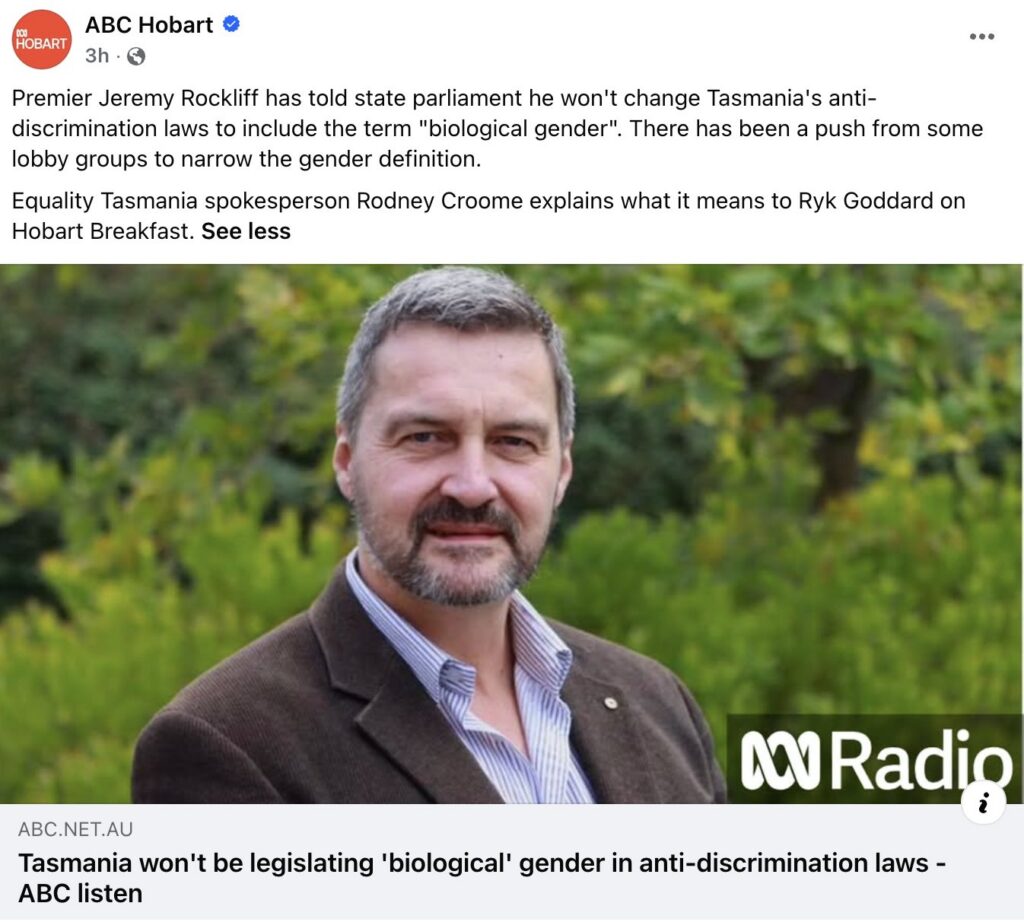
Only one voice: Rodney Croome
The entire segment featured Rodney Croome from Equality Tasmania with no balancing interview from Women Speak Tasmania or any women’s rights advocate. This lack of right of reply allowed several misleading claims to go unchallenged.
Key issues identified in the interview:
- “Almost 30 years” of transgender protections Croome claimed transgender people have been protected for nearly 30 years. In reality, sexual orientation was protected from 1999, but explicit gender identity protections were only added in 2013 — just 13 years ago. Conflating the two is inaccurate.
- Women’s services have no problems Croome stated that Tasmanian women’s services, refuges, and sports have no issues with the current inclusive approach. Many women report concerns about privacy, safety, and fairness, yet these voices are often dismissed or not heard.
- Biological sex testing is “quite invasive” Croome described testing as invasive and oppressive to women. In practice, the cheek-swab (SRY gene test) now used by World Athletics is simple, quick, and non-invasive — similar to a standard COVID swab. Many female Olympians and athletes support it. Disorders of sexual development (DSD) cases are already managed case-by-case under international guidelines.
- “I haven’t seen any problems myself” Croome repeatedly said he has not observed disadvantages to women. As a man, he is not best placed to speak about female experiences in changerooms, refuges, or sports. This “absence of evidence” argument dismisses legitimate concerns raised by women and girls.
A legislative issue deserves balance
This is not a minor cultural debate — it is a legislative issue directly affecting women’s and girls’ rights in Tasmania.
Public broadcasters have a duty under the ABC Charter to present contested matters with impartiality and balance. Giving only Rodney Croome’s ideological perspective falls short of that standard.
Women Speak Tasmania has submitted a formal complaint to ABC Hobart requesting acknowledgment of the issues and future balanced coverage. We hope the ABC takes this opportunity to correct course and include women’s voices on matters that affect us most.
Community debate on sex-based rights deserves more than a one-sided platform.
Source: ABC Hobart Breakfast with Ryk Goddard 21.05.26
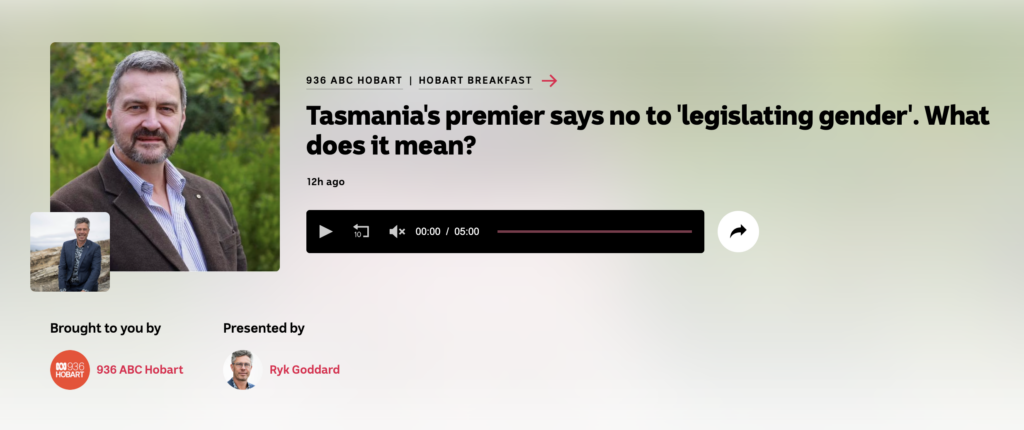
Transcript: Rodney Croome Interview on ABC Hobart Breakfast
Interviewer: Ryk Goddard
Guest: Rodney Croome (Equality Tasmania spokesperson)
Date: 21May 2026
Duration: ~5 minutes
Rodney Croome:
At the moment in Tasmanian law, there’s protection for men and women on the basis of gender. So that’s how you appear — your outward appearance in terms of whether you’re masculine or feminine.
The push is to narrow that to biological characteristics, and that’s chiefly about excluding trans people from those kinds of protections so that it’s easier to exclude trans women in particular from women’s services, or from women’s sport, or from women’s spaces.
That’s what the move is chiefly about. And it was given a bit of a push along by a federal court decision last week, which found that a trans woman had been discriminated against because she was kicked off a women’s site. So yeah, chiefly it’s about allowing discrimination against trans women.
And obviously, that’s something that I and many people oppose. Because in Tasmania, we’ve had laws that protect transgender people from discrimination for almost 30 years now. It’s really hard to see what the problem has been. That law’s been very effective in protecting trans people from discrimination in work, in housing, in a whole lot of other areas — in education, for instance.
Women’s services in Tasmania — Women’s Health, women’s legal, women’s refuges — they don’t discriminate. They open their doors to trans women and diverse people. And so it’s really hard to see what the problem is that we’re trying to solve here.
Ryk Goddard:
Is there any evidence in Tasmania of the sorts of issues that people who are wanting this kind of discrimination legislated are talking about?
Rodney Croome:
Well, they will say there is, but I haven’t been able to see that myself. There was one case in Launceston a couple of years ago that was in the newspaper about a transwoman accessing the changerooms, I think, at the Council aquatic centre in Launceston. That was found to be entirely made up, and the editor of the newspaper had to resign.
So apart from that, I haven’t really seen any issues arising from the fact that in Tasmania we’ve developed some pretty inclusive laws and an inclusive ethos. And I think that’s what the Premier was responding to when he said, well, there’s no need to change the law because there’s no clear problem that we’re trying to solve here. We’ve become a more inclusive society over the last three decades. Thank goodness.
There was a time back up until 2000 when there were laws that actually targeted trans people in Tasmania — particularly trans women. We don’t have those laws anymore. We’re a more inclusive society and that seems to have worked out for everyone. It certainly doesn’t seem to be any disadvantage to other women that I’ve been able to see.
Ryk Goddard:
Rodney, we’ve seen global sports bodies — because it’s the other big issue around inclusion and sports and fairness in sport. We know, outside of elite competition, that again doesn’t seem to be a major problem. Do you think those bodies are coming to the right sorts of decisions?
Rodney Croome:
I think the solution at an elite level — and at a community level, you’re right, there doesn’t seem to be an issue. Many of the sporting codes in Tasmania are very inclusive, so that’s fine.
At an elite level, the solution I think makes most sense is a case-by-case analysis, rather than a blanket ban on all trans people, which is really just based on prejudice and reinforces discrimination. And as you said, it is quite invasive for other women too.
If the ban is based on whether your biological sex was when you were born, then that means that non-trans women have to go through all this testing that can be quite invasive and violate their privacy. And of course, it reinforces the old idea that women are defined by their biology.
I mean, in the past that kind of thing has led to deeper oppression of women. Women were denied the vote in the past because they were seen as biologically irrational or weak. They were told that their place was in the home because their biology dictated that they should be rearing children. Women’s opportunities in life were limited by this idea of them being defined by their biology. It really seems to me a retrograde step to want to go back to that.