
“First they ignore you, then they laugh at you, then they fight you, then you win.” — Nicholas Klein
Today in the Tasmanian Parliament during Question Time, Independent Member for Clark Kristie Johnston named Women Speak Tasmania and attacked our campaign.
She accused us of wanting to “weaken Tasmania’s Anti-Discrimination Act” and “allow discrimination against trans and gender diverse people.” She claimed our Women’s Pledge seeks to “ban trans women from single sex spaces, services and sports” and described this as “a radical change from decades of inclusive practice in Tasmania with no issue.”
Premier Jeremy Rockliff responded:
“We stand with all Tasmanians… and we’ve got no plans to change the anti-discrimination laws.”
It is deeply disappointing to watch a sitting female MP — elected to represent women in Tasmania — argue against sex-based protections for women and girls in favour of the demands of trans-identified males.
Addressing Kristie Johnston’s Claims
- “Weaken the Act” — False. Adding sex strengthens the Act by closing a glaring gap. Most Australian states and comparable countries explicitly protect sex.
- “Allow discrimination against trans people” — False. We oppose erasing sex-based categories that are essential for female safety, privacy, and fairness.
- “Radical change from decades of inclusive practice” — Misleading. Sex-segregated spaces existed for good reason long before self-ID policies. The real radical experiment is placing trans-identified males into female-only areas — an approach that has led to documented safeguarding failures, lost privacy, and unfairness in sport elsewhere.
What We Are Actually Asking
We are not asking to weaken the Act. We are asking to strengthen it by adding “sex” (biological male or female) as an explicit protected attribute.
Tasmania’s current Anti-Discrimination Act 1998 protects “gender” and “gender identity” but does not list “sex” at all. This omission leaves women and girls without clear legal recognition of their biological reality in single-sex spaces, services, sports, and data collection.
Our Women’s Pledge simply asks MPs to support:
- The addition of biological sex as a protected attribute in the Act.
- The right of women and girls to maintain single-sex spaces, services, and sports based on biological sex.
These are mainstream, evidence-based positions. Trans-identified males already have full protections under the existing “gender identity” attribute. We are seeking to protect women’s sex-based rights alongside them.
Equality Tasmania’s Position
Equality Tasmania spokesperson Rodney Croome went further in their media release. They openly opposed adding biological sex to the Act, claiming it “would provide less protection for women and girls than the current ground of gender.”
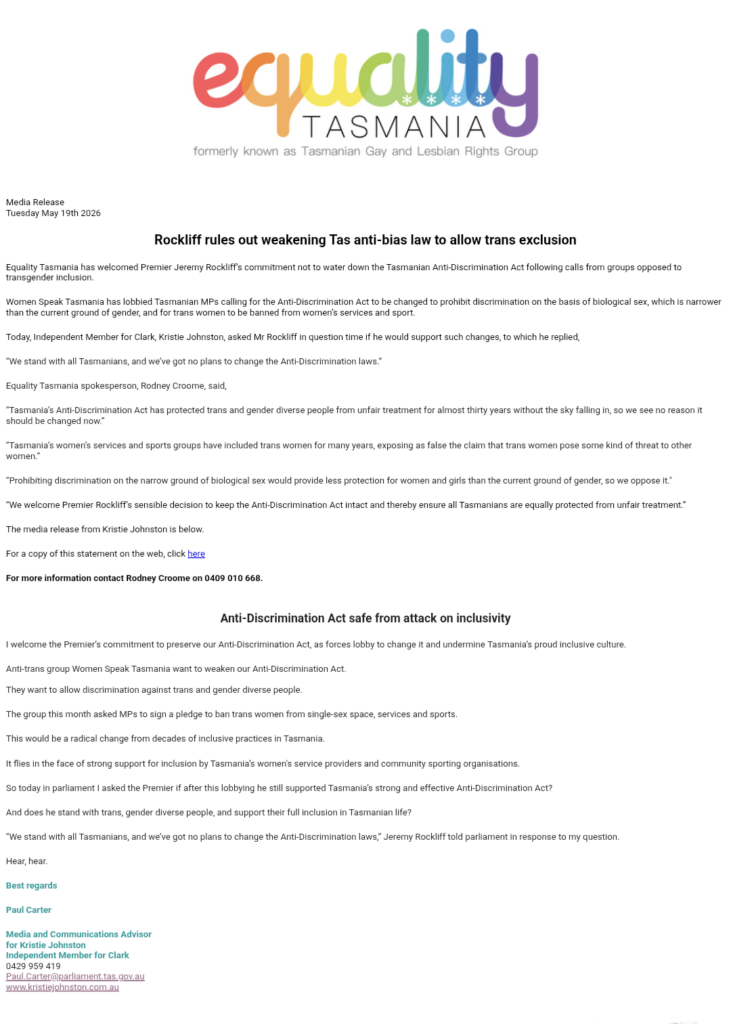
Let that sink in. A prominent LGBTI advocacy group is explicitly arguing that women and girls should not have clear legal protection on the basis of their biological sex. They prefer vague “gender” language that prioritises gender identity over sex. This is not inclusion — it is the erasure of women’s rights.
Trans-identified males are male. They retain male-pattern advantages in strength, speed, and physicality, and male-pattern crime statistics. Women and girls should not be compelled to surrender their safety, privacy, and fair opportunities to accommodate this reality.
Moving Forward
Being named and criticised in Parliament shows one thing clearly: our message is reaching decision-makers. Momentum is building.
We will continue our work — petitions, letters to MPs, public education, and the Women’s Pledge — until Tasmanian law explicitly recognises and protects biological sex.
Tasmanian women and girls deserve nothing less.
Sex is real. Women’s rights are sex-based rights.