
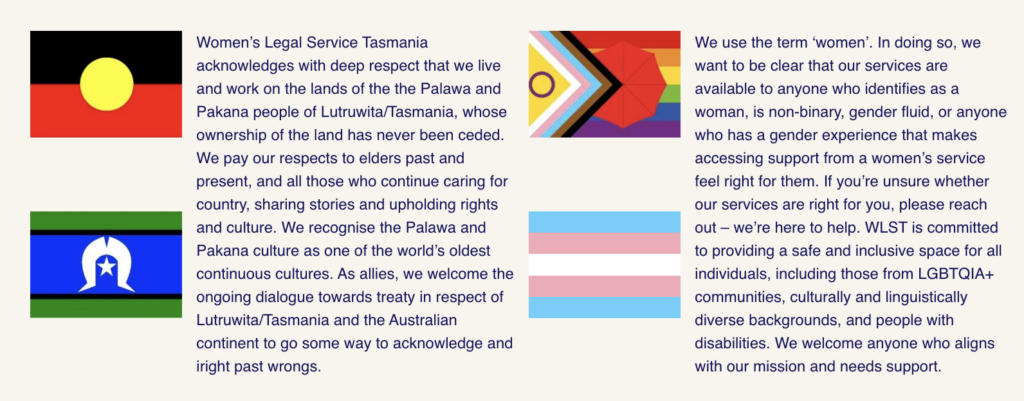
Women Speak Tasmania recently noted that the Women’s Legal Service Tasmania website displays a modified Pride flag incorporating a red umbrella symbol.

Many Tasmanians would understandably not recognise its meaning. The red umbrella is not a generic diversity symbol. Internationally, it is the political emblem of the sex-industry legalisation movement and has been used in campaigns advocating the full decriminalisation of prostitution, including removal of sanctions on sex buyers and third-party profiteers.
Even some LGBTQ organisations do not fully support this flag, explicitly distancing themselves from any movement that normalises the sex industry. This highlights that the flag’s promotion is not universally accepted within communities often assumed to be its natural allies.
This matters because symbols are not neutral. Institutions choose them deliberately, and they communicate a legal and social philosophy.
Women Speak Tasmania supports the Nordic Model — legislation that decriminalises the prostituted person while criminalising the purchase of sex and profiteering. This approach is grounded in the understanding, supported by a large body of research and frontline testimony, that prostitution is closely linked to inequality, economic vulnerability, trafficking, coercion, and male demand. The law should target those who create and profit from that demand, not the women who are often trapped within it.
Our concern is therefore not aesthetic or cultural. It is substantive.
Women’s Legal Service Tasmania provides assistance to women experiencing domestic violence, coercive control, and serious vulnerability. Many women who enter prostitution do so in precisely these contexts: financial desperation, homelessness risk, prior abuse, addiction, or manipulation by controlling men. For those women, prostitution is not experienced as an identity or empowerment. It is experienced as survival.
Over the past year, members of Women Speak Tasmania have met with women across the community who describe the pressures shaping their lives — including the growing influence of online sexualisation and expectations placed on young women and girls. Several raised fears that public institutions are increasingly reluctant to name exploitation where it occurs.
Against that background, the use of a symbol associated with the normalisation of the sex trade raises a legitimate question. A legal service dedicated to protecting vulnerable women must be seen to oppose systems that expose women to exploitation. Displaying the emblem of a political movement advocating the expansion or legitimisation of that industry risks creating confusion about where the organisation stands.
This is not an attack on individuals, nor a claim about motives. It is a request for clarity.
Public trust in women’s advocacy services depends on the confidence that safeguarding, not ideology, guides institutional messaging. Tasmanian women deserve assurance that services established to assist them clearly recognise prostitution as a site of harm and inequality.
We therefore respectfully invite Women’s Legal Service Tasmania to clarify their position on prostitution law reform and the meaning of the symbol displayed on their public website.
Open discussion is healthy in a democratic society. Clear positions are healthier still.