
On the Working It Out website, we found a report titled “Fix the System, Not Me!” – Evaluating the Impact of Working It Out’s Programs in Tasmanian Schools, developed in collaboration with the University of Tasmania. Curious about its contents, we undertook a detailed review.
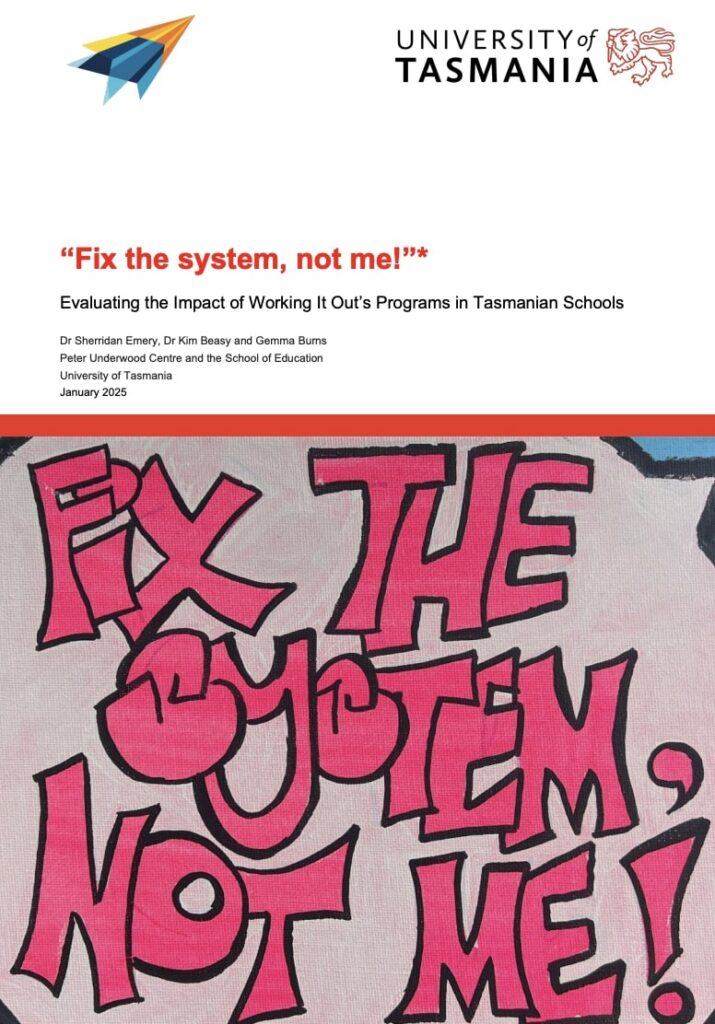
At first reading, the document appears highly one-sided, presenting the work of Working It Out (WIO) in an overwhelmingly positive light, with little acknowledgement of alternative perspectives or potential safeguarding issues. The language and framing suggest a strong advocacy stance rather than a balanced evaluation. In several sections, the report uses terminology such as “cis” and “heteronormative” in ways that seem dismissive of those who are not LGBTIQA+, reinforcing an implicit “us versus them” mentality — where the wider school community is portrayed as needing to change to accommodate one group.
Given these concerns, we set out to analyse this document carefully and answer the following questions:
- Is this a proper, balanced report or a biased advocacy document?
- Does it ensure safeguarding is prioritised ahead of affirmation?
- How is Working It Out involved in Tasmanian schools?
- Are they facilitating or encouraging social transition among students?
- Does the report promote an “us versus them” mindset within the school environment?
1. Is this a proper report or a biased document?
The Final Report appears to be written as an advocacy and evaluation document, not as an independent research or policy report. It presents itself as a summary of WIO’s activities and outcomes rather than an objective external review.
- The tone is affirmative and promotional, focusing on inclusion, diversity, and the organisation’s successes.
- There is no evidence of independent data verification or external auditing of programs.
- References to “best practice” and “inclusion outcomes” are descriptive, not backed by empirical evidence or peer-reviewed sources.
Conclusion: The report is informative but not neutral — it functions as an advocacy and internal accountability document, intended to promote and justify WIO’s approach rather than critically evaluate it.
2. Are they making sure safeguarding is prioritised over affirmation?
Safeguarding (in the sense of child protection, informed consent, and duty of care) is not explicitly prioritised in the report.
- The term “safeguarding” is rarely mentioned or defined.
- The focus is on creating “affirming and inclusive environments,” with little discussion of risk management, parental involvement, or oversight.
- No distinction is made between supportive inclusion and clinical or psychological safeguarding measures (e.g., screening for distress, ensuring parental knowledge, or balancing affirmation with assessment).
Conclusion: Safeguarding is implicit but secondary — the emphasis is on affirmation and identity validation, not risk mitigation or duty of care.
3. How are they involved in schools?
The report describes broad and direct engagement with Tasmanian schools, including:
- Providing training and professional development for teachers and staff on LGBTIQA+ inclusion.
- Supporting schools with affirmation planning for trans and gender-diverse students.
- Advising on inclusive curriculum design, gender-neutral facilities, and staff language use.
- Conducting school visits, workshops, and consultations with both educators and students.
There is no clear evidence of formal oversight or boundaries defining what WIO can do independently versus what must be approved by the Department for Education or parents.
Conclusion: WIO is deeply embedded in schools as a consultant and trainer, with direct influence on teacher practice and school culture. Oversight and transparency mechanisms are not well-documented in the report.
4. Are they socially transitioning children?
The report implies that WIO facilitates or supports social transition in educational settings through:
- Mentions of “affirmation plans” for trans and gender-diverse students.
- Descriptions of helping schools “navigate gender transitions” and “create affirming environments.”
- Focus on ensuring that students can “live as their authentic selves” at school.
However:
- The report does not specify whether WIO directly manages individual student transitions, or merely advises schools on how to respond.
- There is no discussion of parental consent, clinical input, or age thresholds.
Conclusion: The report suggests WIO supports or enables social transition in schools, likely in an advisory or facilitative role, without detailed attention to safeguarding or parental involvement.
5. Are they fostering a mentality of “us against them”?
The tone of the report is advocacy-based but not overtly antagonistic. It frames its work as countering “discrimination,” “hostility,” and “anti-trans rhetoric.” While this language positions WIO as defending marginalised students, it does create an implicit “us versus them” narrative — between “inclusive allies” and those seen as “anti-inclusion.”
Indicators:
- Frequent framing of challenges as “resistance” or “opposition from certain groups.”
- Minimal acknowledgement of legitimate safeguarding or parental concerns.
- No effort to engage dissenting viewpoints in dialogue or to present alternative perspectives.
Conclusion: The report leans toward a polarised framing, where critics are implicitly treated as adversaries rather than stakeholders. It promotes a sense of moral alignment (“inclusion equals good”) rather than encouraging pluralistic discussion.
Overall Summary
| Evaluation Area | Finding |
|---|---|
| Objectivity | Primarily advocacy-oriented; limited neutrality |
| Safeguarding focus | Minimal; affirmation takes precedence |
| School involvement | Extensive, including staff training and student support |
| Social transition | Supported or facilitated; details vague |
| Tone and framing | Advocacy-driven; implicitly “us vs them” mindset |
Final Conclusions
The Working It Out Final Report is a program advocacy summary, not a balanced policy analysis.
It shows substantial involvement in schools through training and affirmation planning, with affirmation framed as the central safeguarding strategy.
However, traditional safeguarding principles — such as informed consent, risk assessment, and parental involvement — are not visibly integrated or prioritised.
Reference:
Working It Out Website “Fix the System, Not Me!” – Evaluating the Impact of Working It Out’s Programs in Tasmanian Schools. University of Tasmania. 2025- https://www.workingitout.org.au/wp-content/uploads/2025/03/Final-Report-Working-It-Out_130225.pdf