
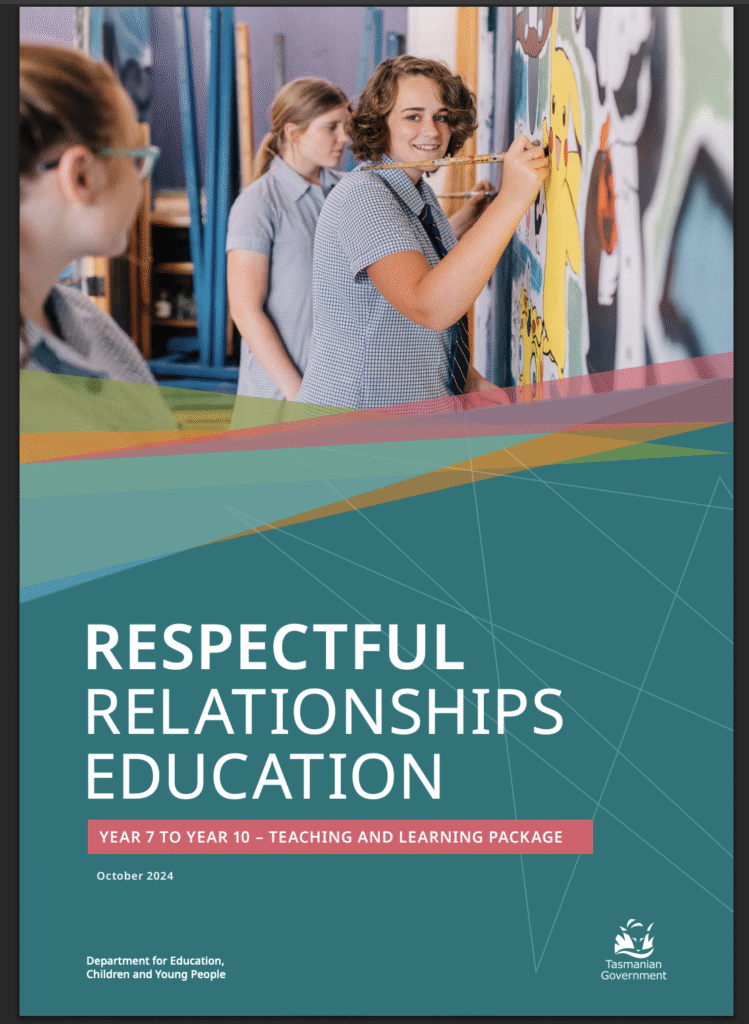
Analysis and summary of the Year 7–10 “Respectful Relationships Education: Teaching & Learning Package” with a focus on content related to gender ideology–adjacent content, any porn/sexting material, and specific role-plays/scenarios that could raise child-safeguarding issues.
Summary
- The resource centres on consent, power, stereotypes, bystander action and online safety, with repeated prompts to challenge “gender stereotypes and roles” and discuss “identities” in relationships. It does not explicitly teach “gender identity theory,” but it does frame gender and power as core lenses for preventing violence.
- Pornography and sexting are addressed through scenarios, discussion and external links; some scenarios name “porn videos,” “nudes,” and “dick pics,” and include coercion/blackmail situations. These appear in Years 7–8 handouts as well as Years 9–10 activities.
- The pedagogy is highly interactive (scripts, instant-replay rewriting, bystander role-plays). Without careful guardrails, these can edge into rehearsing abusive dynamics, peer disclosure, or normalising explicit content. The document contains safeguarding cautions and mandatory-reporting signposts, but implementation details will matter.
Where gender ideology–adjacent content appears
- Repeated aims to “challenge assumptions about gender, power and equality,” “changing beliefs and attitudes about men and women,” and to examine “stereotypes and identities” in relationships and the community. This positions gender as a social construct to interrogate; however, the materials don’t introduce gender-identity labels or transition content.
- Scope notes: “Learners explore the role of gender stereotypes and societal norms and their impact on relationships and identities.” This is the clearest “identity” framing.
- Classroom targets include “respond to biases, stereotypes, prejudices and discrimination,” and “reflect on the relationship between cultures and identities,” which could bring in gender-identity themes depending on teacher interpretation and external resources chosen.
Pornography/sexting content (with concrete classroom examples)
- Years 7–8 handout scenarios include:
- “Luke was … shown a porn video … he says he doesn’t think the women are treated respectfully … mates laughed.” (explicit porn reference with peer-pressure and sexist depictions)
- “Shared some nudes … boyfriend threatened to share unless she gets back together.” (sextortion)
- “A guy … keeps sending her dick pics … she’s asked him to stop.” (unsolicited sexual images)
- Years 9–10 sexting module:
- Lesson states child pornography laws apply to creating/sending nude images of anyone under 18; sender/receiver can be charged; directs to eSafety for remedies (“My nudes have been shared”). Students rewrite a sexting scenario (“Amy & Patrick”) to reduce harms.
- Linked resources used in class (teacher-directed research/viewing) include Kids Helpline animations, the eSafety Commissioner pages, Legal Aid consent factsheets, and youth sites like The Line and ReachOut. (These links range from legal/official to youth-media narratives; content varies in tone/graphicness.)
Role-plays and scenarios that may challenge safeguarding
- Bystander/victim/perpetrator scripting & role-play: Students script what a “victim could say to the perpetrator,” and then role-play those interactions. This risks (a) rehearsing abuse scripts, (b) peer disclosures, or (c) re-traumatisation if students map scenarios to lived experience.
- Instant-Replay for sexting: Students re-write a coercive sexting exchange; good for refusal skills, but can normalise sexualised chat if not tightly facilitated and anonymised.
- “Handshake” & social-media posting activities (Y7–8): prompts include sharing intimate photos and rating peers’ looks—can unintentionally model harmful behaviours if classroom boundaries aren’t explicit.
- External media in class: Teacher notes direct students to YouTube/Twitter/Podcasts with adult consent narratives (e.g., a Twitter thread about consent after “too many drinks”). These may be age-inappropriate in tone or detail for some cohorts.
Safeguarding provisions inside the document (good practice—but need robust delivery)
- Clear ground rules, privacy, right not to answer, and creating a “safe and inclusive learning environment.”
- Managing disclosures and mandatory-reporting signposts (Office of Safeguarding Children & Young People, procedures, training).
Critical risk analysis (what could go wrong + why)
- Age-appropriateness & explicitness
- Year 7–8 materials explicitly reference porn videos, nudes, and dick pics. Even when framed as refusal/bystander skills, naming explicit items in mixed-ability classes could cause distress, curiosity-seeking, or giggling/peer status games. Mitigation: restrict to euphemised or teacher-mediated summaries for younger cohorts; avoid reading graphic terms aloud unless essential for legal clarity.
- Re-enactment of coercion
- Perpetrator/victim/bystander role-play can mirror real abuse dynamics; students may disclose mid-activity or become targets for teasing later. Strong opt-out pathways and non-performative alternatives (written scripts submitted privately; teacher-read anonymised examples) are preferable.
- Normalisation of harmful digital behaviours
- Activities that simulate posting/rating looks or sharing images can be misread as “how-to” rather than “don’t-do,” especially with less mature groups. Emphasise consequences and legal context first; use case studies rather than simulated postings.
- Unvetted external content
- Directing students to open YouTube/Twitter/third-party sites in-class can surface recommended videos/comments that are graphic or political, and may contain contested gender/sex framings beyond the curriculum’s scope. Use teacher-downloaded clips, transcripts, or screenshots, not live feeds.
- Ideological drift
- Because “identities,” “gender stereotypes,” and “beliefs about men and women” are central frames, discussions could drift into contested gender-identity ideology if staff rely on external advocacy resources. Keep lessons anchored to the stated outcomes (consent, safety, legal literacy, respect) and school policy.
Practical safeguards & adaptations (ready to implement)
- Parent communication & opt-in for explicit modules (sexting/pornography scenarios). Provide outlines and alternative activities in advance; signpost eSafety/Legal Aid resources for home discussion.
- Tiered content by year level: reserve explicit terms (e.g., “dick pics”) for older cohorts or use neutral phrasing with clear legal notes for younger years. Keep the legal warning intact but de-sensationalise the language in delivery.
- Swap role-play for low-exposure formats: written scripts, teacher-performed anonymised readings, or digital comic-strip builders—no student-on-student enactment of perpetration.
- No live surfing: pre-download or transcribe any videos/threads; avoid sending students onto social platforms during class. (The document lists specific external items; treat these as staff-previewed references, not open exploration tasks.)
- Clear exit ramps: reinforce the right to pass; provide quiet spaces and follow the Managing Disclosures protocol if any student is distressed or discloses harm.
- Single-sex or small-group delivery for the most sensitive items (sexting/blackmail), to reduce embarrassment and status play.
- Staff script & legal accuracy: keep the child-exploitation law explanation verbatim accurate; use eSafety’s takedown pathways as the actionable focus.
- Stay within curriculum intent: If “gender identity” topics surface, redirect to the unit’s published aims (consent, safety, equal respect) and school policy; avoid introducing contested ideological content not in the resource.
Bottom line
The package is primarily consent/power/safety education with an explicit lens on gendered stereotypes. It does bring up pornography and explicit sexting situations—including in Year 7–8 handouts—and relies on interactive pedagogy. With careful adaptation (no live external feeds, non-performative alternatives, opt-outs, and strong safeguarding practice), schools can preserve the protective aims while reducing risks of exposure, rehearsal of abuse dynamics, or ideological drift beyond the printed curriculum