
Women Speak Tasmania initiated the petition at the centre of the controversy. Yet the Mercury reported on the campaign without contacting the organisation — a recurring omission that raises questions about how women’s rights advocacy is represented.
On 13 October 2026, the Hobart Mercury published a story by Sue Bailey headlined “Therapy ban bill fight: Liberal MP takes aim at Greens, urges conscience vote”. The article focused on Liberal backbencher Michael Ferguson’s opposition to the Greens’ Conversion Practices Prohibition Bill 2026 and his call for Labor to allow a conscience vote.
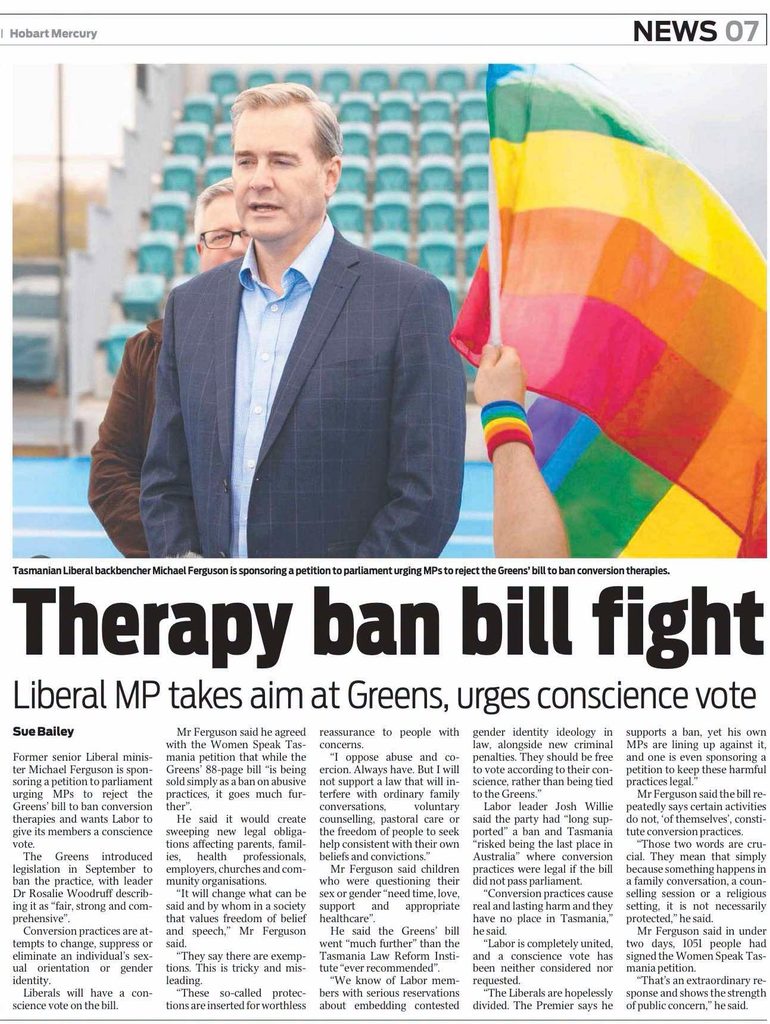
The lead photograph was a composite. An image of Ferguson at the Launceston tennis centre had been combined with a photograph of a person waving a rainbow flag at an unrelated event. The result created the visual impression that Ferguson had been present at a scene in which he had not been photographed. No disclosure that the image had been altered accompanied the story.
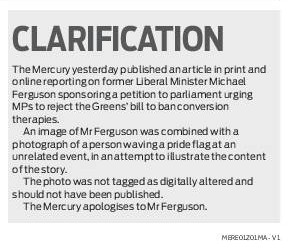
The following day, the Mercury published a clarification acknowledging that the images had been combined to illustrate the story, that the photograph had not been tagged as digitally altered, and that it “should not have been published”. The newspaper apologised to Ferguson.
The photograph was corrected. But the wider questions about the story’s framing, sourcing and representation of the campaign remain.
Whose petition was it?
The parliamentary e-petition HAEP 159-26, “Protect Children. Reject the Greens’ ‘Conversion Practices’ Bill”, was initiated by Women Speak Tasmania (WST). Dr Elizabeth Caballero of WST was named as principal petitioner, with Ferguson as parliamentary sponsor.
Posted on 9 October, the petition had attracted more than 1,500 signatures by the time of the Mercury’s report and has since passed 3,000. Pulse Tasmania’s contemporaneous coverage explicitly identified Women Speak Tasmania as the organisation behind it.
The Mercury’s story centred on Ferguson. He was the parliamentary sponsor, not the initiator of the petition. Ferguson supplied the reporter with Women Speak Tasmania’s contact details, yet the organisation was not approached for comment.
Readers heard Ferguson’s arguments and Labor leader Josh Willie’s support for a ban, but not directly from the organisation that had developed the petition and brought its concerns before Parliament.
A parliamentary sponsor can support a campaign, but he is not a substitute for the people who created it. WST’s absence meant that readers were not given the opportunity to hear the petition’s rationale directly from its principal petitioner.
From conversion practices to a “therapy ban”
The headline also merits scrutiny. The legislation is the Conversion Practices Prohibition Bill 2026, but the Mercury used the shorthand “therapy ban”. Ferguson later noted that the change had been made by the newspaper’s subeditors.
Headlines inevitably simplify complex legislation. But on a contested issue, terminology shapes how readers first understand the dispute. “Therapy ban” frames the argument primarily as one about restricting therapy, while the petition raises broader concerns about whether the bill’s definitions and scope could affect ordinary family conversations, parental guidance, exploratory counselling, pastoral care and the expression of conscience-based views.
These are questions about the reach of the proposed law, not simply whether therapy should be prohibited.
Readers should be able to distinguish between the stated aim of prohibiting harmful conversion practices and the concerns raised about how broadly the legislation might operate. That distinction is central to the petition and deserved to be understood in the reporting.
A photograph that should never have been published
The Mercury’s clarification was unambiguous: the composite photograph should not have been published. The newspaper’s apology to Ferguson was appropriate. But the episode illustrates how an image can influence the interpretation of a political story before readers have considered its arguments.
Women Speak Tasmania also drew attention to the alteration on social media. The episode brought a separate issue of representation into sharper focus: while the image created a misleading visual context for Ferguson, the organisation that initiated the petition was absent from the article’s account of the campaign.
The photograph and the omission are different issues. Both, however, concern how readers are presented with a story and the context through which they are invited to understand it.
When women’s advocates are left out
For Women Speak Tasmania, the concern extends beyond this one article. This is not the first time the organisation has been associated with a petition or campaign reported on by journalists without being contacted for comment.
When this happens repeatedly, women’s advocacy can be reported without the voices of the women doing the advocating. Politicians may be quoted debating a petition, while the organisation that initiated it, developed its arguments and mobilised public support remains unheard.
The effect is to make women’s rights advocates peripheral to coverage of their own campaigns. Their work becomes a subject for others to explain, interpret or contest, rather than an opportunity for their own arguments to be heard.
This matters particularly when legislation affecting women, children, families and freedom of conscience is under public debate. Readers need more than competing political statements. They need to understand who initiated a campaign, what its concerns are and why its organisers believe those concerns matter.
A newspaper is not obliged to endorse Women Speak Tasmania’s position or give every participant equal space. It should, however, take care to represent the origins of a campaign accurately, seek relevant perspectives and ensure that its presentation does not create a misleading impression.
The Mercury acknowledged its photographic error and apologised. The broader question remains: how often are women’s rights advocates missing from the reporting of contested legislation, even when they are the people who initiated the campaigns under discussion?
Correcting a photograph matters. So does ensuring that women are not repeatedly left out of the stories about the causes they have worked to bring before the public.