
On 30 June 2026, the United States Supreme Court delivered a landmark ruling affirming that states may determine eligibility for women’s and girls’ sports based on biological sex. In West Virginia v. B.P.J. and Little v. Hecox, the Court held that laws reserving female sporting categories for biological females are consistent with Title IX and the Equal Protection Clause.
Justice Brett Kavanaugh wrote:
“Consistent with Title IX and the Equal Protection Clause, we hold that the States may maintain women’s and girls’ sports for biological females. They may determine eligibility for women’s and girls’ sports based on biological sex.”
Justice Clarence Thomas went further, citing the German philosopher Josef Pieper:
“To use language to obscure reality—to show indifference regarding the truth—is to lie to the public and cease to treat our fellow citizens as equals.”
The quotation comes from Pieper’s influential work Abuse of Language, Abuse of Power, which warns that language can be used not merely to describe reality, but to shape perceptions of it.
That warning feels increasingly relevant in contemporary political debates.
When Words Lose Precision
Language matters because law depends upon definitions.
Every legal right, obligation, exemption, and prohibition begins with words whose meaning must be understood by ordinary people. If those words become vague, inconsistent, or interchangeable, public understanding suffers.
Traditionally, three distinct concepts have been recognised:
- Biological sex – whether someone is male or female.
- Sexual orientation – who a person is attracted to.
- Gender identity – a person’s internal sense of being male, female, both, or neither.
These concepts are related, but they are not interchangeable. Public debate becomes difficult when these distinctions are blurred.
Tasmania’s Latest Debate
This issue is currently on display in Tasmania. The Greens have released draft legislation designed to prohibit conversion practices.
In announcing the proposal, Greens leader Rosalie Woodruff referred to banning “sexual and gender orientation conversion practices.”
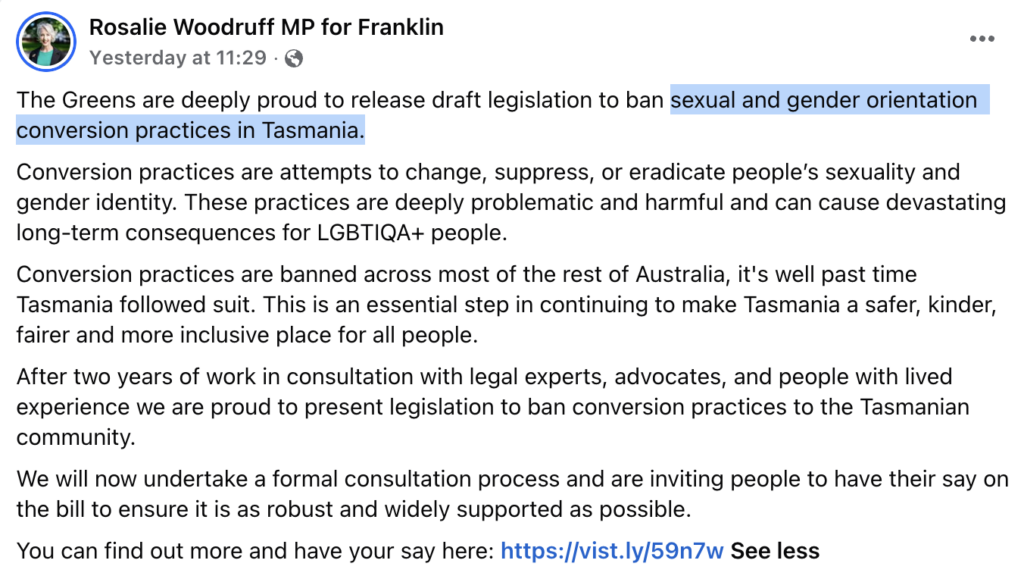
Yet the draft legislation itself does not regulate “gender orientation.” Instead, it consistently refers to sexual orientation and gender identity.
Some may dismiss this as a simple wording error. Perhaps it was. However, the discrepancy illustrates a broader problem. Most Tasmanians will never read a draft bill. They will read headlines, social media posts, and media summaries. The language used in those public discussions therefore matters enormously.
Whether intentional or not, terminology used in public messaging can shape public understanding long before people examine the legislation itself.
Framing the Debate
The way legislation is described often shapes public opinion before the public has examined its details. The Mercury’s coverage provides an interesting example.
The online version of the story appeared under the headline:
“New Greens bill aims to outlaw ‘cruel’ gay conversion in Tasmania.”
The following day’s print edition adopted a different headline:
“Greens propose Bill to ban ‘cruel quackery’.”
Neither headline is necessarily inaccurate. However, both direct readers toward a particular understanding of the legislation before they encounter its contents.
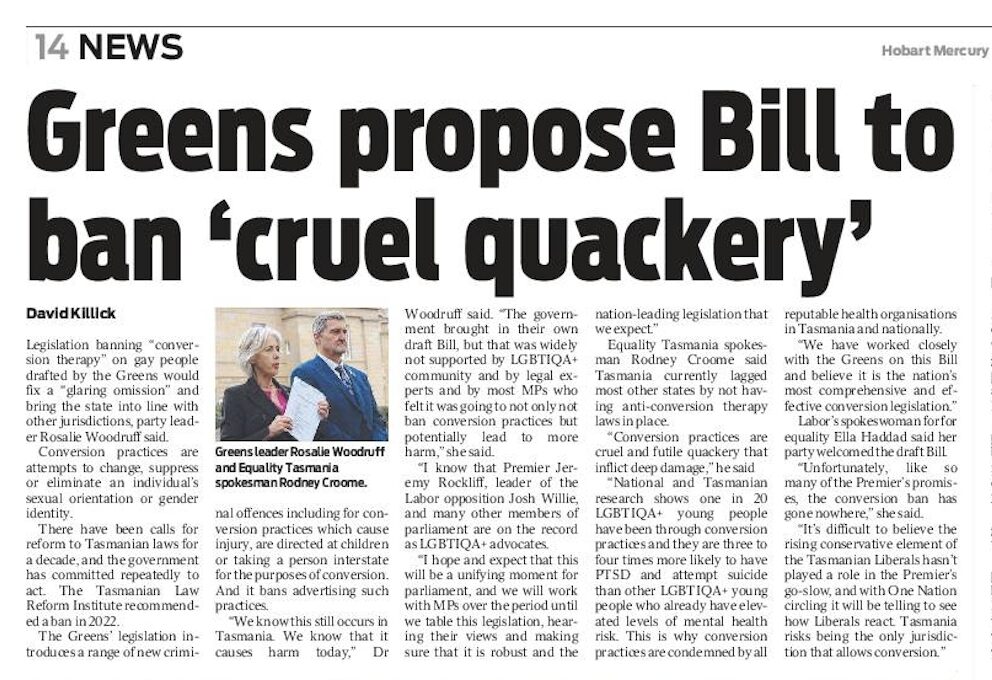
The online headline focuses attention on “gay conversion”, encouraging readers to think primarily about attempts to change a person’s sexual orientation.
The print headline goes further by describing the targeted conduct as “cruel quackery”—a phrase that incorporates a moral and professional judgment directly into the framing of the issue.
To be fair, the article itself later explains that the proposed legislation concerns both sexual orientation and gender identity. However, the headlines and opening framing are likely to shape how many readers initially understand the proposal.
Yet the draft legislation extends beyond sexual orientation. It also addresses conduct relating to gender identity.
The distinction matters.
A debate about attempts to change a person’s sexual orientation is not necessarily the same debate as one about counselling, parental guidance, healthcare, or support for individuals experiencing gender distress.
Whether one supports or opposes that broader scope, it should be clearly understood and openly debated.
What Gets Lost?
The problem is not that anyone is necessarily lying. The problem is that framing can direct public attention toward one aspect of a proposal while drawing attention away from others.
Consider a hypothetical example. A thirteen-year-old girl experiences distress during puberty and begins expressing a desire to be a boy. A counsellor may explore a range of factors: anxiety, autism, trauma, body image concerns, same-sex attraction, social influences, or family circumstances. The purpose of such exploration is not necessarily to affirm or reject a particular identity, but to understand the child’s circumstances before reaching conclusions.
The obvious question is:
At what point does exploration become “suppression”?
If practitioners, parents, or young people themselves cannot confidently answer that question, then the law may not be as clear as legislators intend.
Lessons From Victoria
Tasmania is not entering entirely new territory.
Victoria introduced its own Change or Suppression (Conversion) Practices legislation several years ago. Since then, regulators have produced extensive guidance explaining what conduct may and may not fall within the law.
That guidance demonstrates that these issues are often more complex in practice than they appear in political slogans.
The need for detailed regulatory guidance suggests that legislators, practitioners, and regulators have all grappled with questions about where legitimate exploration ends and prohibited conduct begins.
Some view that guidance as evidence that appropriate safeguards exist. Others see it as evidence that the underlying concepts remain difficult to define and apply consistently.
Academic psychiatrist Andrew Amos has publicly argued that Victoria’s legislation has created uncertainty for some clinicians working with gender-distressed young people, while supporters of the legislation maintain that it provides necessary protections against harmful practices. The existence of this ongoing debate itself demonstrates the importance of clarity in legislative drafting and public communication.
Either way, Victoria’s experience shows that these issues cannot be reduced to simple slogans.
Pieper’s Warning
Josef Pieper warned that language becomes dangerous when it ceases to describe reality and instead becomes a tool for shaping it.

The issue is not always whether a statement is technically true or false. The issue is whether the language used illuminates a subject or obscures it.
Language can direct attention toward some aspects of reality while drawing attention away from others.
In the space of a single day, Tasmanians encountered at least four different descriptions of the same legislative proposal:
- “sexual and gender orientation conversion practices”;
- sexual orientation and gender identity conversion practices;
- “gay conversion”;
- “cruel quackery.”
Each phrase highlights something different. Each invites a different emotional or political response. Yet all refer to the same draft legislation.
This is precisely why precision matters.
When terminology shifts depending on the audience, public understanding becomes more difficult. Citizens may believe they are debating one issue while legislators are drafting laws that address another.
A Democratic Responsibility
Tasmania’s debate over conversion practices is ultimately not just about sexuality or gender identity.
It is about democratic accountability.
Citizens cannot meaningfully evaluate legislation if they do not clearly understand what the legislation actually does.
Before Parliament creates new offences, restrictions, and regulatory powers, Tasmanians should be encouraged to examine the actual text of the proposal rather than rely solely on headlines, slogans, or social media summaries.
The question is not simply whether conversion practices should be prohibited. It is whether the public has been given a clear understanding of the scope of the legislation and the concepts upon which it rests.
Justice Thomas’ warning, drawing on Josef Pieper’s philosophy, was not simply about sport or gender. It was about democratic discourse itself. A healthy democracy depends on citizens being able to discuss public policy using clear and consistent language.
Because when language shapes public understanding, precision is not a luxury—it is a democratic necessity.