Secret submissions reveal how the ABC let a trans lobby group influence its programming, but the broadcaster won’t release key documents – because it might stop it ‘attracting the best talent’.
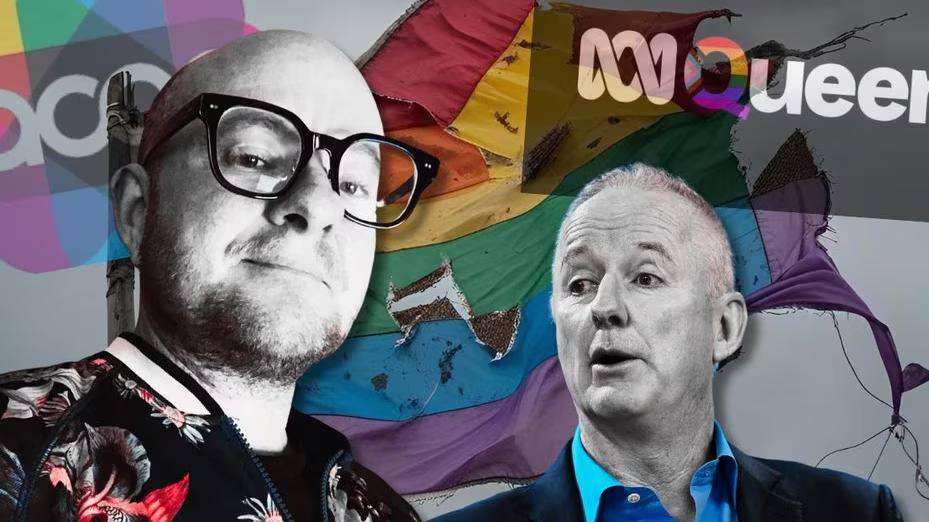
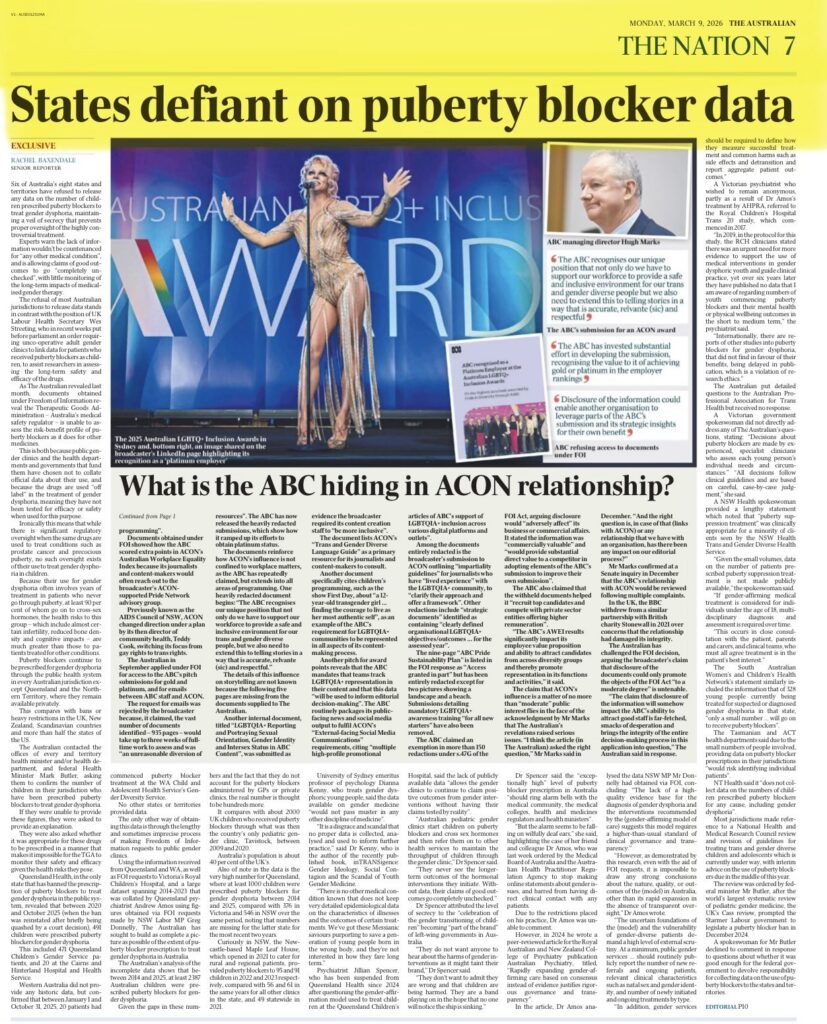
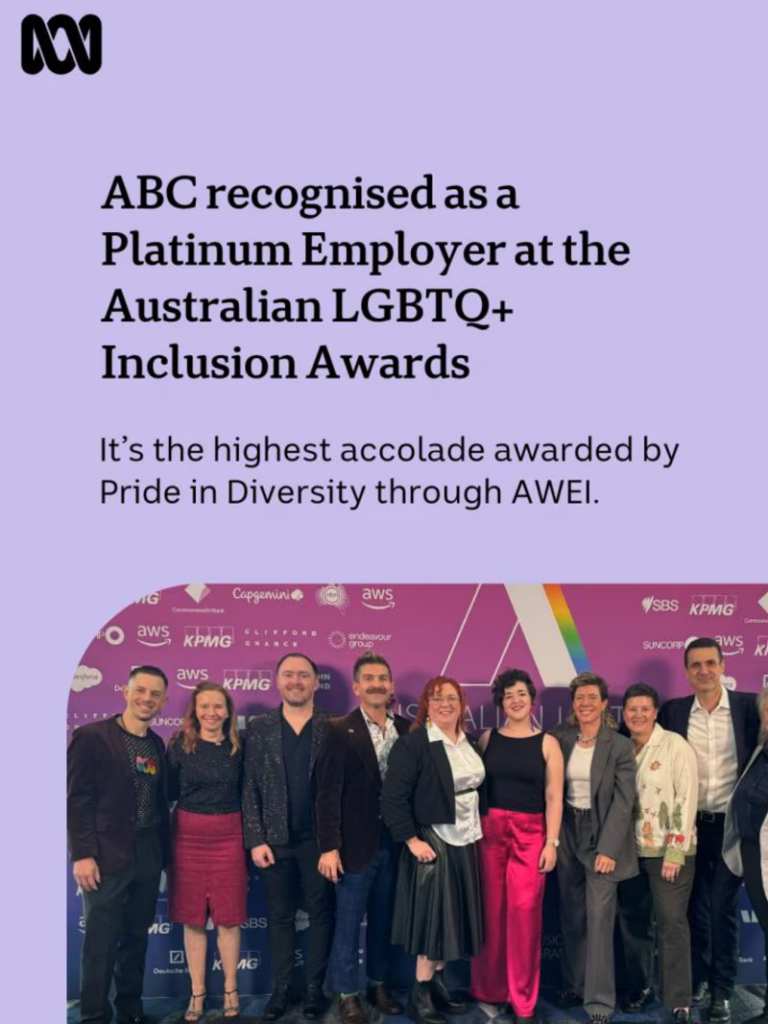
Newly released documents show how the ABC won platinum status last year with trans lobby group ACON after pledging to use its unique position to push the advocacy group’s agenda in its on-air journalism and programming.
But the ABC has refused to reveal key documents submitted to ACON in its chase for gold and platinum over the last two years, despite a promise by managing director Hugh Marks to review links with the lobby group after The Australian exposed repeated breaches of the broadcaster’s editorial standards.
The media giant has declined to hand over more than a dozen documents it submitted to score points in ACON’s “workplace equality” scheme, and heavily redacted other documents released to The Australian under freedom of information legislation.
The ABC is required by law to release documents unless it would “on balance be contrary to the public interest” but claims that this issue is of only “moderate” public interest and disclosure would “adversely impact” its business affairs.
The Australian revealed in December how the ABC’s newsrooms and other productions had been influenced by ACON’s radical trans agenda, with the broadcaster winning points and awards for developing “positive programming”.
Documents obtained under FOI showed how the ABC scored extra points in ACON’s Australian Workplace Equality Index because its journalists and content-makers would often reach out to the broadcaster’s ACON-supported Pride Network advisory group.
Previously known as the AIDS Council of NSW, ACON changed direction under a plan by its then director of community health, Teddy Cook, switching its focus from gay rights to trans rights.
The Australian in September applied under FOI for access to the ABC’s pitch submissions for gold and platinum, and for emails between ABC staff and ACON.
The request for emails was rejected by the broadcaster because, it claimed, the vast number of documents identified – 935 pages – would take up to three weeks of full-time work to assess and was “an unreasonable diversion of resources”.
The ABC has now released the heavily redacted submissions, which show how it ramped up its efforts to obtain platinum status.
The documents reinforce how ACON’s influence is not confined to workplace matters, as the ABC has repeatedly claimed, but extends into all areas of programming.
One heavily redacted document begins: “The ABC recognises our unique position that not only do we have to support our workforce to provide a safe and inclusive environment for our trans and gender diverse people, but we also need to extend this to telling stories in a way that is accurate, relvante (sic) and respectful.”
The details of this influence on storytelling are not known because the following five pages are missing from the documents supplied to The Australian.
Another internal document, titled “LGBTQIA+ Reporting and Portraying Sexual Orientation, Gender Identity and Intersex Status in ABC Content”, was submitted as evidence the broadcaster required its content creation staff to “be more inclusive”.
The document lists ACON’s “Trans and Gender Diverse Language Guide” as a primary resource for its journalists and content-makers to consult.
Another document specifically cites children’s programming, such as the show First Day, about “a 12-year-old transgender girl … finding the courage to live as her most authentic self”, as an example of the ABC’s requirement for LGBTQIA+ communities to be represented in all aspects of the broadcaster’s content-making process.
Another pitch for award points reveals that the ABC mandates that teams track LGBTQIA+ representation in their content and that this data “will be used to inform editorial decision-making”.
The ABC routinely packages its public-facing news and social media output to fulfil ACON’s “External-facing Social Media Communications” requirements, citing “multiple high-profile promotional articles of ABC’s support of LGBTQIA+ inclusion across various digital platforms and outlets”.
Among the documents entirely redacted is the broadcaster’s submission to ACON outlining “impartiality guidelines” for journalists who have “lived experience” with the LGBTQIA+ community, to “clarify their approach and offer a framework”.
Other redactions include “strategic documents” identified as containing “clearly defined organisational LGBTQIA+ objectives/outcomes … for the assessed year”.
The nine-page “ABC Pride Sustainability Plan” is listed in the FOI response as “Access granted in part” but has been entirely redacted except for two pictures showing a landscape and a beach.
Submissions detailing mandatory LGBTQIA+ awareness training “for all new starters” have also been removed.
The ABC claimed an exemption in more than 150 redactions under s.47G of the FOI Act, arguing disclosure would “adversely affect” its business or commercial affairs. It stated the information was “commercially valuable” and “would provide substantial direct value to a competitor in adopting elements of the ABC’s submission to improve their own submission”.
The ABC also claimed that the withheld documents helped it “recruit top candidates and compete with private sector entities offering higher remuneration”.
“The ABC’s AWEI results significantly impact its employee value proposition and ability to attract candidates from across diversity groups and thereby promote representation in its functions and activities,” it said.
The claim that ACON’s influence on the broadcaster is a matter of no more than “moderate” public interest flies in the face of the acknowledgment by Mr Marks that The Australian’s revelations raised serious issues.
“I think the article (in The Australian) asked the right question,” Mr Marks said in December. “And the right question is, in case of that (links with ACON) or any relationship that we have with an organisation, has there been any impact on our editorial process?”
Mr Marks confirmed at a Senate inquiry in December that the ABC’s relationship with ACON would be reviewed following multiple complaints by women’s groups and gay and lesbian groups that the ABC’s coverage of trans issues had been infected by bias.
In the UK, the BBC withdrew from a similar partnership with British charity Stonewall in 2021 over concerns that the relationship had damaged its integrity.
The Australian has challenged the FOI decision, arguing the broadcaster’s claim that disclosure of the documents could only promote the objects of the FOI Act “to a moderate degree” is untenable.
“The claim that disclosure of the information will somehow impact the ABC’s ability to attract good staff is far-fetched, smacks of desperation and brings the integrity of the entire decision-making process in this application into question,” The Australian said in response.
by Stephen Rice
Source: The Australian
or archive link:
or printed edition: