
In a troubling display of activism overriding scientific discourse, the Royal Australian College of General Practitioners (RACGP) has bowed to pressure from trans activist groups, including the Australian Professional Association for Trans Health (AusPATH), effectively silencing a webinar by renowned Finnish expert Professor Riittakerttu Kaltiala. Titled Medical Gender Reassignment Among Minors: Why Are We Cautious in Finland?, the event was set for March 10, 2026, but was abruptly “redesigned” into a panel discussion after complaints from activists claiming it threatened “patient safety” and showed “hostility to trans people.”
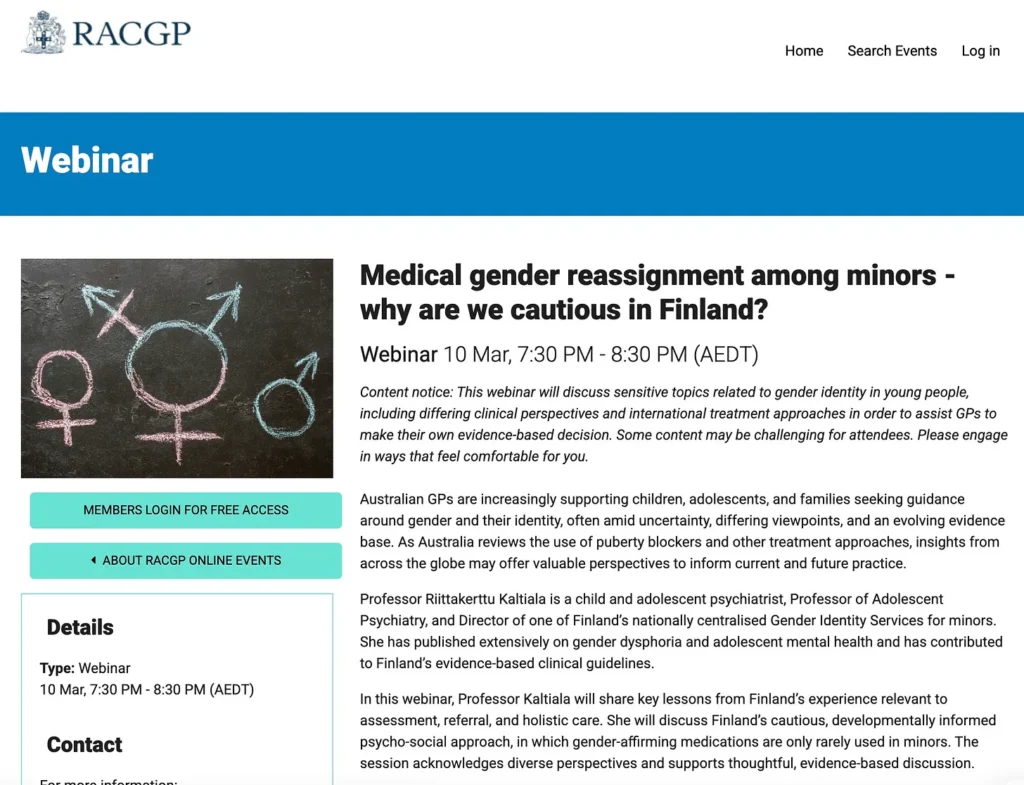
The RACGP emailed over 200 prospective attendees on Wednesday, stating: “To clarify, this isn’t a cancellation. It is a postponement.” Yet, as reported in The Australian, the college has not confirmed if Prof. Kaltiala has been invited to the new format, nor explained why a solo talk by a global leader in evidence-based pediatric gender care could pose a “threat” to medical professionals. RACGP Specific Interests chair Jeremy Hudson emphasized the intent to “support informed, evidence-based discussion,” but critics see this as capitulation to ideological pressure rather than fostering open debate.
Prof. Kaltiala, chief psychiatrist at Tampere University Hospital’s adolescent psychiatry department and leader of one of Finland’s two centralized gender identity services for minors since 2011, has been at the forefront of Finland’s shift away from routine medical interventions for youth gender dysphoria. I had the privilege of hearing her speak at the Coalition for Advancing Scientific Care (CASC) Gender Healthcare Summit in Adelaide in October 2025. During her presentation, she detailed how Finnish clinicians initially adopted the “Dutch protocol”—involving puberty blockers, cross-sex hormones, and surgery—but soon realized their patients didn’t match the early studies: most were adolescent girls with severe pre-existing psychiatric issues, and outcomes weren’t improving.
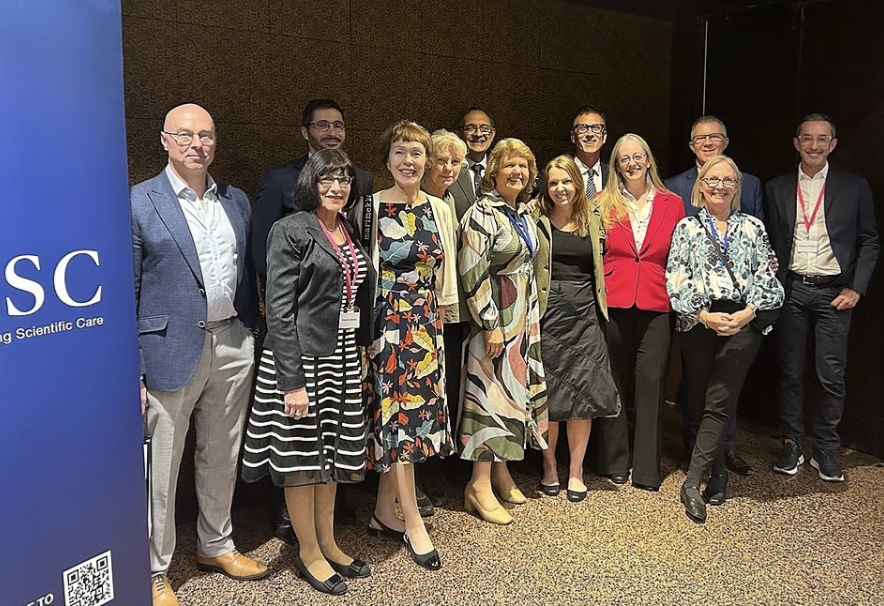
“Adolescents with psychological issues continued presenting problems even after one year of cross-sex hormones,” she explained. Concerned, Finland conducted systematic reviews, concluding: “You can modify the body, but the benefits for mental health have not been shown.” In 2020, Finland became the first country to deem such interventions “experimental,” prioritising mental health support over medicalisation. As Kaltiala told The Australian ahead of the summit: “Many medical professionals are afraid to speak out against the orthodoxies that prevail in countries such as Australia.”
This “redesign” follows intense lobbying by AusPATH and GPDU for Gender-Affirming Healthcare, who urged members to petition RACGP president Michael Wright and CEO Georgina van de Water. Prominent trans activist Teddy Cook—a GPDU administrator—has a history of controversial social media posts, including material on bestiality, public nudity, bondage parties, and transgender orgies. Cook, who identifies as male despite being biologically female, was also at the center of an eSafety Commissioner case in 2024, where a tweet by Canadian activist “Billboard Chris” Elston was geo-blocked in Australia for “misgendering” Cook. The eSafety order, issued by Julie Inman Grant, equated transgender identity with a psychiatric condition and claimed it caused “serious harm.” This highlights a pattern of using “safety” claims to suppress dissent.
But AusPATH’s role in this saga raises deeper concerns. Far from a neutral professional body, AusPATH functions as an activist organization, as detailed in a 2025 paper in Australasian Psychiatry by Dr. Jillian Spencer and Patrick Clarke: “AusPATH: Activism influencing health policy.” The authors argue that AusPATH’s membership policy—admitting individuals based on “lived experience” rather than accredited medical expertise—undermines its credibility. “There is no accreditation or endorsement underpinning AusPATH’s influence on health policy in Australia,” they write. “Its role as an activist organisation is demonstrated by a lack of caution in its position statements, which are misleading in circumstances where accurate information has been long available.”
The paper dissects AusPATH’s claims on puberty blockers, labeling them “safe,” “reversible,” and “lifesaving” despite longstanding evidence to the contrary. For instance, AusPATH compares blockers to treatments for precocious puberty, ignoring distinct risks like reduced bone density, IQ impacts, and infertility. Contrasting AusPATH’s statements with the UK’s Cass Review, the authors note: “The evidence does not adequately support the claim that gender affirming treatment reduces suicide risk.” They conclude that AusPATH’s influence on Australian policy—via endorsements like the Australian Standards of Care and Treatment Guidelines (ASOCTG), which scored poorly in the Cass Review—needs urgent reconsideration, alongside RANZCP Position Statement 62 for failing to balance “lived experience” with clinical evidence and ethics.
This activism extends to Tasmania, where the Tasmanian Health Service (THS) was a Gold Sponsor of AusPATH’s national conference in Hobart and offered sponsorship for three GPs to attend. Why is public money funding an organization that “pushes back” against evidence-based inquiries like the Cass Review? Tasmania’s health system is already strained—scarce resources should prioritize patient safety, not ideology.
Adding to the scrutiny, former Australian Charities and Not-for-profits Commissioner Gary Johns, backed by the Australian Medical Professionals Society and Nurses Professional Association of Australia (representing 16,000 members), lodged a formal complaint against AusPATH’s charitable status in August 2025. In a 30-page submission reported by The Australian, Johns argues AusPATH fails the “public benefit” test due to promoting gender-affirming hormones that expose children to risks like infertility, impaired brain development, bone fragility, cardiovascular issues, and regret. Citing the Cass Review and a recent Family Court ruling by Judge Andrew Strum—which criticized Australia’s guidelines as misleading—Johns states: “The identifiable detriment from the achievement of AusPATH’s purpose is harm to the very people AusPATH claims its purpose will benefit.” AusPATH CEO Eloise Brook called the complaint “shocking and disappointing,” defending gender-affirming care as “evidence-based.”

We stand at a fork in the road: succumb to silencing and censorship through activist claims of “danger” without evidence, or advance with evidence-based tools that prioritize child welfare. The “redesign” of Prof. Kaltiala’s webinar exemplifies a chilling effect on debate, where caution is labeled “hostility.” It’s time for governments, like Tasmania’s, to withdraw support for AusPATH and recommit to rigorous, evidence-based healthcare. Children’s futures depend on it.