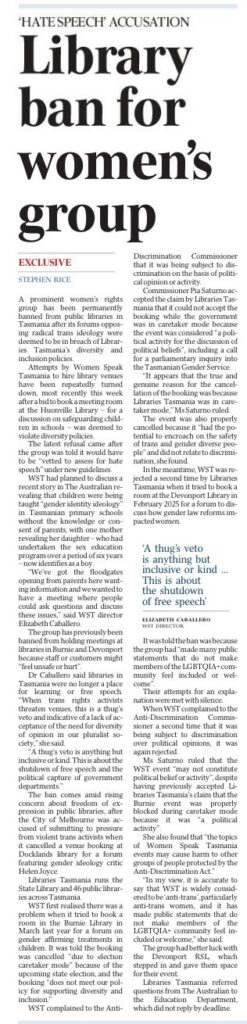
A prominent women’s rights group has been permanently banned from public libraries in Tasmania after its forums opposing radical trans ideology were deemed to be in breach of Libraries Tasmania’s diversity and inclusion policies.

Attempts by Women Speak Tasmania to hire library venues have been repeatedly turned down, most recently this week after a bid to book a meeting room at the Huonville Library – for a discussion on safeguarding children in schools – was deemed to violate diversity policies.
The latest refusal came after the group was told it would have to be “vetted to assess for hate speech” under new guidelines.
WST had planned to discuss a recent story in The Australian revealing that children were being taught “gender identity ideology” in Tasmanian primary schools without the knowledge or consent of parents, with one mother revealing her daughter – who had undertaken the sex education program over a period of six years – now identifies as a boy.
“We’ve got the floodgates opening from parents here wanting information and we wanted to have a meeting where people could ask questions and discuss these issues,” said WST director Elizabeth Caballero.
The group has previously been banned from holding meetings at libraries in Burnie and Devonport because staff or customers might “feel unsafe or hurt”.
Dr Caballero said libraries in Tasmania were no longer a place for learning or free speech. “When trans rights activists threaten venues, this is a thug’s veto and indicative of a lack of acceptance of the need for diversity of opinion in our pluralist society,” she said.
“A thug’s veto is anything but inclusive or kind. This is about the shutdown of free speech and the political capture of government departments.”
The ban comes amid rising concern about freedom of expression in public libraries, after the City of Melbourne was accused of submitting to pressure from violent trans activists when it cancelled a venue booking at Docklands library for a forum featuring gender ideology critic Helen Joyce.
Libraries Tasmania runs the State Library and 46 public libraries across Tasmania.
WST first realised there was a problem when it tried to book a room in the Burnie Library in March last year for a forum on gender affirming treatments in children. It was told the booking was cancelled “due to election caretaker mode” because of the upcoming state election, and the booking “does not meet our policy for supporting diversity and inclusion.”
WST complained to the Anti-Discrimination Commissioner that it was being subject to discrimination on the basis of political opinion or activity.
Commissioner Pia Saturno accepted the claim by Libraries Tasmania that it could not accept the booking while the government was in caretaker mode because the event was considered “a political activity for the discussion of political beliefs”, including a call for a parliamentary inquiry into the Tasmanian Gender Service.
“It appears that the true and genuine reason for the cancellation of the booking was because Libraries Tasmania was in caretaker mode,” Ms Saturno ruled.
The event was also properly cancelled because it “had the potential to encroach on the safety of trans and gender diverse people” and did not relate to discrimination, she found.

In the meantime, WST was rejected a second time by Libraries Tasmania when it tried to book a room at the Devonport Library in February 2025 for a forum to discuss how gender law reforms impacted women.
It was told the ban was because the group had “made many public statements that do not make members of the LGBTQIA+ community feel included or welcome”.
Their attempts for an explanation were met with silence.
When WST complained to the Anti-Discrimination Commissioner a second time that it was being subject to discrimination over political opinions, it was again rejected.
Ms Saturno ruled that the WST event “may not constitute political belief or activity”, despite having previously accepted Libraries Tasmania’s claim that the Burnie event was properly blocked during caretaker mode because it was “a political activity”.
She also found that “the topics of Women Speak Tasmania events may cause harm to other groups of people protected by the Anti-Discrimination Act.”
“In my view, it is accurate to say that WST is widely considered to be ‘anti-trans’, particularly anti-trans women, and it has made public statements that do not make members of the LGBTQIA+ community feel included or welcome,” she said.
The group had better luck with the Devonport RSL, which stepped in and gave them space for their event.
Libraries Tasmania referred questions from The Australian to the Education Department, which did not reply by deadline.
WST has written to Tasmanian Attorney-General Guy Barnett expressing their concerns about the ban and requesting he intervene “to ensure that these guidelines are implemented in a manner consistent with Tasmania’s commitment to freedom of expression and political belief”.
“We urge you to publicly affirm Tasmanians’ right to hold and express impartial political opinions, and to ensure that Libraries Tasmania – as a public institution and a centre for learning – remains open to all community organisations acting in good faith for educational purposes,” Dr Caballero wrote.
Mr Barnett did not respond to questions by deadline.
By Stephen Rice
Source: The Australian
or archive link:
Printed version 31.10.25