
Elected representatives should be able to discuss matters of public policy — particularly contentious issues involving women’s rights, child safeguarding, and legislation — without facing prolonged legal processes for expressing political opinions.
Regardless of where one stands on debates surrounding gender identity, the use of anti-discrimination complaints against elected officials raises important questions about freedom of political communication, proportionality, and the chilling effect lengthy legal proceedings can have on democratic participation.
Hobart City Councillor Louise Elliot has faced multiple complaints under Tasmania’s Anti-Discrimination Act relating to comments made in public debate about sex-based rights and gender identity policy. Although the complaints were ultimately withdrawn, the processes imposed significant personal, financial, and professional burdens.
Inciting Hatred Action 1
Action
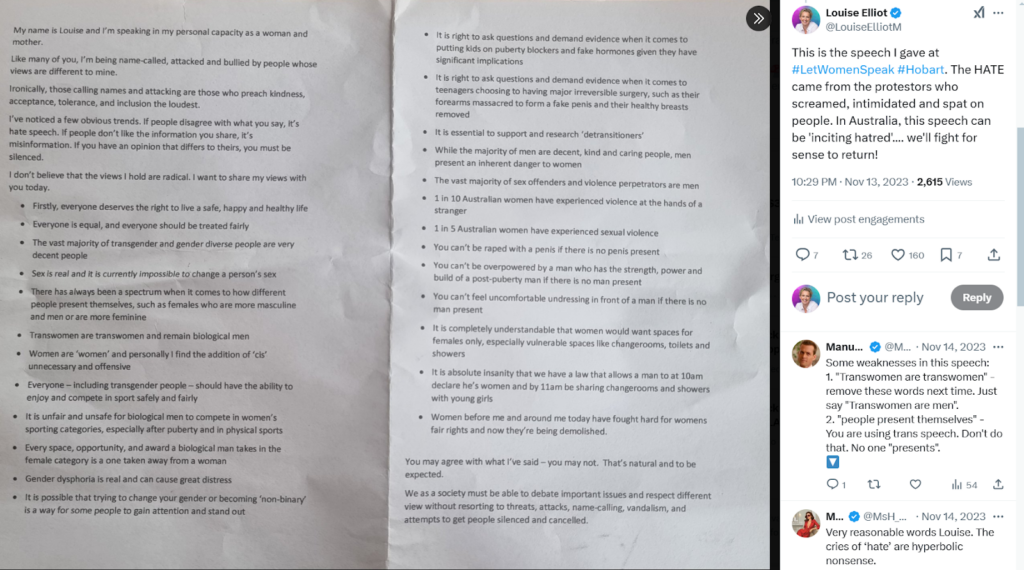
Councillor Louise Elliot spoke at a Let Women Speak event on Parliament Lawns in Hobart in February 2023. During her speech, Cr Elliot stated that transgender women remain biologically male.
Complaint and Tribunal Process
A complaint was accepted by the Anti-Discrimination Commissioner alleging that Cr Elliot had engaged in conduct that could “incite hatred, serious contempt or severe ridicule” against a person or group under Tasmania’s Anti-Discrimination Act.
Following an investigation process, the matter was escalated to the Tasmanian Civil and Administrative Tribunal (TASCAT).
The complaint was later withdrawn by the complainant before the matter proceeded further.
Cr Elliot reportedly incurred legal costs exceeding $17,000 defending the complaint. An application for costs was unsuccessful.
Case reference: Hindle v Elliot [2024] TASCAT 45 (21 March 2024)
Inciting Hatred Action 2
Action
Councillor Louise Elliot was speaking with members of the public at Northgate Shopping Centre when an individual allegedly threatened her. Separate complaints were also made regarding social media posts in which Cr Elliot expressed views relating to women’s rights, child safeguarding, and evidence-based healthcare for gender-distressed children.
Complaint and Legal Proceedings
The Anti-Discrimination Commissioner accepted complaints alleging both discrimination and conduct capable of “inciting hatred, serious contempt or severe ridicule.”
Part of the discrimination complaint related to Cr Elliot referring to an individual using male pronouns. Additional allegations related to political commentary and social media posts concerning gender ideology and women’s sex-based rights.
The matter was again escalated to TASCAT.
Cr Elliot’s legal representatives argued that the Tribunal lacked jurisdiction because the matter involved the implied constitutional freedom of political communication. The proceedings were subsequently transferred to the Magistrates Court.
The complaint was later withdrawn by the complainants.
Cr Elliot reportedly incurred legal costs exceeding $11,000 defending the matter.
Case reference: Esmeralda Rosalia Isabelle Miller and Lucy Richmond v Louise Elliot [2024] TASCAT 215
Why These Cases Matter
These cases extend beyond one councillor or one political issue. They raise broader questions about how anti-discrimination laws are applied when public officials, activists, and citizens participate in debates on contested matters of public policy.
Tasmania’s anti-discrimination framework exists to protect individuals from genuine discrimination and harassment. However, concerns arise when legal complaint mechanisms are used in response to lawful political speech, particularly where the subject matter involves significant public interest such as women’s rights, child safeguarding, healthcare policy, or legislative reform.
The proceedings against Cr Louise Elliot have prompted concerns among many observers about whether anti-discrimination processes can have a chilling effect on democratic participation. Even where complaints are ultimately withdrawn, respondents may face substantial financial costs, emotional stress, reputational damage, and years of uncertainty.
Critics argue that lengthy legal proceedings and significant legal expenses can themselves become punitive, regardless of the eventual outcome. When elected representatives are required to defend political opinions through protracted legal processes, questions arise about proportionality, freedom of political communication, and the ability of public officials to engage openly with their constituents on matters of public concern.
A healthy democracy depends on the ability to debate difficult and controversial issues openly, respectfully, and robustly. Whether one agrees or disagrees with Cr Elliot’s views, these cases highlight the importance of ensuring that legal processes protect individuals from genuine discrimination while also safeguarding freedom of political participation and public debate.