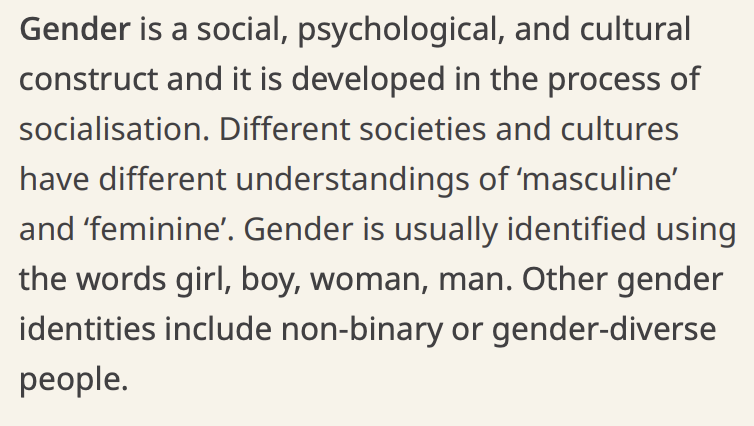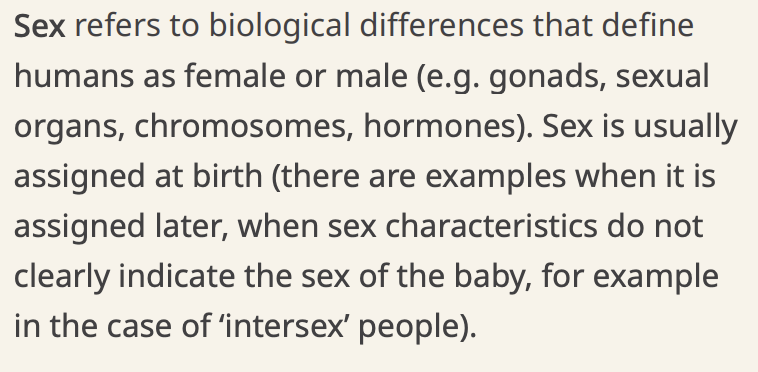
The Respectful Relationships and Consent in the Early Years document contains some useful material for teachers. However, a close reading – along with an examination of the links embedded within it – shows that the resource is underpinned by gender ideology. It is written on the assumption that this ideology is universally accepted and uncontroversial, when in reality it remains deeply contested.
Examples of bias in the document
Page 22
This section states that everyday interactions provide opportunities to develop each child’s sense of self. It asserts: “Gender is a way to describe someone’s identity. It is not the same thing as their biological sex. People can feel they are male, female, both or neither.” Teachers are instructed to “affirm children’s unconventional choices – our job is to support all children in their decisions.”
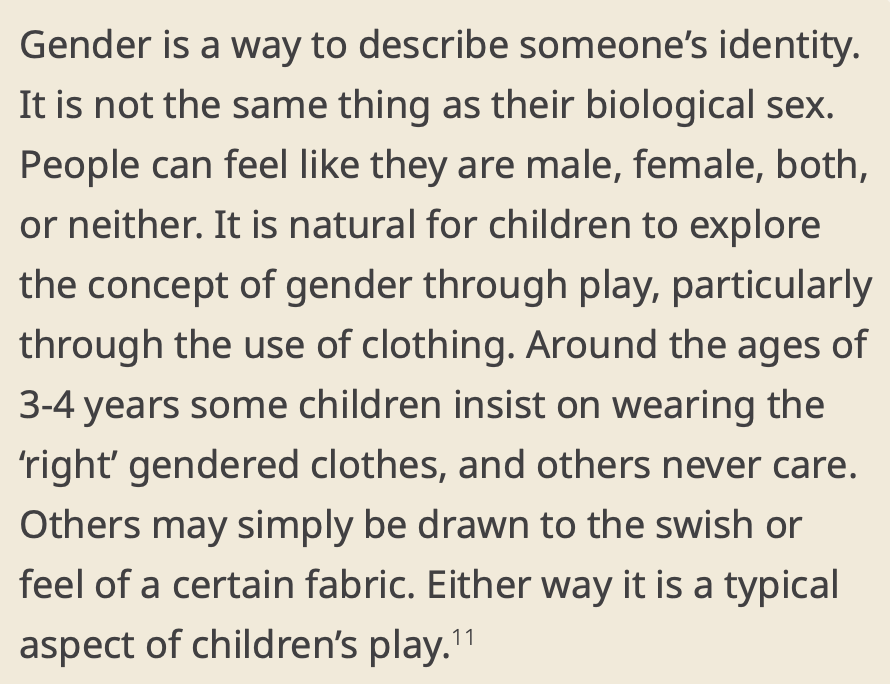
Here, gender ideology is presented as fact. Teachers are expected to deny the biological reality of two sexes and instead encourage children to adopt self-declared identities, a pathway unlikely to be supported by the majority of Tasmanians—most of whom would be unaware that this is being taught in schools.
Page 29
The text encourages acceptance of differences, noting that children may absorb gender stereotypes such as “boys can’t have long hair” or “girls can’t like trucks.” Strategies are provided to help children understand they can enjoy whatever activities make them happy.
This rejection of gender stereotypes and support for non-gendered play is something Women Speak Tasmania and women’s groups welcome. However, the first reference given here links to the Australian Psychological Society’s factsheet Transgender and Gender Diverse Children, which explicitly endorses the “affirmation-only” model.
This factsheet defines a transgender child as “a child who was assigned male at birth but is female, or a child who was assigned female but is male.” It advises that parents must affirm a child’s expressed gender through names, pronouns, dress and activities, stating: “It is essential to their child’s well-being that parents, caregivers and families support the child and affirm the child’s gender.” It further claims “some children know as young as three years old.”
This is deeply concerning. The Cass Report has highlighted serious shortcomings in the affirmation-only approach. Australian psychologists such as Diana Kenny and Jillian Spencer also challenge this model, yet it is presented here as if it were an uncontested truth.
Page 55
In the section titled “Who has what?” the resource tells children: “Boy, girl, man and woman are words that describe gender identity, and some people with the gender identities ‘boy’ or ‘man’ have vulvas, and some with the gender identity ‘girl’ or ‘woman’ have penises/testicles. Your genitals don’t make you a boy or a girl.”
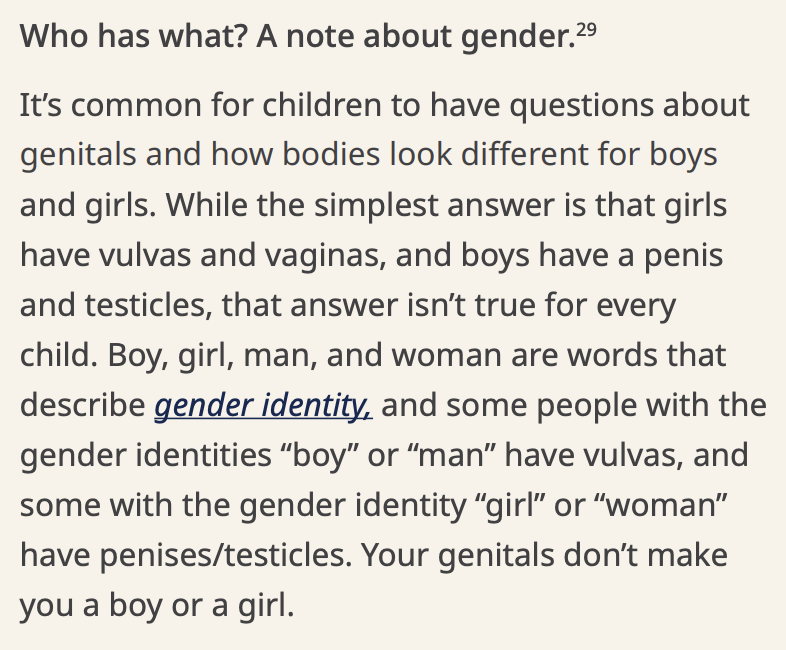
Again, teachers are expected to deny biological fact and instruct children in an ideological belief with no scientific foundation. A footnote in this section directs readers to Planned Parenthood, an American organisation that now promotes gender-affirming treatments, including hormones and surgery, and is currently facing lawsuits from detransitioners who allege they were rushed into medical transition without adequate safeguarding or counselling.

Page 57
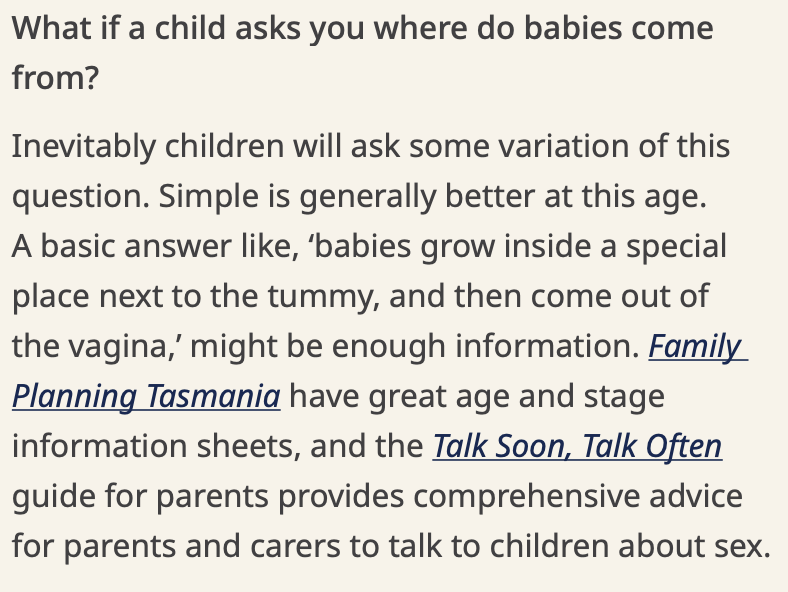
This section suggests a model answer if a child asks where babies come from: “Babies grow inside a special place next to the tummy, and then come out of the vagina.” Notably, there is no reference to “mothers” or “women.” The omission is clearly designed to avoid offending in cases where a child’s parent identifies as a trans man, but it erases the reality that it is women who give birth.
Summary
This analysis highlights how, while the document contains some positive material about respect and rejecting stereotypes, it repeatedly presents gender ideology as fact, embeds contested medical advice, and directs teachers and children to external organisations with controversial practices. These are serious concerns for parents and the community.