
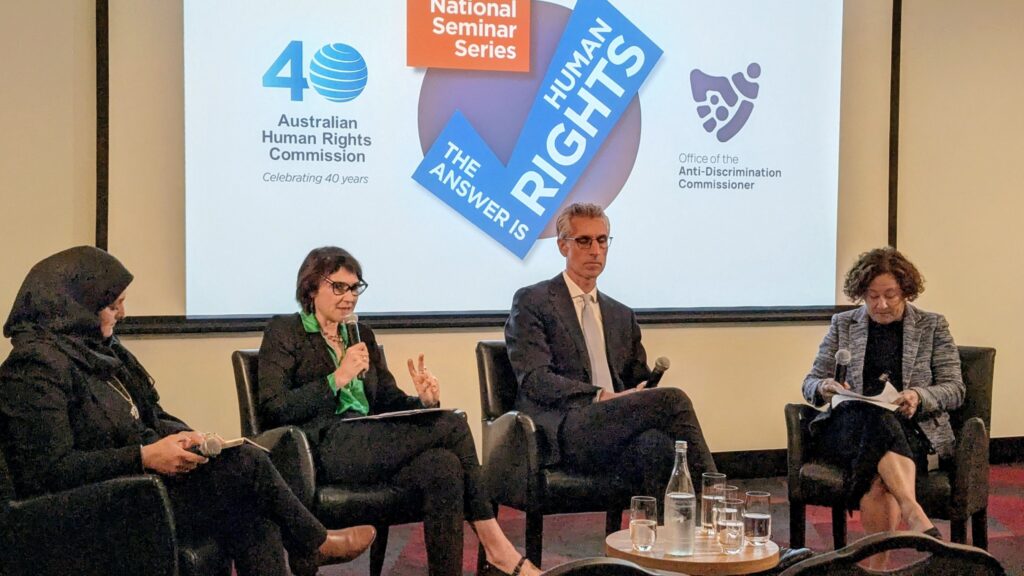
On 21 April 2026, the Australian Human Rights Commission (AHRC), in partnership with Tasmania’s Office of the Anti-Discrimination Commissioner, hosted the first event in its national seminar series titled “The Answer Is Human Rights” at the RACV Hobart Hotel.
The event marked the AHRC’s 40th anniversary and promoted two major reform agendas:
- a national Human Rights Act, and
- the modernisation and harmonisation of Australia’s anti-discrimination laws.
The evening featured AHRC President Hugh de Kretser, Sex Discrimination Commissioner Dr Anna Cody, migrant advocate Aimen Jafri, and was moderated by Acting Tasmanian Anti-Discrimination Commissioner Pia Saturno.
The seminar provided an important insight into the direction Australia’s human rights institutions appear to be heading — and raised serious questions about whether sex-based rights, free expression, and women’s concerns are still being treated as legitimate human-rights issues.
The Push for a National Human Rights Act
Hugh de Kretser opened the evening by outlining the Commission’s vision for a federal Human Rights Act.
The proposal would require governments and public bodies to consider human rights when developing laws, policies, and services. It would also expand anti-discrimination protections and place stronger positive obligations on organisations to prevent discrimination and sexual harassment before it occurs.
The presentation framed Australia as a country with strong democratic institutions but significant “human rights gaps,” particularly affecting:
- Aboriginal Australians,
- migrants and refugees,
- women,
- people with disabilities,
- and LGBTIQA+ communities.
The AHRC also advocated reforming and harmonising the Sex Discrimination Act, Racial Discrimination Act, Disability Discrimination Act, and Age Discrimination Act.
Throughout the evening, speakers strongly emphasised anti-racism initiatives, multiculturalism, changing gender roles, family violence prevention, inclusion, and human-rights education in schools. There was repeated discussion about the responsibility of employers and institutions to proactively shape workplace culture and prevent discrimination before it occurs.
Human Rights and Sex-Based Protections
One particularly notable moment came when Dr Anna Cody discussed the importance of culturally appropriate accommodation for Muslim women escaping violence.
She gave an example of advocating for women-only crisis accommodation rather than mixed accommodation with men.
Ironically, this example highlighted something many women’s rights advocates have been pointing out for years: sex-based protections remain important precisely because privacy, dignity, religion, trauma, and safety still matter in real life.
The question many women are increasingly asking is:
If policymakers recognise the need for sex-separated spaces in some contexts, why are women’s concerns so often dismissed in others?
The Questions the Panel Struggled to Answer
The most significant exchanges of the evening came during the audience Q&A session.
A member of Women’s Action Alliance Tasmania (WAAT) raised concerns about the erosion of sex-based protections in both Tasmanian and federal anti-discrimination law. She noted that Tasmania’s Anti-Discrimination Act does not explicitly protect women and girls on the basis of biological sex, and argued that recent interpretations of the federal Sex Discrimination Act by the Australian Human Rights Commission have created increasing uncertainty about whether women can still rely on sex-based protections in practice.
As an example, she referenced the Australian Human Rights Commission’s refusal to grant an exemption to the Lesbian Action Group in Victoria to hold lesbian-only, single-sex events.
She then asked:
“Will the AHRC accept that federal and state legislation should include a clear and accurate definition of sex, to ensure that women and girls once again have recourse when they experience sex discrimination, and so that Australia can meet its obligations under CEDAW Article 1 and ICCPR Article 26?”
Dr Anna Cody responded by stating that the law currently operates using what she described as “an inclusive definition of sex.” She further suggested that CEDAW also adopts an inclusive understanding.
However, this interpretation is contested. CEDAW Article 1 refers specifically to discrimination “on the basis of sex” and does not explicitly redefine sex to include gender identity. The treaty itself is grounded in the recognition of sex-based discrimination against women as a biological class, although modern interpretations by some institutions have expanded the concept more broadly.
Dr Cody also spoke about evolving understandings of women and changing gender roles. However, the response appeared to avoid directly addressing the central concern: whether women and girls continue to possess clear sex-based legal protections distinct from gender identity.
This ambiguity is becoming increasingly significant in debates surrounding female-only events, sport, prisons, shelters, changing facilities, and lesbian spaces.
Silence on Free Speech and Medical Dissent
A second question from an attendee addressed the treatment of health professionals and academics who have raised concerns about the evidence base surrounding paediatric gender medicine.
The question specifically referenced Australian clinicians including Dr Jillian Spencer and Dr Andrew Amos, both of whom have publicly expressed concerns regarding gender-affirming medical pathways for minors and subsequently faced professional scrutiny and complaints.
The attendee also raised broader concerns relating to freedom of conscience and freedom of expression for medical professionals questioning contested treatments affecting children.
No panel member directly answered this part of the question.
The second half of the question referenced criticism from UN Special Rapporteur on Violence Against Women and Girls Reem Alsalem regarding the suppression of discussion around sex-based rights and women’s protections. The attendee also noted reports that an Australian government official had allegedly attempted to pressure the United Nations to remove Ms Alsalem from her position following her criticisms of Australia’s policies.
At this point, the atmosphere in the room appeared noticeably more uncomfortable. Discussion briefly shifted to the placement of transgender-identifying male prisoners in women’s prisons. Dr Cody referred to differing state approaches and risk-assessment processes for prison placement decisions.
The exchange became tense when the attendee challenged how any risk assessment could justify placing a male rapist in a women’s prison cell. Another audience member expressed disbelief that such cases had occurred, prompting discussion of recent interstate cases, including compensation settlements involving female prisoners.
From our perspective, the panel appeared increasingly uneasy during this exchange. Moderator Pia Saturno seemed visibly keen to move the discussion along, although whether this reflected time pressures or discomfort with the topic itself is impossible to know with certainty. The attendee who asked the questions later commented that she felt as though the panel wanted the discussion shut down quickly.
While the discussion eventually moved on, the exchange highlighted a broader issue running throughout the evening: some human-rights concerns appeared welcome and central to the discussion, while others — particularly those involving sex-based rights, free speech, and safeguarding — received noticeably less engagement.
Human Rights Must Include Women’s Rights
The seminar clearly demonstrated the growing institutional push for:
- a federal Human Rights Act,
- expanded anti-discrimination frameworks,
- and broader positive duties on organisations.
These are significant reforms that would reshape Australian law and public administration.
But events like this also raise important questions:
Who defines human rights? Which rights receive institutional protection? And which concerns are increasingly treated as inconvenient, controversial, or outside acceptable discussion?
Women’s rights are human rights.
Freedom of conscience is a human right.
Freedom of expression is a human right.
Safeguarding vulnerable children is a human-rights issue.
Privacy, dignity, and sex-based protections are human-rights issues.
A genuinely democratic human-rights framework must allow open discussion of contested questions — including where rights may conflict — rather than assuming ideological consensus already exists.
For many attendees, the evening was informative. But it also reinforced the growing sense that women concerned about sex-based rights are increasingly being asked not to debate, but simply to accept institutional reinterpretations of language, law, and reality.
That is not a healthy foundation for public trust.