
In a unanimous decision on 16 April 2025, the UK Supreme Court ruled in For Women Scotland Ltd v The Scottish Ministers [2025] UKSC 16 that the terms “sex”, “man”, and “woman” in the Equality Act 2010 refer to biological sex, meaning sex as recorded at birth. The Court held that these terms are not altered by the acquisition of a Gender Recognition Certificate (GRC) for the purposes of the Equality Act.
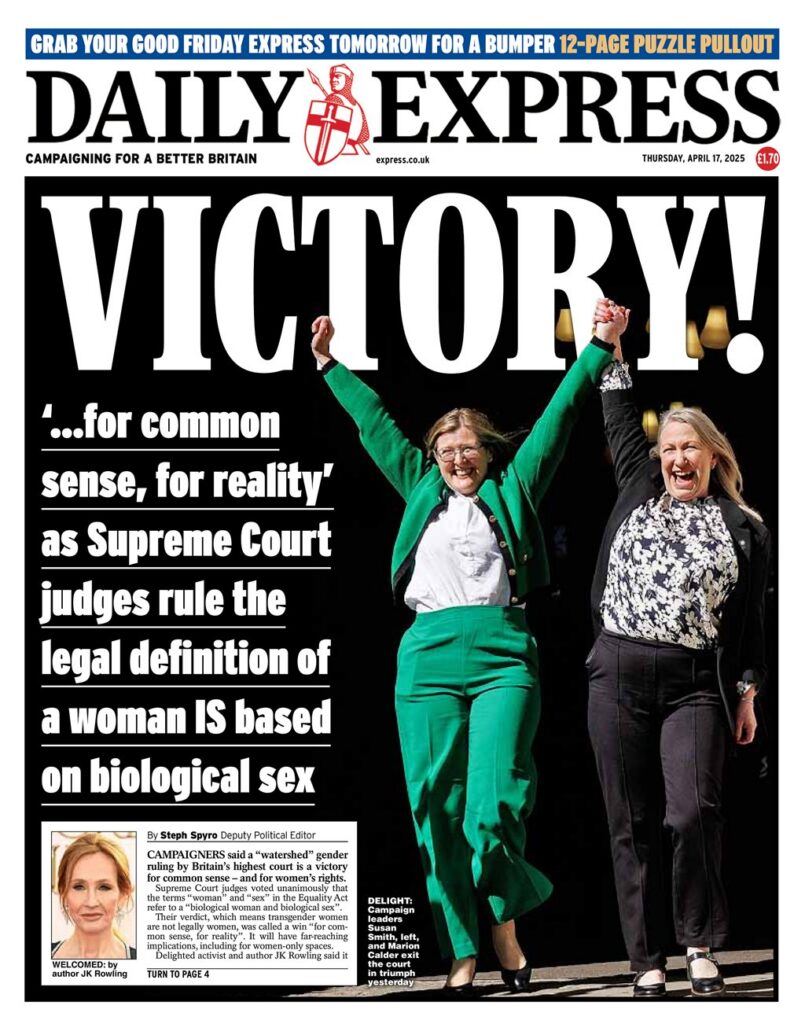
This landmark judgment arose from a challenge brought by For Women Scotland (FWS) to Scottish Government guidance that treated trans women with GRCs as women for the purpose of meeting female representation quotas on public boards under the Gender Representation on Public Boards (Scotland) Act 2018.
Legal clarity on sex and gender
The case highlighted longstanding tensions between sex-based protections for women and gender recognition rights under the Gender Recognition Act 2004. Delivering the judgment, Deputy President Lord Hodge emphasised that the ruling was deliberately narrow and interpretive, not ideological. The Court’s task was to determine how Parliament intended the Equality Act to operate when enacted in 2010.
Crucially, the Court confirmed that while the Equality Act protects people from discrimination on the basis of gender reassignment, this protection operates alongside, not in place of, sex-based rights. Trans-identifying individuals therefore retain robust legal protections against discrimination and harassment, but those protections do not override or redefine the meaning of sex within the Act.
The judgment applies UK-wide and does not seek to redefine social or cultural understandings of gender. Instead, it restores legal certainty by confirming that biological sex remains a distinct and protected characteristic in equality law.
Implications for single-sex spaces and services
The ruling provides much-needed clarity for providers of single-sex spaces and services, including domestic violence refuges, hospitals, changing rooms, toilets, sports, and prisons. It confirms that organisations may lawfully restrict access based on biological sex where doing so is proportionate and pursues a legitimate aim, such as privacy, safety, or dignity.
This clarification is particularly significant for women, who rely on sex-based provisions to ensure safety and fairness in intimate, vulnerable, or physically competitive settings.
Immediate reactions and protests
The judgment prompted sharply polarised reactions. Women’s rights organisations, including FWS and prominent supporters such as J.K. Rowling, welcomed the decision as a vital safeguard for the rights of women and girls. The UK Government also welcomed the ruling, describing it as confirmation that single-sex spaces can be lawfully based on biological sex.
By contrast, trans rights organisations characterised the ruling as a setback and expressed concern that it could lead to increased exclusion, despite the Court’s explicit affirmation of continued legal protections.
On 19 April 2025, large protests took place across the UK. Thousands gathered in London’s Parliament Square for a “trans liberation” rally, with additional demonstrations in Edinburgh and other cities. While the protests were largely peaceful, isolated incidents of vandalism occurred in Parliament Square. Several statues were defaced with graffiti, including the only statue of a woman — that of suffragist Millicent Fawcett.
The Metropolitan Police launched an investigation into the criminal damage, and Home Secretary Yvette Cooper condemned the vandalism as “disgraceful.” Women’s rights advocates pointed to the incident as emblematic of hostility directed at women following a legal victory achieved through democratic and judicial processes.
Why It Matters
The Supreme Court’s decision represents a pivotal moment in UK equality law. It strengthens the legal foundation of sex-based rights while maintaining protections for trans-identifying people under the characteristic of gender reassignment. By affirming that biological sex remains legally meaningful, the judgment enables proportionate single-sex provisions without removing safeguards against discrimination.
Although public debate will continue, the Court’s authoritative interpretation provides enduring clarity for service providers, employers, lawmakers, and women seeking to uphold hard-won sex-based protections under the law.