
On 15 December 2025, Women Speak Tasmania met with the Tasmanian Attorney-General, the Hon. Guy Barnett MP, to discuss a matter we believe is fundamental to the safety, dignity and legal recognition of women and girls in this state.
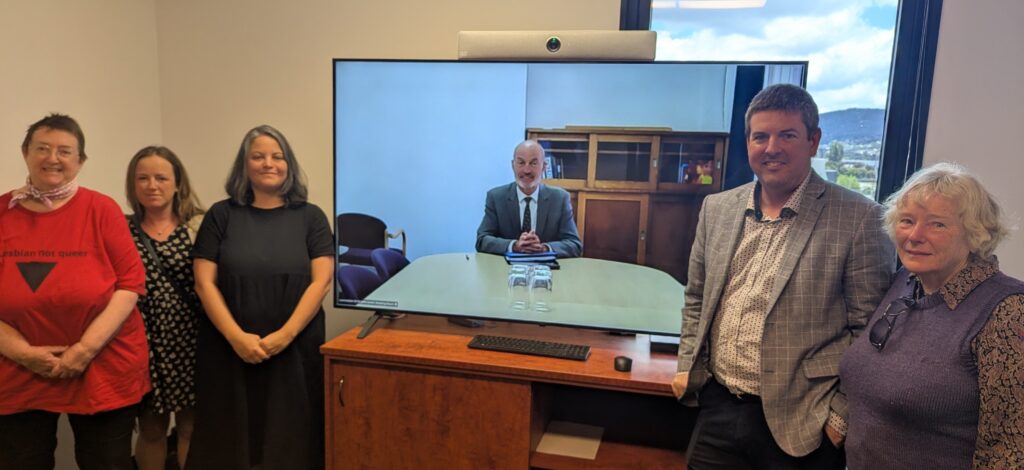
At that meeting we formally presented our submission calling for reform of the Anti-Discrimination Act 1998 (Tas).
We also provided something just as important as legal analysis — the lived experiences of Tasmanians.
Alongside our submission, we delivered 29 community testimonies from women, parents, and service users describing how current laws and policies are affecting their daily lives. These accounts included concerns about privacy in facilities, fairness in sport, safeguarding in vulnerable settings, and the fear many now feel about speaking openly on matters relating to sex.
The Attorney-General listened carefully to our concerns, and we appreciated the opportunity for respectful and constructive discussion. We also recognise the significance of this being the first meeting between a Tasmanian Attorney-General and representatives from groups advocating for both LGB rights and women’s sex-based rights.
We have since written again to thank him and to ask that the submission and testimonies be formally considered as part of a review process.
The Legal Problem
Our submission identifies a simple but serious issue:
Tasmania’s Anti-Discrimination Act protects gender and gender identity — but not sex.
This is unusual. In most anti-discrimination law, the category “sex” is foundational. It is the basis on which women’s protections have historically existed, including protections relating to pregnancy, maternity, and female-only spaces.
In Tasmania, however, “sex” does not appear as a protected attribute at all.
This creates confusion and uncertainty. Services, organisations, and institutions are left without clear guidance about whether they can lawfully provide female-only spaces or policies when privacy, safety, dignity or fairness are involved.
The consequences are practical, not theoretical. Women have raised concerns about:
- single-sex changerooms and toilets
- women’s hospital wards and shelters
- fairness and safety in sport
- accommodation and intimate care settings
- data collection about male violence against women
Without clear recognition of sex in the law, decision-makers often rely on interpretations of “gender” that are undefined and inconsistent.
Why Clarity Matters
Our submission does not propose removing protections for transgender or intersex Tasmanians.
What we are asking for is legal clarity.
Biological sex is an objective characteristic recognised across medicine, law and public policy. It can be identified even before birth through routine medical screening such as Non-Invasive Prenatal Testing (NIPT), which detects Y-chromosome DNA to determine whether a fetus is male or female. Yet despite this well-established reality, the Tasmanian Act does not explicitly protect people from discrimination on the basis of sex.
We believe a law cannot effectively protect women if it does not clearly recognise women as a sex class.
What We Proposed
Our recommendations are modest and practical. We asked the Government to:
• Add “sex” as a protected attribute
• Define sex clearly in the interpretation section of the Act
• Extend anti-vilification protections to cover hatred directed at women as a sex
• Provide clear lawful exceptions for single-sex spaces where privacy, safety or fairness requires it
These changes would not remove anyone’s rights. They would simply restore legal balance and certainty.
Why This Matters to Ordinary Tasmanians
The 29 testimonies we provided show this is not an abstract legal debate.
Women described avoiding facilities, self-censoring their views, and feeling that their concerns are dismissed or misunderstood. Parents described confusion about school policies. Service providers described uncertainty about legal obligations.
At its core, the issue is recognition. Anti-discrimination law exists to protect vulnerable groups. Women and girls — half the population — should not be the only group without explicit protection based on the defining characteristic for which sex discrimination law was originally created.
Our Next Step
We have written again to the Attorney-General thanking him for the meeting and respectfully asking that the Government review the Act and consider our proposed amendments.
We hope this will begin a constructive process. Laws work best when they are clear, balanced, and grounded in reality. Our aim is not conflict, but clarity — a framework that protects everyone while recognising the specific needs of women and girls.
We will continue to advocate respectfully, present evidence, and ensure that the voices of Tasmanian women are heard in the development of law and policy that affects their lives.