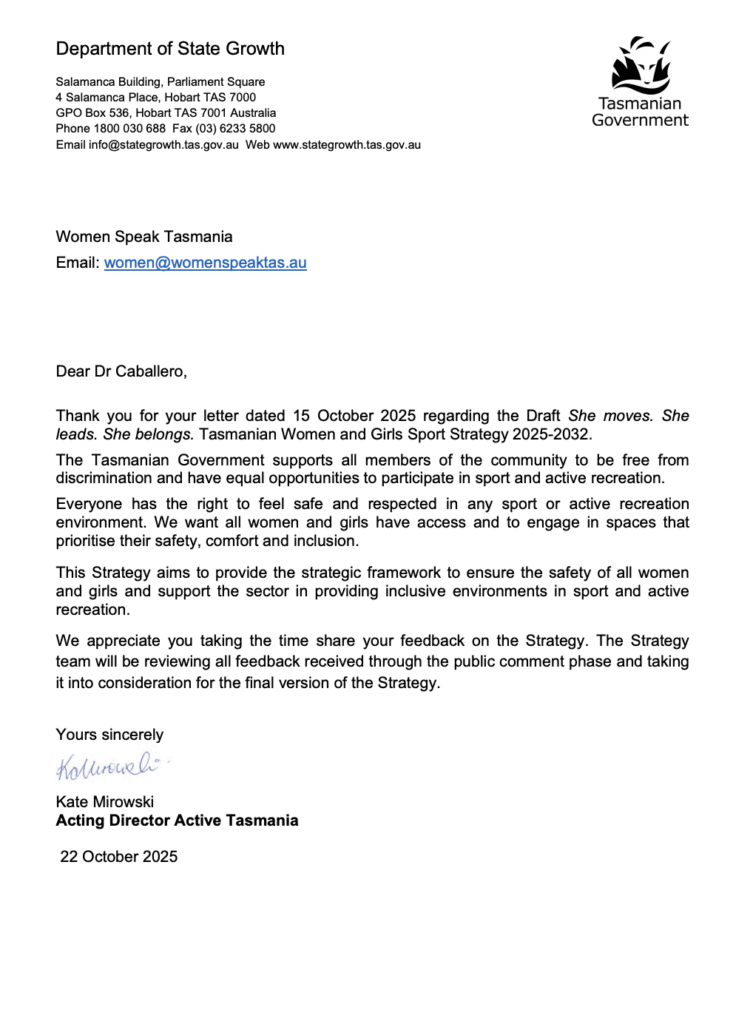
Women Speak Tasmania welcomes the Tasmanian Government’s commitment to increasing participation and leadership opportunities for women and girls in sport.
However, we are deeply concerned that the draft strategy, as written, risks undermining the very group it seeks to support — females.
Our submission draws on international and domestic legal frameworks, including:
- UN Special Rapporteur Reem Alsalem’s Report (A/79/325) on Violence Against Women and Girls in Sports (October 2024), which warns that including males in female sports and spaces constitutes a form of discrimination and potential violence against women and girls.
- The Australian Sex Discrimination Act 1984 (Cth), particularly Section 42, which allows the lawful exclusion of males from female sporting competitions where strength, stamina or physique are relevant to fair competition.
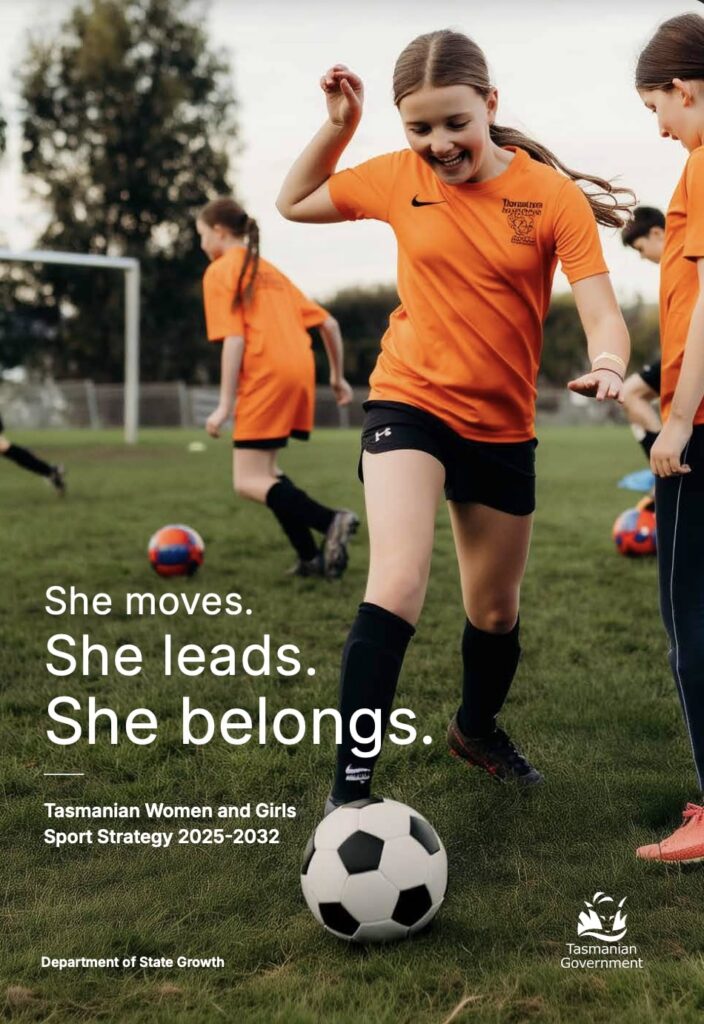
Key Concerns with the Draft Strategy
1. Lack of a Sex-Based Definition
The draft does not define “women” or “girls” in biological terms, and instead relies on language such as “gender equity” and “gender diverse needs.”
Without clear definitions, the strategy risks erasing the sex-based focus required to address the barriers that females uniquely face.
Recommendation:
Define “women” and “girls” as biological females and distinguish this from “gender identity.” Policies regarding gender-diverse individuals must not compromise sex-based protections for females.
2. Omission of Female-Only Facilities
While the strategy promotes “inclusive environments,” it fails to guarantee privacy and safety for women and girls in changing rooms, showers, and toilets.
Female athletes, especially young girls and those with trauma histories, need spaces free from exposure to males for reasons of safety, dignity, and wellbeing.
Recommendation:
Require that all sports facilities maintain female-only changing rooms and toilets, with separate unisex or private options for gender-diverse participants. This approach safeguards everyone respectfully.
3. Absence of Protection for Female Sporting Categories
The draft does not explicitly affirm sex-based sporting categories or reference the legal exemption in Section 42 of the Sex Discrimination Act 1984 (Cth).
Ignoring biological differences undermines fairness and equal opportunity in competition.
Recommendation:
Reaffirm that women’s and girls’ sporting categories exist to ensure fair competition and safety. Eligibility for female competition should be based on sex, not gender identity, consistent with Australian law and international human rights guidance.
4. Governance and Consultation
The draft strategy mentions an “implementation group” but provides no assurance that women’s rights or safeguarding organisations will be included.
Without representation from these groups, the implementation risks being captured by ideology rather than evidence-based policy.
Recommendation:
Include women’s rights and child-safeguarding organisations on the implementation group to ensure genuine female representation and accountability.
5. Alignment with International Human Rights
The UN Special Rapporteur’s report on Violence Against Women and Girls in Sports (A/79/325) emphasises that including males in female sports can expose women to physical and psychological harm, violating their rights to safety, dignity, and equal opportunity.
Recommendation:
Explicitly reference and align the Tasmanian strategy with these UN findings. Tasmania should lead the nation by reaffirming that protecting women’s sport is consistent with both Australian and international law.
Conclusion
Tasmania has the opportunity to lead Australia in safeguarding women’s and girls’ sport by creating a strategy that is inclusive without compromising fairness, privacy, and safety.
We urge the Government to revise the draft to ensure:
- Clear, sex-based definitions of “women” and “girls.”
- Protection of female-only facilities.
- Maintenance of sex-based sporting categories.
- Inclusion of women’s safeguarding organisations in implementation.
Without these measures, the strategy risks failing to deliver genuine equality for women and girls.
References:
- Australian Government (1984, as amended).Sex Discrimination Act 1984 (Cth). Federal Register of Legislation.
https://www.legislation.gov.au/C2004A02868/latest/versions- See in particular Section 42 – Competitive Sporting Activity Exemption, which permits single-sex sporting categories where strength, stamina, or physique are relevant to fair competition.
- See in particular Section 42 – Competitive Sporting Activity Exemption, which permits single-sex sporting categories where strength, stamina, or physique are relevant to fair competition.
- Australian Human Rights Commission (2023). Federal Discrimination Law – Chapter 4: Sex Discrimination Act 1984.
https://humanrights.gov.au/our-work/legal/federal-discrimination-law-chapter-4-sex-discrimination-act - Women Speak Tasmania (2025). Fairness Under Strain: Women’s Sport in Tasmania at a Crossroads. 2 June 2025.
https://womenspeaktas.au/2025/06/02/fairness-under-strain-womens-sport-in-tasmania-at-a-crossroads/ - Tasmanian Government, Department of State Growth (2025). She Moves. She Leads. She Belongs. Tasmanian Women and Girls Sport Strategy 2025–2032 (Draft).
https://www.active.tas.gov.au - United Nations Human Rights Office (2024). A/79/325 – Violence Against Women and Girls in Sports (Full Report). https://documents.un.org/doc/undoc/gen/n24/249/94/pdf/n2424994.pdf
Response from Active Tasmania 27.10.25