Policy Proposals on Anti-Discrimination Law and Birth Certificates
Women Speak Tasmania (WST) has developed a set of policies that seek to restore clarity to the way sex and gender are treated in Tasmanian law. At the heart of these proposals is the principle that biological sex must be recognised and protected, while social identity should be acknowledged without undermining sex-based rights.
1. Anti-Discrimination Law Policy
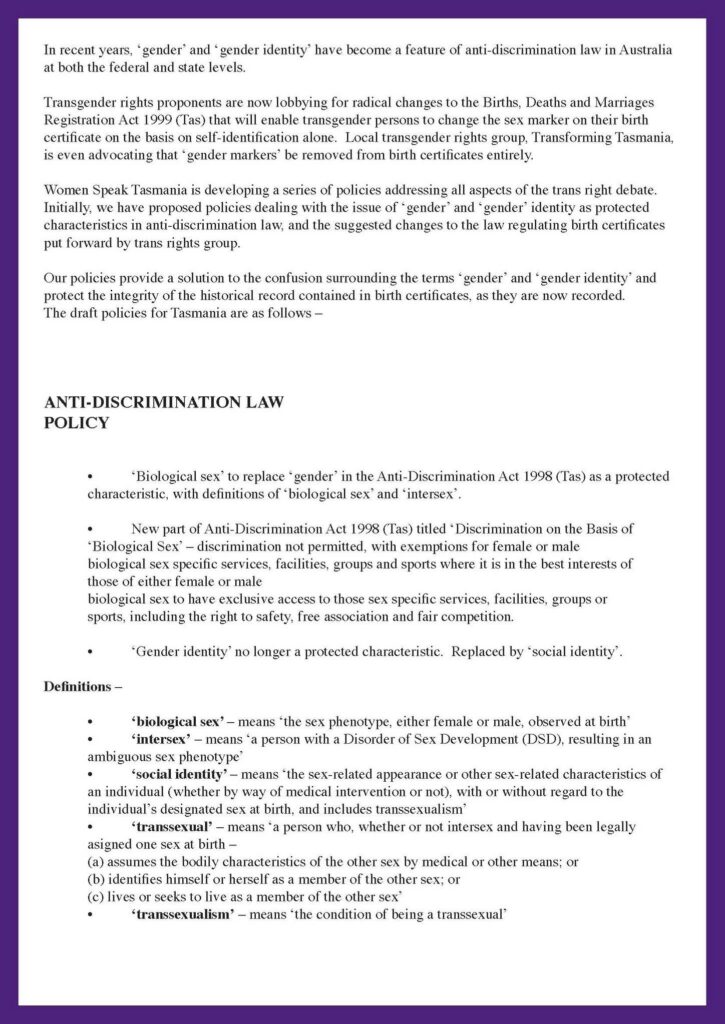
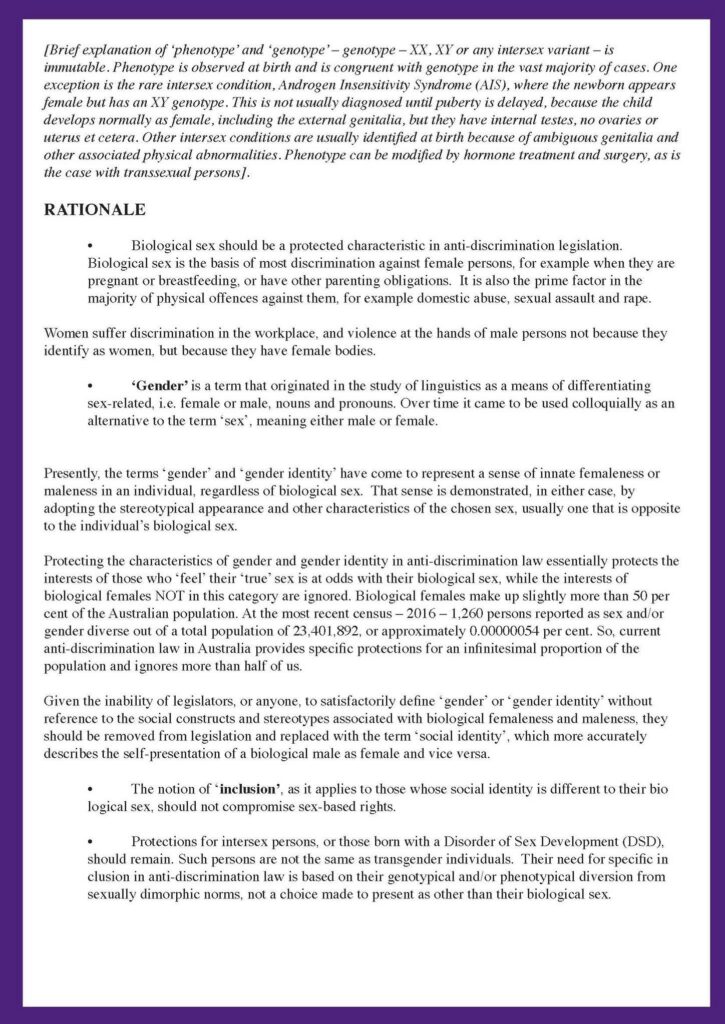
WST proposes that the Tasmanian Anti-Discrimination Act 1998 be updated so that “biological sex” replaces “gender” as a protected characteristic. This would ensure that discrimination against women—such as during pregnancy, breastfeeding, or in relation to safety and violence—is addressed on the basis of female bodies, not gender identity.
Key elements include:
- Biological sex (female or male, observed at birth) recognised as the protected characteristic.
- Intersex persons explicitly protected, defined as those with Disorders of Sex Development (DSDs).
- Social identity introduced as a separate concept to describe self-presentation (e.g. transsexual individuals).
- Exemptions to allow female-only or male-only services, facilities, groups, or sports in the interests of safety, fairness, and free association.
- “Gender identity” removed as a protected category and replaced with the clearer term “social identity.”
This approach ensures protections for women as a biological class, while still acknowledging the reality of people who live with a social identity different from their sex at birth.
2. Birth Certificates Policy
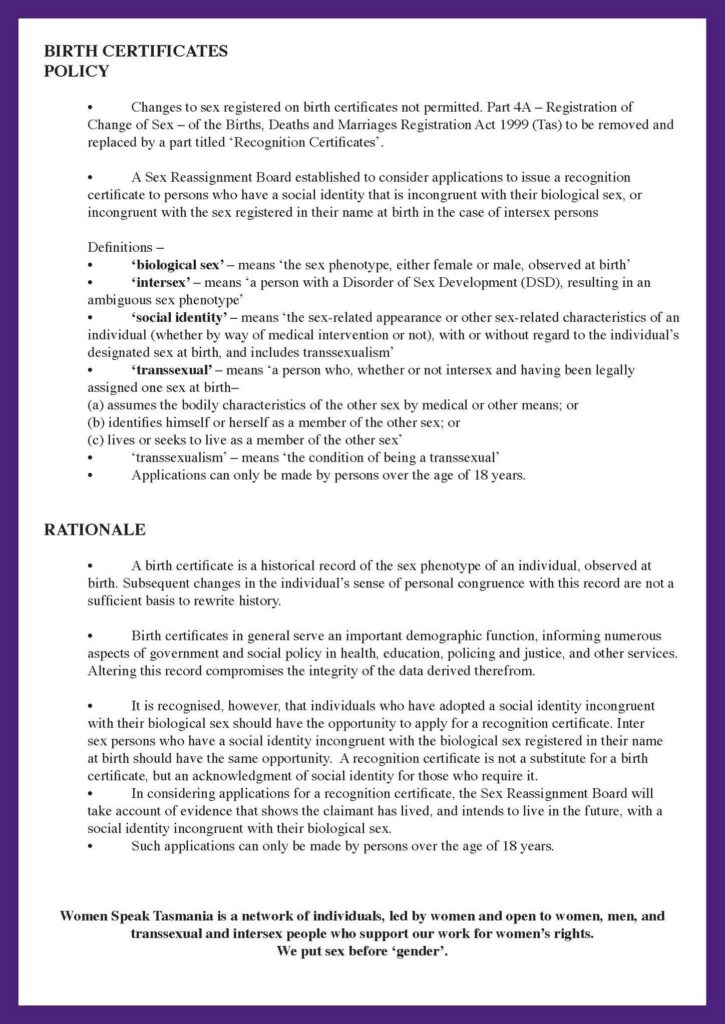
WST argues that a birth certificate is a historical record of biological sex observed at birth, not a document that should be altered to reflect later changes in social identity. For that reason, the group proposes removing the current option of changing sex on birth certificates.
Instead, they suggest:
- Establishing a Sex Reassignment Board to issue Recognition Certificates for adults (18+) whose social identity does not align with their biological sex.
- Recognition Certificates would acknowledge a person’s lived social identity (e.g. transsexual or intersex persons whose sex marker at birth differs from how they live).
- Birth certificates would remain as unaltered demographic records, ensuring data integrity for health, education, justice, and policy planning.
- Intersex people with an incongruent social identity would also be eligible for Recognition Certificates.
This system provides an alternative means of formal recognition for adults while safeguarding the accuracy of birth records.
Why These Policies?
WST stresses that sex-based protections are essential for women’s safety, privacy, and fairness, and should not be compromised by concepts of gender identity that are based on social stereotypes. At the same time, the proposals acknowledge that people may need recognition of their social identity, but without rewriting historical records or eroding women’s sex-based rights.
In short:
- Biological sex is the foundation for rights and protections.
- Social identity can be recognised separately.
- Birth certificates should remain factual records, while Recognition Certificates provide a respectful alternative.
Read our policies below: