
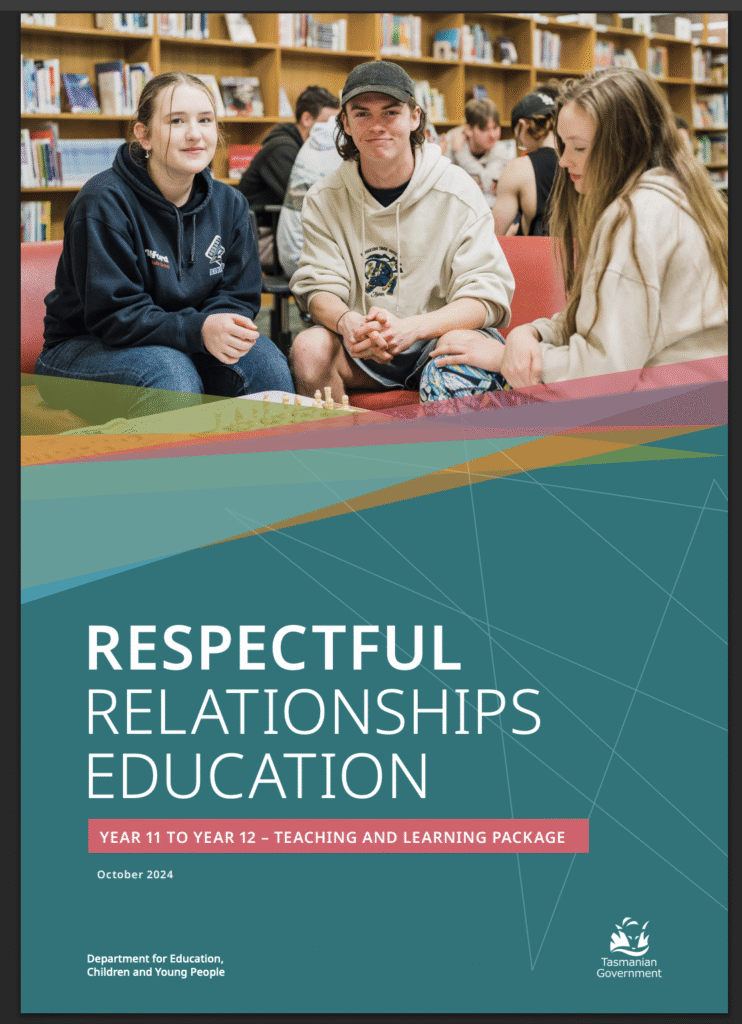
Analysis and summary of the Year 11–12 “Respectful Relationships Education: Teaching and Learning Package,” with a focus on content involving sexuality and porn that could raise safeguarding concerns for this age group.
Summary of contents
- The resource is structured into three modules (Respectful Relationships; Protective Behaviours; Help-seeking) with explicit activities, teacher notes, and linked media (videos, websites). It emphasises consent, bystander action, online safety, grooming, and legal frameworks (e.g., image-based abuse, stealthing, non-fatal strangulation).
- It positions schools as key sites for inclusive, comprehensive education and cites youth feedback asking for instruction that is less “heteronormative” and more inclusive of LGBTIQA+ students. It also frames the program as addressing “gender norms, expectations and stereotypes,” “gender-based violence,” and promoting “gender equality and respect.”
Where “gender ideology”–adjacent content appears
- The rationale calls for challenging “gender norms, expectations and stereotypes,” and for inclusivity of LGBTIQA+ students. This is the document’s clearest “gender” framing and may be read as aligning with contemporary gender-identity discourse even though it does not define “gender identity” explicitly.
- Module aims repeatedly reference “gender-based violence” and “gender equality,” and encourage students to analyse and challenge general assumptions about gender in the community.
Scenarios and role-plays involving sexuality/porn
These activities are explicit and may warrant careful safeguarding controls:
- Porn-influenced sexual practice (choking)
- “Will… likes watching porn… has seen girls… enjoy being choked. He would like to try this with Jess…” The handout notes Tasmanian law on non-fatal strangulation. While it aims to prompt discussion around abuse, consent, power, and legality, the scenario explicitly links porn content and choking for senior students.
- Sexting & image-based abuse
- Students discuss pressures to send nudes, legality (including age-difference hypotheticals), and bystander responsibilities; scenarios explicitly involve a 17-year-old being asked for nude images and later non-consensual sharing post-breakup.
- The resource instructs teachers to screen specific videos and to have students re-write scenarios about leaked images (Jarrod/Mia/Caleb). These are realistic but potentially triggering.
- Grooming role-plays
- Students analyse grooming scenarios (coach/athlete; online adult “Anonymous123”) and are asked to script/role-play help-seeking conversations with trusted adults. The approach is practical and survivor-supportive, but live scripting can surface disclosures in class if not tightly managed.
- “Draw the Line” bystander scenarios (includes sexual violence risk)
- Includes: receiving sexual images of an ex; discussion of a passed-out girl at a party; adult school staff texting a student; and the porn/choking request. These ask students to identify abuse, power dynamics, legal risks, and to propose interventions.
- Rape-trajectory video for discussion
- Teacher note warns a fictional clip “leading up to a rape” may be distressing and advises trigger warnings and opt-out, followed by bystander-intervention discussion.
Safeguarding risks & gaps (with examples)
- Exposure to porn-derived acts: The choking scenario explicitly references porn and a harmful practice. Although the legal context is provided, the example could normalize porn as a script for experimentation; robust pre-briefing, opt-out, and trauma-informed delivery are essential.
- Graphic/triggering content: The rape-trajectory video requires strong controls (advance notice, alternative tasks, ready access to support staff). The document gives a trigger-warning note, but schools must evidence how they implement it.
- Live role-plays on grooming/sexual content: Scripting conversations about grooming may inadvertently prompt disclosures in front of peers unless “protective interrupting” and private follow-up are consistently executed. (The guide mentions protective interrupting and mandatory reporting pathways, which is good practice, but fidelity of delivery is key.)
- Linking out to external media: The program embeds YouTube and third-party resources. While reputable (eSafety, Kids Helpline), schools should ensure previewing and filtering, and offer offline alternatives for students who opt out.
What’s done well (from a safeguarding lens)
- Emphasis on legal literacy around image-based abuse, stealthing, and non-fatal strangulation; the inclusion of Tasmanian-specific legal notes is clear.
- Multiple prompts to identify trusted adults and services; structured help-seeking practice; and links to official eSafety and government resources.
- Teacher guidance acknowledging sensitivity, with trigger warnings and options not to participate (this should be standardised and documented in lesson plans).
Recommendations to strengthen safeguarding
- Parental communication & consent: Provide parents/carers with advance, plain-language outlines of lessons that include porn-related scenarios, rape-trajectory videos, and sexting case studies; enable opt-out and alternative tasks. (Aligns with the doc’s own sensitivity notes but makes it systematic.)
- Content framing & harm-minimisation: When using the choking scenario, foreground that porn is not an education source, clarify the health risks, coercion dynamics, and the criminal status of non-fatal strangulation; consider replacing with a less explicit example if cohort risk is high.
- Disclosure management: Require teachers to demonstrate use of protective interrupting and post-lesson follow-up protocols whenever role-plays touch grooming/abuse; have student support staff on standby for these sessions.
- Alternative pathways: Ensure every high-risk activity (rape-trajectory video, porn-linked scenarios) has an equivalent assessment-aligned alternative (e.g., anonymised case summaries without graphic elements).
- Review of external links: Mandate pre-screening and caching of all linked videos/resources; keep a log to evidence age-appropriateness and accessibility for opt-out students.
- Balancing “gender” framing: Where the resource challenges “gender norms,” add parallel, explicit clarity on sex-based safeguarding risks (e.g., coach-athlete power imbalances, sex-based crime statistics if used) to ensure discussions don’t dilute safeguarding around biological vulnerability.