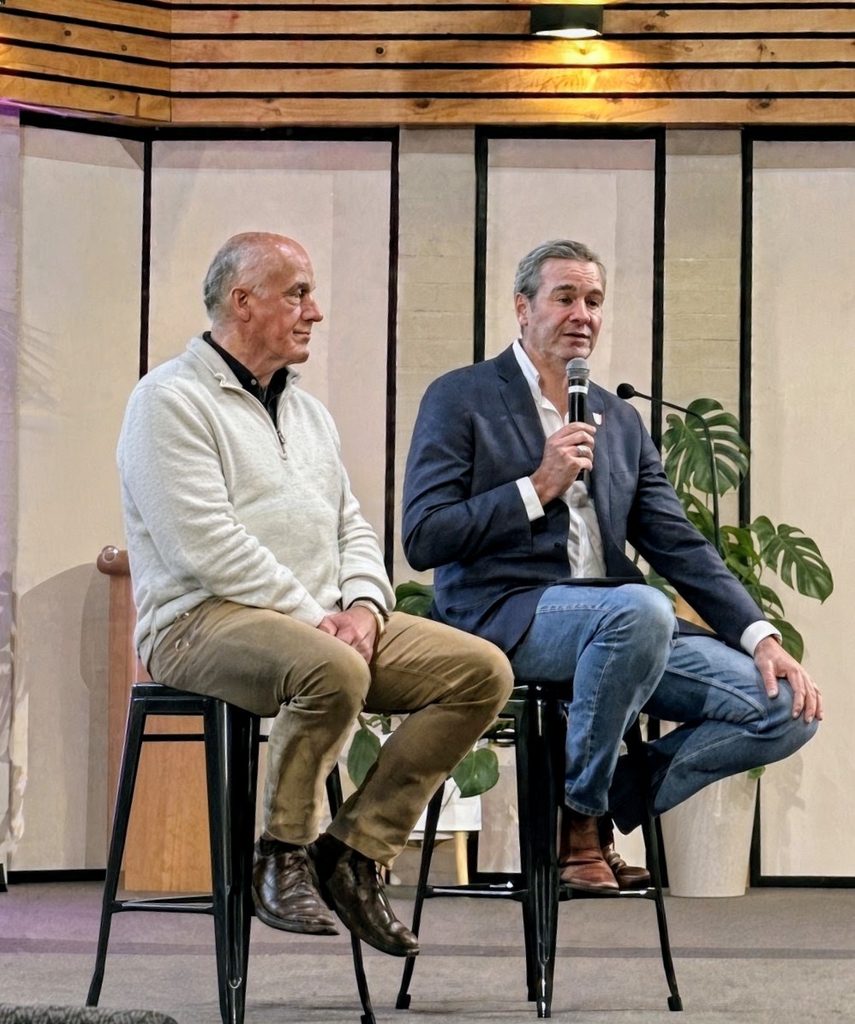
On Saturday evening, 7 November 2026, Liberal Member for Bass Michael Ferguson addressed a public meeting at Kingston Reformed Church about the Greens’ Conversion Practices Prohibition Bill 2026. His Liberal colleague, the Hon. Eric Abetz, also joined the meeting.
The purpose of the gathering was to raise awareness about the Bill, which passed the House of Assembly on 29 October and is now before the Legislative Council for further consideration.
The speakers outlined their concerns about the legislation, its potential implications for individuals, families, health professionals and organisations, and possible avenues for reform before the next stage of parliamentary debate.
Several significant concerns were discussed.
Vague definitions
A major problem with the Bill, which eight of the fourteen Liberal MPs in the House of Assembly, along with two non-Liberal MPs, voted against, is its vague definition of conversion practices.
What exactly does it mean to “change, suppress or eradicate” someone’s sexual orientation or gender identity? What does “identity” mean? The conduct to be avoided is not precisely defined, raising concerns about legal uncertainty.
A much wider purpose?
The Bill appears to do far more than was promised and casts a very wide net for the unwary. Michael Ferguson quoted legal expert Professor Patrick Parkinson AM:
“When a law creates uncertainty, it has unintended consequences”.
Unlike other states, this Bill incorporates concepts associated with gender theory into legislation. It has the potential to affect speech, thought and belief, and applies to individuals, families and organisations alike.
A low threshold for action
Provisions that are draconian:
- The Bill doesn’t require harm to have been done for a complaint to be made.
- No harm is required for an investigation to begin.
- The “victim” need not file the complaint.
- A third party can be the complainant.
- Consent is not a defence.
Draconian penalties:
– Maximum penalty is 21 years in prison.
The question was raised: What is this Bill about, if it’s not about prohibiting coercion and harm, as it was touted to be?
Exemptions that aren’t exemptions
The long list of cobbled-together and last-minute “exemptions” (i.e. activities that don’t attract liability) amounts to pseudo-exemptions.
As always, the devil is in the detail. The phrase “not of itself” is attached to each exempted activity. This means any exemption can be overridden if the “intent to suppress” someone’s orientation or identity is proven. Liberals tried to get these words removed but were unsuccessful.
The chilling effect of this legal loophole will likely result in psychologists and other helpers avoiding gender-distressed clients, which will leave kids/young people with no other choice than to seek support from gender-ideology-influenced institutions and helpers.
The point was made by a WSA representative in the Q&A that health professionals are “exempt” only so long as they follow their professional body’s guidelines. But as virtually all these organisations follow the “gender-affirmation” model, this means that activity that once may have gotten a clinician merely disciplined or, at worst, deregistered (i.e. activity such as refusing to use pronouns) can now see those activities criminalised. Some exemption!
In any case, the process of being investigated, which could drag on for years, is the punishment, along with associated legal and financial costs, even if a practitioner is ultimately exonerated.
The new Gender Czar
The Bill creates a new position: the Conversion Practices Commissioner.
This person:
- will be given broad powers that operate beneath the criminal court threshold;
- will be able to conduct investigations and enforce compliance, including compulsory “education”; and
- in the worst case, will be able to refer the complaint to a tribunal.
The Commissioner will also be able to:
- compel attendance;
- demand evidence;
- override the accused’s right to remain silent; and
- publish findings, thus exposing the accused to public criticism and other consequences.
Criminalisation can occur even if no harm is proven, in the case of someone publicising “conversion practices”.
Harm includes “mental health harm” and is defined using circular reasoning as “psychological harm”, which need only be temporary.
Again, a dangerously vague definition, low thresholds for action and a trap for the unwary.
Why this Bill is particularly concerning
This Bill is the harshest in the country, thanks to:
- its extraordinarily severe maximum penalty of 21 years’ imprisonment, compared to 10 years and five years in Victoria and NSW, respectively;
- the fact that even “temporary harm” (and no harm) are criminalised, as opposed to “substantial harm” in NSW; and
- the imposition of an organisational “positive duty” on all schools, churches and businesses to proactively ensure that “conversion ideology” is “eradicated” from their premises. “Conversion ideology” is not defined.
Michael Ferguson and Eric Abetz continue to push for a parliamentary inquiry into the Bill. They are hoping, among other things, to get the definition of “conversion practices” and other vague or undefined features of the Bill made clearer and more explicit, and for the worst excesses, which unreasonably limit free speech and unnecessarily expose individuals to criminalisation, to be removed.
They urged audience members to contact their Legislative Councillors (MLCs), who can be found on the Parliament of Tasmania’s website, to raise concerns and ask for the Bill to be referred to a parliamentary committee for review. They encouraged people to identify themselves and their suburb, use their own words, and be courteous and factual in any such correspondence.
Thanking MPs who opposed the Bill or raised concerns
The speakers also encouraged attendees to thank the parliamentarians who opposed the Bill in the House of Assembly and raised concerns during the debate.
Those MPs were:
Liberal Party
- Eric Abetz
- Guy Barnett
- Felix Ellis
- Rob Fairs
- Michael Ferguson
- Jane Howlett
- Gavin Pearce
- Mark Shelton
- Jacqui Petrusma
- Marcus Vermey
Independent
- George Razay
Shooters, Fishers and Farmers Party
- Carlo Di Falco
Eight Liberal MPs, together with Independent George Razay and Shooters, Fishers and Farmers MP Carlo Di Falco, voted against the Bill. Marcus Vermey was paired against the Bill, while Jacqui Petrusma, as Speaker, did not vote.
People were encouraged to contact these parliamentarians by email or telephone, or visit their electorate offices to acknowledge their efforts and express their appreciation.
Final observations
The meeting provided an opportunity for members of the public to hear directly from parliamentarians who have opposed the Greens’ Conversion Practices Prohibition Bill and to ask questions about what happens next.
It was particularly important to raise the implications for health professionals, families and the ability of clinicians to provide open and exploratory support to people experiencing gender-related distress.
With the Bill now before the Legislative Council, the coming weeks will be important. Members of the public are encouraged to make their views known to their MLCs and call for proper scrutiny before the legislation proceeds further.
Acknowledgement
Women Speak Tasmania (WST) acknowledges and thanks WSA member Jenny Kyng for attending the meeting, participating in the discussion and generously contributing this report and photograph.