
The ABC has reported on new Australian research examining whether wearing a breast binder affects exercise performance. The subject is important. So is the physical safety of a practice involving prolonged compression of the chest.
But the way the ABC frames the story deserves scrutiny.
The article begins with “trans joy”, describes binding as “life-changing”, and repeatedly presents the emerging research as “comforting” and “reassuring”. Evidence of physical adverse effects receives considerably less attention and is described as “anecdotal”, despite published research involving 1,800 people.
People can genuinely experience relief from binding, but the problem is that the article’s overall framing gives a much stronger impression of safety than the evidence currently supports.
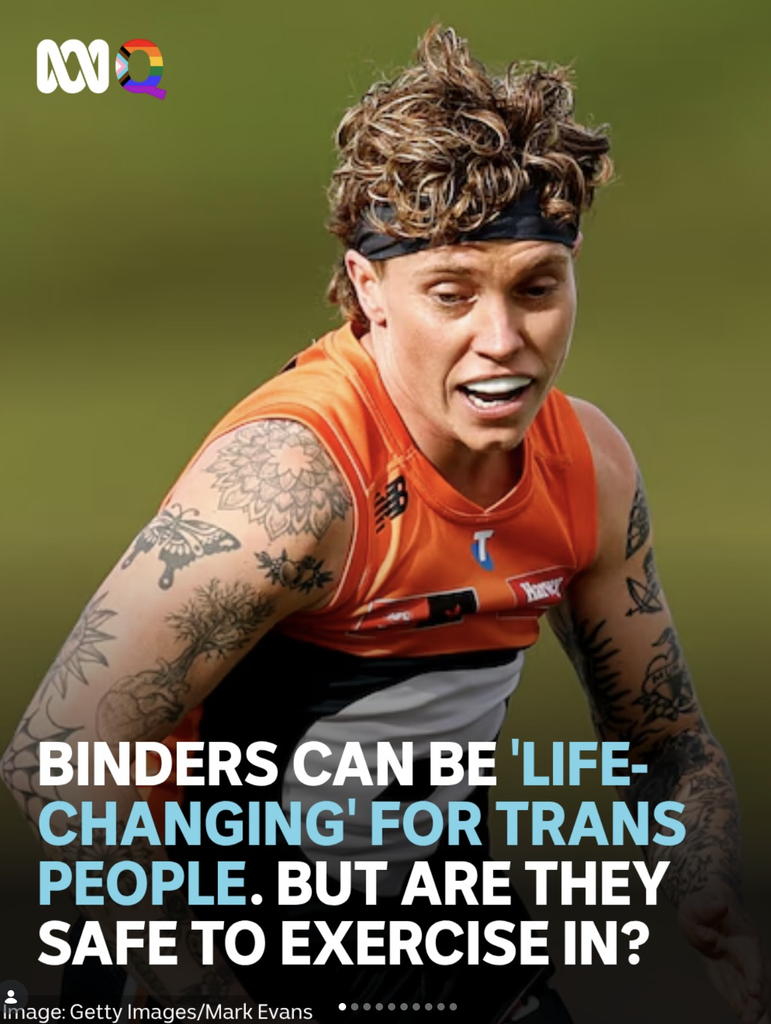
The story begins with “trans joy”
The headline is:
“Binders bring gender-diverse people ‘trans joy’ but are they safe for exercise?”
The article then opens with AFLW player Tilly Lucas-Rodd recalling the first time they wore a binder:
“It was incredible.”
“It was so relieving…”
“this is life-changing.”
The reader is therefore introduced to binding through a strongly positive personal experience before any discussion of physical risks.
The article goes on to discuss dysphoria, the difficulty of obtaining binders and the role binding can play in a person’s transition.
The emotional frame is established first:
binding → relief → joy → life-changing
The question of physical safety comes afterwards.
That is a form of framing. The article does not begin by asking what is known about the benefits and harms of binding. It begins by establishing its psychological value.
What does “anecdotally” mean?
When the article turns to possible harms, it says:
“Anecdotally, however, binding can also have unwanted side-effects…”
That wording is difficult to reconcile with the existing research.
A 2017 study of 1,800 adults with experience of chest binding found that 97.2% reported at least one negative physical outcome. Reported effects included back pain, overheating, chest pain, shortness of breath, shoulder pain, neurological symptoms and numbness. The researchers also found associations between greater binding frequency and a greater number of negative outcomes.
This was a cross-sectional, self-report study and therefore cannot establish that every reported symptom was caused by binding. But it was still published research involving 1,800 participants — not simply anecdotal accounts.
Calling this evidence “anecdotal” risks giving readers the impression that there is little scientific evidence of physical problems associated with binding.
There is.
What remains uncertain is the extent, causation and long-term consequences of those effects.
“There wasn’t a lot of research” — but what research?
Lucas-Rodd explains that when looking for information about binding while playing sport:
“There wasn’t a lot of research.”
The statement is reasonable if the question is specifically about exercise while wearing a binder.
But the article does not make that distinction clearly enough.
There is research on the physical effects of binding generally. What has been much less studied is whether wearing a binder during exercise produces additional or measurable short-term effects on exercise capacity.
Those are different questions.
The ABC moves from the first idea — that there was little information about exercise — directly to the new UWA research, creating a reassuring narrative without giving the larger body of research on physical symptoms equivalent prominence.
The new Australian study
The study highlighted by the ABC involved just 21 participants, all of whom never wore a binder before.
Participants completed exercise testing with and without a binder, allowing researchers to compare their short-term physiological responses.
The study is useful. Its crossover design means participants could be compared with themselves, and research into an area that has previously received little attention is worthwhile.
But it is also a small study.
More importantly, people who had never previously worn a binder cannot tell us whether repeated binding over months or years produces cumulative physical effects.
The study examined an acute exercise question.
It did not establish the long-term safety of regular binding.
The researchers themselves were cautious. Kai Schweizer said:
“We don’t have enough evidence to say anything with certainty yet.”
That qualification is important.
“No significant difference” is not the same as “safe”
The study found no significant differences in the exercise measures examined when participants wore a binder compared with when they did not.
That is a finding worth reporting.
But it does not establish that binding is harmless.
“No significant difference was detected in this study” is not equivalent to “binding has been demonstrated to be safe”.
The difference becomes particularly important when the sample is only 21 people and the research examines short-term effects.
The ABC describes the findings as providing “some reassurance”, and later quotes Dr Adam Brownhill, medical director of a gender-affirming care clinic in Melbourne, saying:
“This is a really reassuring piece of research, in that there was no harm found.”
Reassuring about what?
The study provides some information about short-term exercise performance under the conditions tested.
It does not tell us whether repeated binding causes cumulative musculoskeletal, respiratory, skin or other physical problems.
Another small study
The ABC also refers to a pilot study involving 18 adolescents which found no significant difference in exercise capacity when participants exercised with and without a binder.
Again, this is useful preliminary research. But it is a study of 18 people.
It cannot establish long-term safety for adolescents who may bind repeatedly over years. The researchers themselves called for further research, including investigation of whether reduced cardiopulmonary fitness might be related to low physical activity or chronic binding.
The existence of these studies therefore does not justify moving from:
“we have not detected a significant difference in these short-term tests”
to:
“binding is safe.”
The mental-health framing
The ABC repeatedly connects binding, exercise and mental health.
The article argues that trans and gender-diverse people participate in physical activity at lower rates and discusses the consequences of this for conditions including cardiovascular disease, type 2 diabetes and osteoporosis.
But the article does not establish that lower exercise participation is responsible for those health disparities.
Health outcomes are complex. Mental health, underlying health conditions, medications, hormonal status and other factors may also be relevant.
The article ends where the evidence becomes least critical
After the research discussion, the article returns to the practical and positive aspects of binding: fitting binders, commercial suppliers, swimming, surfing, returning to sport and the psychological benefits of participation.
The physical side-effects that appeared earlier largely disappear from the discussion.
The result is a story that begins with “trans joy”, moves through preliminary research described as reassuring, and ends with the positive social and psychological benefits of being able to participate in sport.
That is a very particular narrative.
It is not necessarily factually false. But it is not the only way the evidence could have been presented.
What the evidence actually supports
The available evidence supports a more cautious conclusion.
Some people report substantial psychological relief from binding.
Small studies have found no significant differences in certain short-term exercise measures when participants wear a binder.
At the same time, larger observational research has found very high rates of self-reported physical symptoms among people who bind.
The long-term physical consequences of repeated binding remain insufficiently studied.
Those facts can all be true at the same time.
The question for the ABC is therefore not whether it should report that some people experience binding positively.
It should.
The question is whether a national broadcaster should describe preliminary evidence as “reassuring” without giving comparable prominence to the much larger evidence base documenting physical symptoms and the very significant limitations of the new research.
A more accurate framing would have been:
Binding may provide psychological relief for some people, but the evidence on its physical effects — particularly long-term and repeated use — remains limited. Small short-term exercise studies provide useful preliminary information, but they do not establish long-term safety.
That is a very different message from “trans joy” followed by reassurance.
The ABC should report what the research shows — including its limitations — rather than allowing the emotional appeal of the subject to become the frame through which the evidence is understood.