
Cascades Female Factory Historic Site, Hobart — 13 April 2026 A first-hand account documented by Female Factory Flash Mob 2026
There is a particular irony in what happened at the Cascades Female Factory on 13 April 2026. To see it clearly, the place has to be taken on its own terms.
In the early years of Van Diemen’s Land, convict women were held with men in overcrowded Hobart accommodation. Male and female prisoners could communicate freely. Authorities decided that women required a separate institution.
In late 1828 the first women were moved to the new Cascades Female Factory in South Hobart. Between 1828 and 1856 about 7,000 convict women and girls passed through it. They had been transported from Britain and Ireland, often for offences born of poverty. At Cascades they met hard labour, strict discipline, separation from their children, punishment and, in parts of the factory, enforced silence. The site’s own historical material records that Governor Arthur ordered the women into three classes which were “on no account” to communicate with each other.
The factory is now part of the Australian Convict Sites World Heritage property. It describes its purpose as bearing witness to the “displacement, oppression and control of women” in Tasmania, and says it honours their pain and loss, courage and perseverance. Visitors are told:
“The women were silenced. Their story roars on.”
Among the stories the site still tells is that of the Flash Mob. In historical accounts the name attached to women in the crime class associated with resistance, disorder and a defiant style of dress — “flash” meaning showy clothing, not a modern pop-up protest. The record is not neat. An 1840 inquiry questioned whether an organised Flash Mob could even be identified. The name survived anyway, as part of the factory’s story of women who would not submit quietly.
On 13 April 2026 it was used again.
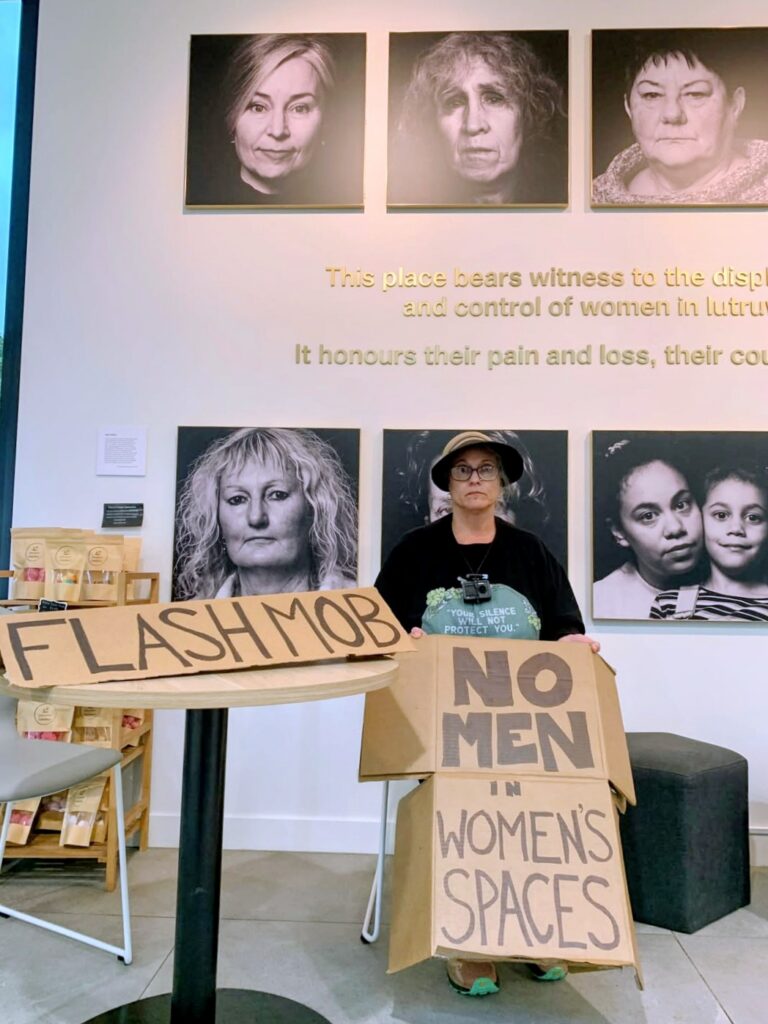
A woman identified here as Ms S sat in the reception area beneath the site’s Wall of Women, with signs reading “Flash Mob” and “No Men in Women’s Spaces.” A second member of Female Factory Flash Mob 2026 was present throughout the afternoon to witness and document what followed.
The Wall of Women is part of the contemporary Female Gaze exhibition, which the factory describes as celebrating women whose lives connect with the history of the site. Among those included is Martine Delaney, whom the factory identifies as the “first transgender woman recognised on the Honour Roll of Women.” Female Factory Flash Mob 2026 had already written to the Tasmanian Minister for Arts and Heritage, Madeleine Ogilvie, asking that the portrait be removed.
Ms S stated the objection aloud:
“I’m having a protest at the Cascades Female Factory, which was a convict prison for women and girls. And on the wall behind me, there’s a person honoured by inclusion on a woman’s wall … a person that isn’t a woman, and I object to that.”
It was not a protest against anyone’s right to live as they choose. It was a protest about sex, at a site whose historical significance rests on the sex of the people imprisoned there.
She arrived at about 1.30pm and sat quietly. The acting manager said he was “not sure of operational requirements” and would need to speak with the Cascades manager, Shelley. Ms S said she was “not here for trouble.” He replied that he was “here to learn.”
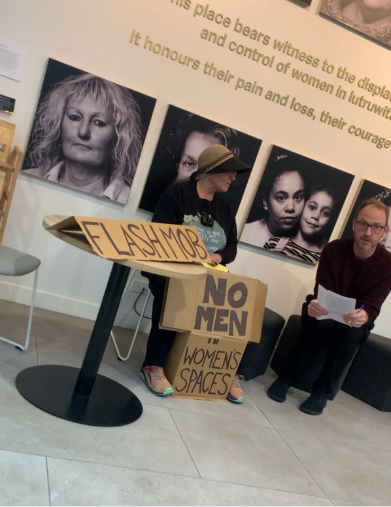
A few minutes later, according to Ms S, he returned and said he had spoken with Will Flamsteed, chief executive of the Port Arthur Historic Site Management Authority, which manages the factory. The CEO’s position, she was told, was that if she was “not impacting anyone or not being a nuisance,” a protest in reception was acceptable. He would let Flamsteed know she intended to stay until closing and was “not causing trouble.”
She stayed until 4pm. She did not approach visitors who did not approach her. Those who did were offered a short statement; many took one. Families kept arriving. Staff kept greeting them. No police or security attended.
During the afternoon a female reception staff member asked: “What if a transgender person sees this?”
Ms S said: “It’s okay, they know they’re trans.”
The staff member said: “We had a transgender person in this morning.”
The question was not whether a transgender person might see a protest about sex. It was whether women may still object when gender identity is substituted for sex in a place built to remember women.
Later a visitor asked where the protest was directed. According to Ms S:
Visitor: “Where? On the wall here?”
Staff: “We’ve got a transgender woman just there, Martine.”
Ms S had not named Delaney in that exchange. The staff member did.
A woman visiting with her daughter told Ms S that everyone was “allowed their voice,” and that she would not stop someone even if she disagreed. The women confined at Cascades had lived under rules governing work, clothing, movement, behaviour and speech. The protester was not seeking that power over anyone else. She was using her own.
At one point a man accepted the written statement. According to Ms S, the acting manager followed him, took the document and put it in a bin. Ms S was then asked not to hand anything out, because people “may believe the contents are endorsed by the Female Factory.” She was visibly protesting. She was not speaking for the factory. She was speaking to it, to the minister and to the public.
Later Fiona Bridges, PAHSMA’s director of interpretation and education, asked her to leave. Ms Bridges said the organisation had to keep the workplace safe for staff. According to Ms S, she referred to protected characteristics being “threatened.”

Ms S had been sitting in reception for two and a half hours. Visitors had come and gone. There had been no confrontation and no call to police. The protest concerned a contested political question: whether biological sex still matters in law and in women’s commemorative space. The question for a public institution is whether a peaceful statement of a sex-based belief becomes a workplace threat simply because it contradicts the institution’s account of gender identity.
Ms S left at about 4pm. At the desk she said: “Thank you for allowing a strumpet to protest unmolested, I’ll see you next time.”
After she had gone, the second Flash Mob member heard the same reception staff member say she respected them “standing up for what they believe in.” Bridges then spoke with the second member, acknowledged that the issue produced passionate views, and again said her responsibility was a safe workplace where protected characteristics were being “threatened.”
One side was invoking the protection of women as a sex class. The other was invoking the protection of gender identity. Those are not the same thing.
Cascades is not an ordinary heritage stop. Its tours are built around convict women and girls. Its own language is sexed: displacement, mistreatment, forced migration, oppression and control of women. If a site dedicated to that history can treat a trans-identified male as one of the women on a commemorative wall, the category the site exists to preserve is no longer stable.
A male does not become female by identification. Institutional recognition of gender identity does not turn him into one of the women whose sexed lives the factory commemorates. Women Speak Tasmania’s position is that the legal conflation of sex and gender which makes that substitution look obligatory must be confronted.
Tasmania’s Anti-Discrimination Act 1998 has protected gender identity since amendments that commenced on 1 January 2014. The Justice and Related Legislation (Marriage and Gender Amendments) Act 2019 widened that protection and changed birth registration, including how sex and gender are recorded. Institutions are now required to navigate gender-identity rules while women continue to assert interests based on sex. The afternoon at Cascades was what that collision looks like in a building erected to hold women.
The convict women of Cascades could not have imagined the argument now conducted in their name. Their stories survived because later people insisted on remembering them as women. On 13 April 2026 another woman sat under the Wall of Women and said that the category still has content.
The factory celebrates voice. The question for Tasmania is whether that voice is still welcome when it says no men in women’s spaces — or whether women’s history, at the one site built to tell it, may now be remembered only on someone else’s terms.