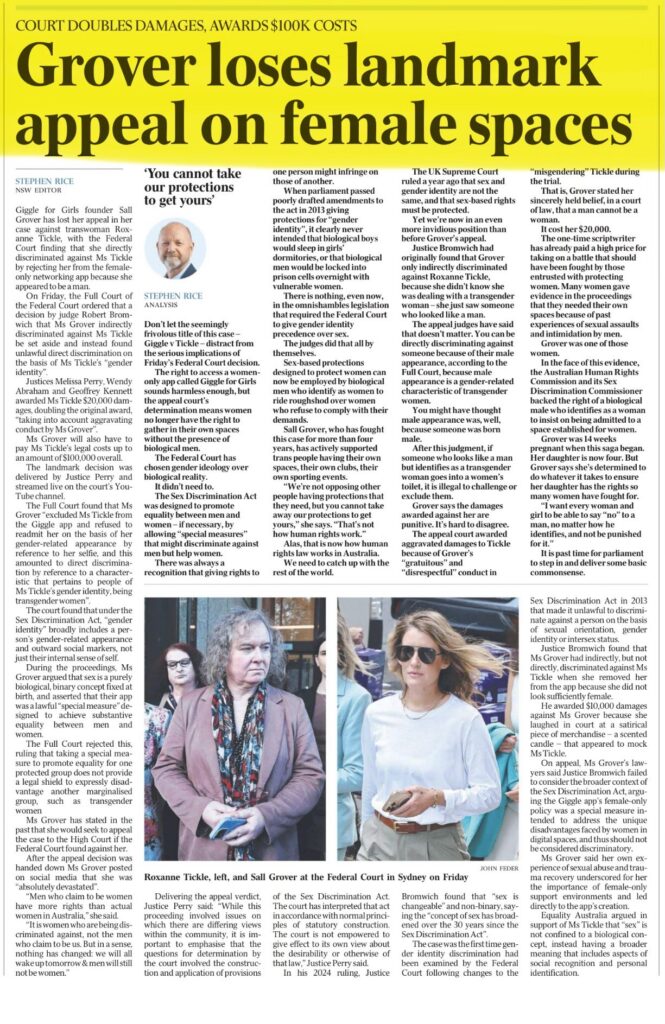
On 15 May 2026 the Full Federal Court of Australia delivered its judgment in Giggle for Girls Pty Ltd v Tickle. The court dismissed Sall Grover’s appeal and upheld (in part) Roxanne Tickle’s cross-appeal. It recharacterised the discrimination as direct rather than indirect, doubled the damages to $20,000, and ordered Grover and her company to pay capped costs of up to $100,000.
Why the case happened – a short recap
In 2021, Roxanne Tickle (a trans-identified male who had undergone surgery and obtained an updated Queensland birth certificate listing female sex) registered for the women-only Giggle app. The app’s AI initially granted access after Tickle uploaded a selfie. Later, during a manual human review intended to exclude males, Sall Grover (founder and CEO of Giggle) or someone acting for the company reviewed the photo and blocked Tickle. Tickle could no longer post, comment, or use full features. Multiple requests for readmission went unanswered.
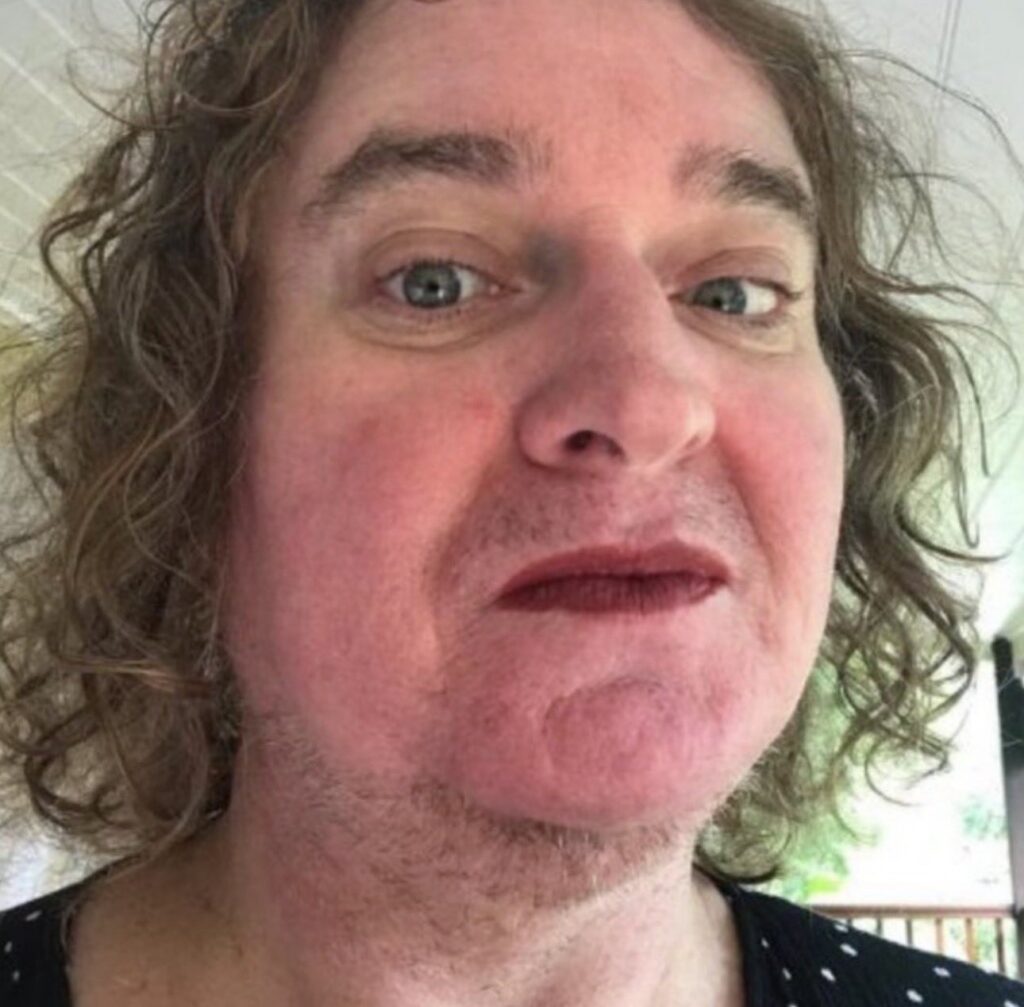
Tickle complained to the Australian Human Rights Commission and then sued in the Federal Court, alleging unlawful discrimination on the ground of gender identity under the Sex Discrimination Act 1984 (Cth) (SDA). The 2024 trial judge found indirect discrimination and awarded $10,000. Grover appealed; Tickle cross-appealed seeking a finding of direct discrimination and higher damages.
The appeal and cross-appeal – what the Full Court decided
Justices Perry, Abraham and Kennett heard the matter in August 2025. Their unanimous judgment (delivered 15 May 2026) dismissed Grover’s appeal and allowed Tickle’s cross-appeal in part.
The court found that Grover and Giggle engaged in unlawful direct discrimination against Tickle on the ground of gender identity, contrary to ss 5B(1) and 22 of the SDA. The original declaration of indirect discrimination was set aside and replaced with a declaration that Grover and Giggle:
“engaged in unlawful direct discrimination against the respondent, Ms Roxanne Tickle, on the ground of her gender identity … by:
(a) excluding Ms Tickle from access to the Giggle App on the basis of her gender-related appearance;
(b) refusing to restore Ms Tickle’s access to the Giggle App on the basis of her gender-related appearance; and
(c) thereby treating Ms Tickle, who is a transgender woman, less favourably than a person designated female at birth seeking access to the Giggle App.”
Damages were increased to $20,000 ($12,000 general + $8,000 aggravated).
The critical legal reasoning – “gender-related appearance” as a protected characteristic
The decisive passage is the court’s interpretation of the statutory definition of “gender identity” in s 4(1) of the SDA:
“gender identity means the gender-related identity, appearance or mannerisms or other gender-related characteristics of a person (whether by way of medical intervention or not), with or without regard to the person’s designated sex at birth.”
The Full Court ruled that Tickle’s male-typical facial features in the selfie were characteristics that “generally appertain to or are generally imputed to” trans-identified males who present as women. Therefore, when Grover excluded Tickle because of that appearance, the exclusion was “by reason of” a protected characteristic of Tickle’s gender identity.
Importantly, the court held that Grover did not need to know Tickle identified as transgender. Actual knowledge of self-ID is not required for direct discrimination under s 5B(1)(b) or (c). The comparator used by the court was a woman (biological female). Treating Tickle less favourably than such a woman, on the basis of male-typical appearance, was direct discrimination.

What this ruling means for women
This is circular reasoning dressed up as law:
- Women’s spaces and services have always relied on observable sex and appearance to keep males out.
- The court now says that male appearance can itself be a protected “characteristic” of a trans-identified male’s “gender identity”.
- Therefore, excluding someone because they look male can be unlawful discrimination on gender identity grounds.
In practice, this ruling makes it extremely difficult — and legally risky — for women to maintain female-only spaces using visual or appearance-based screening.
An hypothetical example
Imagine you are running a public seminar on women’s health, trauma recovery after male violence, or any topic that requires a female-only space. A person who is clearly male at birth, looks male, and speaks like a male turns up at the door. You politely explain the event is for women only.
Under this judgment, if that person claims (even on the spot) a female gender identity, you cannot safely turn them away on the basis of their male appearance. Doing so risks a direct discrimination claim under the SDA. The correct legal comparator becomes a woman, and excluding the trans-identified male on appearance grounds is now treated as less favourable treatment on the ground of gender identity.
The chilling effect is immediate. Organisers of women’s events, clubs, support groups, networking apps, changing rooms, shelters, and sports categories must now weigh the real risk of complaints, AHRC investigations, Federal Court proceedings, damages, and costs. Many will simply open their spaces to self-identified males rather than risk litigation.
Conclusion
The Full Federal Court has applied the 2013 gender identity amendments to the SDA in a way that prioritises self-identified gender and “gender-related appearance” over biological sex. As the judgment itself notes, the court’s role is to apply the law as Parliament wrote it — not to debate its desirability.
Sall Grover has stated she is “absolutely devastated” and intends to seek leave to appeal to the High Court. Women’s groups across Australia will be watching that application closely.
In the meantime, this decision sends a clear message: under current federal law, maintaining female-only spaces based on observable sex and appearance is now legally precarious whenever a trans-identified male is involved. The practical result is that women’s right to same-sex spaces and services is significantly eroded.
Women Speak Tasmania will continue to advocate for the restoration of clear, enforceable sex-based rights. Biological reality cannot be legislated away, and women’s safety and dignity must not be sacrificed on the altar of gender ideology.
Further Reading:
Federal Court of Australia, 15 May 2026. Giggle for Girls Pty Ltd v Tickle [2026] FCAFC 64 –https://www.judgments.fedcourt.gov.au/judgments/Judgments/fca/full/2026/2026fcafc0064
Federal Court to define ‘woman’ in landmark ruling on female-only app. The Australian, 14 May 2026 – https://www.theaustralian.com.au/nation/federal-court-to-define-woman-in-landmark-ruling-on-femaleonly-app/news-story/4fc95bfdcd5a105bc521204fab0a994b. archive link: https://archive.is/x24lS
Sall Grover loses landmark appeal on women’s spaces against Roxanne Tickle. The Australian, 15 May 2026 – https://www.theaustralian.com.au/nation/sall-grover-loses-landmark-appeal-on-womens-spaces-against-roxanne-tickle/news-story/0d3f3b82833a4ea66797969193428643. Archive link: https://archive.is/h7cqi
Grover loses landmark appeal on female spaces. The Australian, 16 May 2026