Letter sent to the Tasmanian Minister for Health, Hon. Bridget Archer, on 06 May 2026
Dear Minister Archer,
Re: Duty of Care and Clinical Governance Considerations – Tasmanian Gender Service
I write regarding the continued provision of puberty suppression (Stage 1) and gender-affirming hormone treatment (Stage 2) to patients under 18 years of age through the Tasmanian Gender Service (TGS).
This correspondence arises in light of recent developments in Australia and internationally that directly engage questions of clinical governance, patient safety, and ministerial responsibility.
It is now clear that responsibility for decisions regarding the provision of these treatments in Australia rests with state governments.
Federal Health Minister Mark Butler has confirmed that puberty blockers are prescribed off-label by clinicians within state health systems and are not Pharmaceutical Benefits Scheme (PBS) items. He further stated that “ultimately, state governments have to decide whether or not these prescriptions are delivered by their services,” while the Commonwealth’s role is limited to providing advice through the National Health and Medical Research Council (NHMRC).
This clarification confirms that awaiting NHMRC guidance does not displace the State’s existing duty of care, nor its responsibility to act where evidence is uncertain and potential risks are significant.
International developments reinforce the need for careful review. Following the Cass Review, NHS England restricted the routine use of puberty blockers outside research settings. More recently, the United Kingdom’s Department of Health and Social Care halted the PATHWAYS clinical trial after serious safety concerns were raised by the national medicines regulator, including potential impacts on bone density, neurological development, and fertility.
In Australia, the Vine Review identified significant limitations in the evidence base for these interventions in minors, and Queensland has since extended its pause on new initiations of Stage 1 and Stage 2 treatments in the public system pending further evidence.
At the same time, documents obtained through Freedom of Information from the Therapeutic Goods Administration indicate that it is not currently possible to assess the risk–benefit profile of puberty blockers for gender dysphoria due to the absence of efficacy data and the lack of national usage and outcomes data for off-label prescribing.
This absence of data reflects a broader lack of transparency across jurisdictions, including Tasmania. There remains no publicly available, comprehensive dataset regarding patient numbers, treatment pathways, or outcomes within the TGS.
A further issue arises in relation to the provision of these treatments in the private sector. Even where public services are subject to internal governance processes, there appears to be no clear, centralised mechanism for monitoring prescribing practices, patient outcomes, or adverse events in private clinical settings. This raises questions about consistency of care, oversight, and patient safety across the broader health system.
In addition, there are emerging questions regarding medical indemnity arrangements for clinicians providing these interventions, including whether insurers are imposing additional conditions, limitations, or risk-based restrictions in light of evidentiary uncertainty. This further underscores the need for clear governance and risk oversight.
In most areas of paediatric medicine, a combination of evidential uncertainty, emerging risk signals, and limited outcome data would ordinarily prompt precautionary review and strengthen clinical oversight.
In light of the above, I ask whether the Tasmanian Government will consider:
- whether an independent clinical governance review of TGS practices, including informed consent guidelines, should be initiated without delay;
- whether interim precautionary measures, including a pause on new initiations of Stage 1 and Stage 2 treatments in the public system, should be considered pending the outcome of NHMRC guidance and further evidence;
- whether mandatory, centralised data collection and public reporting on referrals, treatments, adverse events, and long-term outcomes should be implemented as a matter of priority; and
- how the Department intends to monitor, regulate, or otherwise oversee the provision of these treatments in the private sector, including data collection and patient safety mechanisms.
Given the State’s clear responsibility in this matter, I would appreciate a written response confirming the Department’s:
- current position regarding the issues outlined above;
- reasons why any review or interim measures are not currently under consideration; and
- approach to ensuring transparent and effective data collection and clinical governance in relation to both public and private provision.
This is a matter of significant public interest involving the care of children and adolescents in a context of evolving evidence. Clear, transparent, and accountable clinical governance is essential.
Thank you for your consideration.
Yours sincerely,
Dr. Elizabeth Caballero
Retired General Practitioner
President, Women Speak Tasmania
CC:
Hon Guy Barnett MP, Attorney-General
Hon Jeremy Rockliff MP, Premier
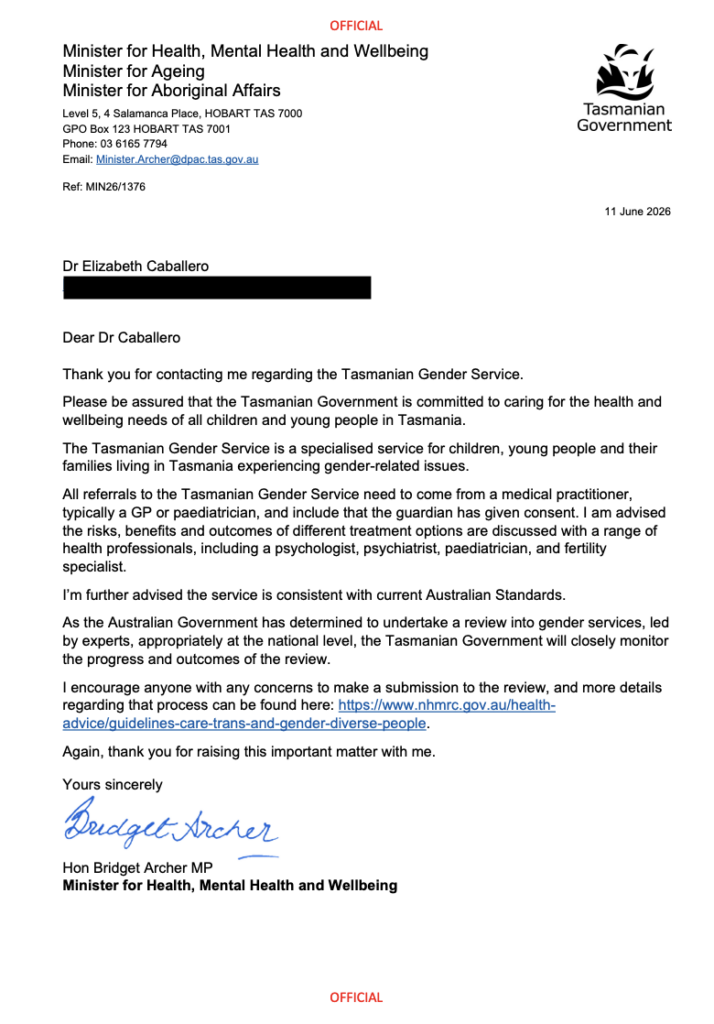
Reply from the Tasmanian Minister for Health, the Hon. Bridget Archer MP, 11 June 2026