
On 15 April 2026, the Federal Court of Australia delivered a significant verdict in favour of the Lesbian Action Group (LAG). Justice Mark Moshinsky allowed LAG’s appeal, set aside the earlier decision of the Administrative Review Tribunal, and remitted the matter for fresh consideration.
This ruling is an important development for women’s sex-based rights in Australia. After lesbians fought for the legal recognition of same-sex marriage — finally achieved in 2017 — women who are same-sex attracted now find themselves back in court simply to hold public events open only to lesbians born female. The push to include trans-identified males in lesbian spaces has largely destroyed open lesbian socialisation and community building. Many groups have been forced into private, invitation-only gatherings to avoid complaints under anti-discrimination law.
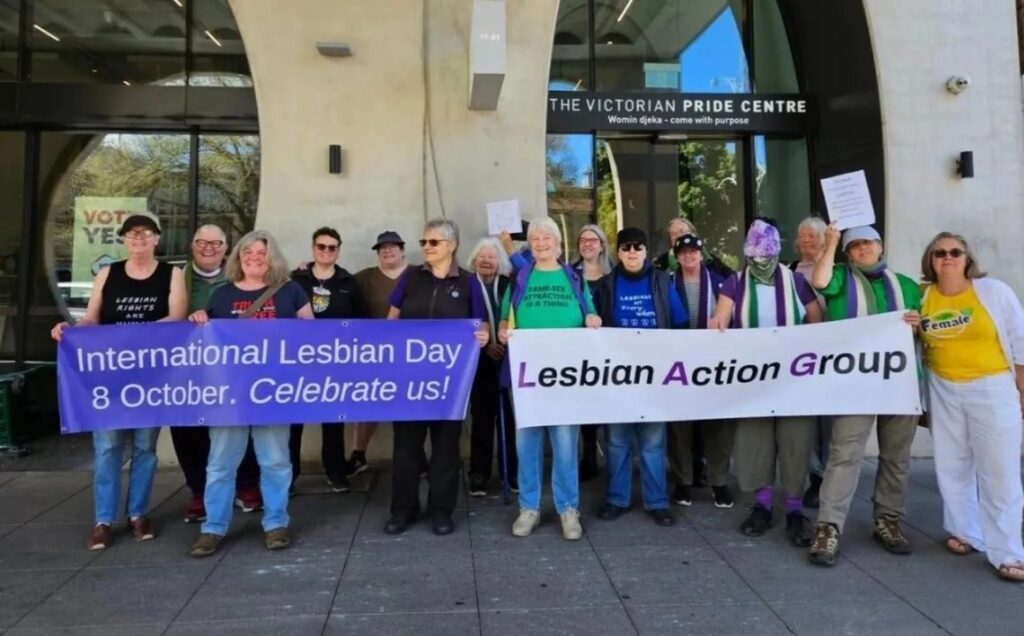
The Erosion of Lesbian Spaces
The Lesbian Action Group is a small Melbourne-based incorporated association of lesbians, many with decades of involvement in the lesbian feminist movement. They formed in direct response to the steady disappearance of single-sex lesbian spaces — the pubs, dances, festivals, sports teams, and cafes that once existed exclusively for biological females attracted to other females.
LAG stands firmly on the principle that lesbians are adult human females who are same-sex attracted. Public events advertised as “lesbian” must therefore be for lesbians born female only. This protects safety, shared sex-based experiences of growing up female, and the fundamental right of same-sex attracted women to associate without males present. The inclusion of trans-identified males has made many such spaces untenable, effectively erasing distinct lesbian culture and community.
LAG’s Application for Exemption
In August 2023, LAG applied to the Australian Human Rights Commission (AHRC) under section 44 of the Sex Discrimination Act 1984 (Cth) for a five-year temporary exemption. The goal was straightforward: to lawfully advertise and hold public community events — starting with an International Lesbian Day celebration — exclusively for lesbians born female. These would be ordinary social gatherings for connection, discussion, and celebration among same-sex attracted women.
Private member-only events are already lawful, but public advertising triggers the Act’s prohibitions on discrimination on the grounds of sex, sexual orientation, and gender identity. Without an exemption, LAG risked complaints simply for trying to maintain female-only boundaries.
LAG vs AHRC: The Commission’s Refusal
On 12 October 2023, just days before the planned first public event, the AHRC rejected the application. While the Commission acknowledged the history of discrimination against lesbians and the benefits of community events, it placed greater weight on the inclusion of trans-identified males.
The AHRC stated it was “not persuaded it is appropriate and reasonable to make distinctions between women based on their biological sex at birth or transgender experience, and to exclude transgender lesbians from a community event of this kind.” It expressed concern that granting the exemption “may have led to the further exclusion of and discrimination against transgender women who are lesbian.” The Commission emphasised that exemptions under the SDA should not be granted lightly, as they temporarily remove legal protections for those who might be excluded.
In practice, the AHRC prioritised gender identity over sex-based rights. This decision forced LAG to cancel or privatise events and highlighted how current interpretations of the law are being used to undermine the associational rights of same-sex attracted females.
The Tribunal Upholds the Refusal
LAG appealed the AHRC decision to the Administrative Review Tribunal (formerly the Administrative Appeals Tribunal). After hearings in September 2024, the Tribunal upheld the refusal on 20 January 2025. It viewed the proposed exemption as impermissibly endorsing discrimination on gender identity grounds, thereby undermining the objects of the Sex Discrimination Act.
The Tribunal’s reasoning treated any differential treatment based on biological sex as automatically problematic, failing to properly balance the competing rights at stake. This decision left lesbians born female with limited options for lawful public gatherings.
Federal Court Judgment: Key Legal Wins
LAG appealed to the Federal Court on questions of law. On 15 April 2026, Justice Moshinsky allowed the appeal on two central grounds:
- Scope of the exemption power (s 44 SDA): The Tribunal adopted an overly narrow view. Exemptions can authorise conduct that would otherwise be unlawful discrimination where, on balance, it serves legitimate sex-based rights and produces a net benefit for the protected group. The Sex Discrimination Act does not demand the elimination of all forms of differential treatment “at all costs.”
- Human rights considerations (s 10A AHRC Act): The Tribunal failed to properly regard the indivisibility and universality of human rights and the principle that every person is free and equal in dignity and rights. In particular, it did not adequately weigh the sex-based rights and needs of lesbians born female.
The Court did not grant the exemption itself, nor did it rule on whether “sex” in the SDA means biological sex (that issue remains before the Full Federal Court in other proceedings). Grounds 3 and 4 were not determined.
What Happens Next?
The matter has been remitted to the Administrative Review Tribunal, differently constituted, for a fresh hearing and determination according to the corrected legal framework. This process is expected to take several months.
If the new Tribunal grants the five-year exemption, LAG will be able to lawfully hold and publicly advertise lesbians-born-female-only events. This would be an important practical victory for sex-based rights and the ability of same-sex attracted women to associate on the basis of sex.
This judgment is not the end of the battle, but it is a vital procedural win. It confirms that applications seeking to protect female-only spaces must be given proper, balanced consideration rather than being dismissed outright. For women’s sex-based rights organisations, it reinforces that the Sex Discrimination Act can and should protect the sex-based boundaries of lesbians.
LAG and its supporters have welcomed the decision as a step toward reclaiming lesbian spaces grounded in biological reality. As lesbians won the right to same-sex marriage, they are now fighting for the right to meet as lesbians — adult human females attracted to other adult human females.
Full Federal Court judgment:
Lesbian Action Group Inc v Australian Human Rights Commission [2026] FCA 432