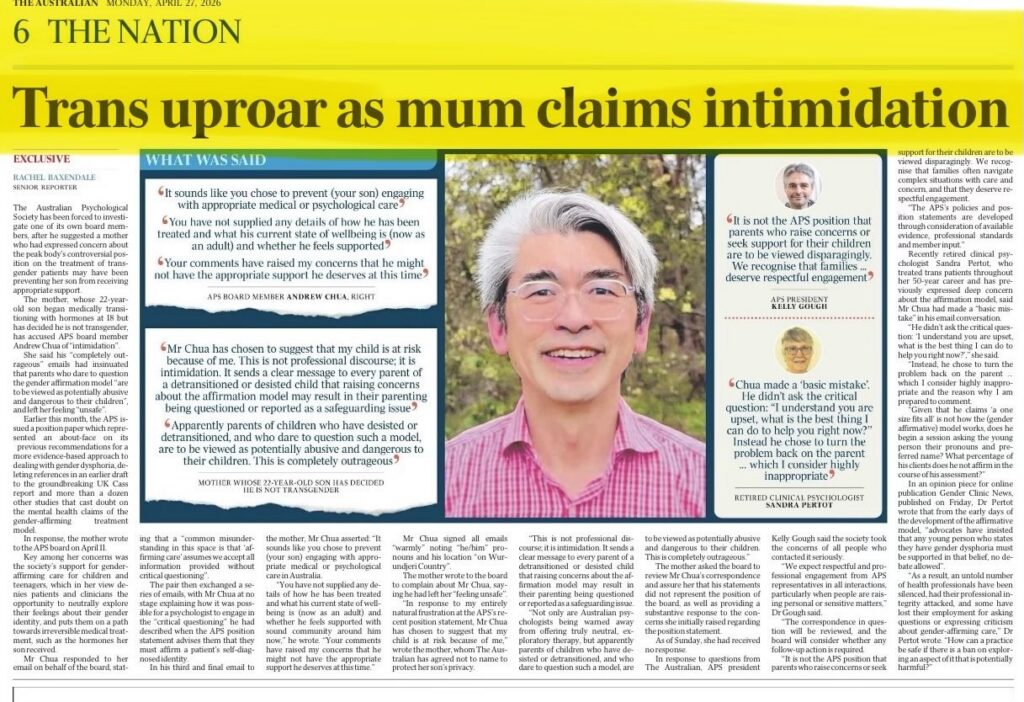
On 26 April 2026, The Australian published a report by Rachel Baxendale examining a complaint made against Australian Psychological Society board member Andrew Chua by the mother of a detransitioned young man.
The article reports that the mother, whose son medically transitioned with hormones at age 18 before later deciding he was not transgender, contacted the APS to express concerns about the organisation’s recently released position statement on gender-affirming care. In particular, she questioned the APS’s support for gender-affirming approaches and argued that they may limit opportunities for neutral therapeutic exploration of gender-related distress.
According to the report, Mr Chua responded on behalf of the APS Board and exchanged several emails with the mother. In his final correspondence, he suggested that her comments raised concerns that her son may not have received appropriate medical or psychological support and deserved adequate support going forward. The mother subsequently lodged a complaint with the APS, describing the correspondence as intimidating and arguing that it implied parents who question gender-affirming care could be viewed as harmful or unsafe influences on their children.
Key Highlights
– The complaint arose after the APS released a revised position statement on gender-affirming care, which critics argue moved away from a more evidence-based and exploratory approach.
– The mother of a detransitioned son wrote to the APS expressing concerns that gender-affirming care can place young people on a pathway toward irreversible medical interventions without sufficient exploration of underlying issues.
– APS board member Andrew Chua responded on behalf of the Board, stating that affirming care does not mean accepting information without critical questioning.
– In later correspondence, Mr Chua expressed concern that the mother’s son may not have received appropriate support, prompting the mother to accuse him of intimidation and of questioning her parenting.
– The mother argued that the exchange sends a message that parents who raise concerns about gender-affirming care risk being viewed as abusive or dangerous.
– APS President Kelly Gough stated that the organisation expects respectful and professional engagement from its representatives and confirmed that the correspondence would be reviewed.
– Dr Sandra Pertot, a recently retired clinical psychologist with decades of experience working with transgender patients, criticised Mr Chua’s approach, describing it as inappropriate and arguing that he failed to engage constructively with the mother’s concerns.
– Dr Pertot also reiterated broader concerns about the gender-affirmative model, arguing that questioning or critically examining aspects of the approach has become increasingly difficult within professional settings.
Why the Story Matters
The article highlights growing debate within Australian psychology and healthcare about how best to support individuals experiencing gender dysphoria. It raises questions about professional standards, the role of exploratory therapy, the treatment of detransitioners and their families, and whether clinicians and parents can openly question prevailing gender-care models without facing professional or social repercussions.
Source: The Australian
or archive link:
printed edition: