
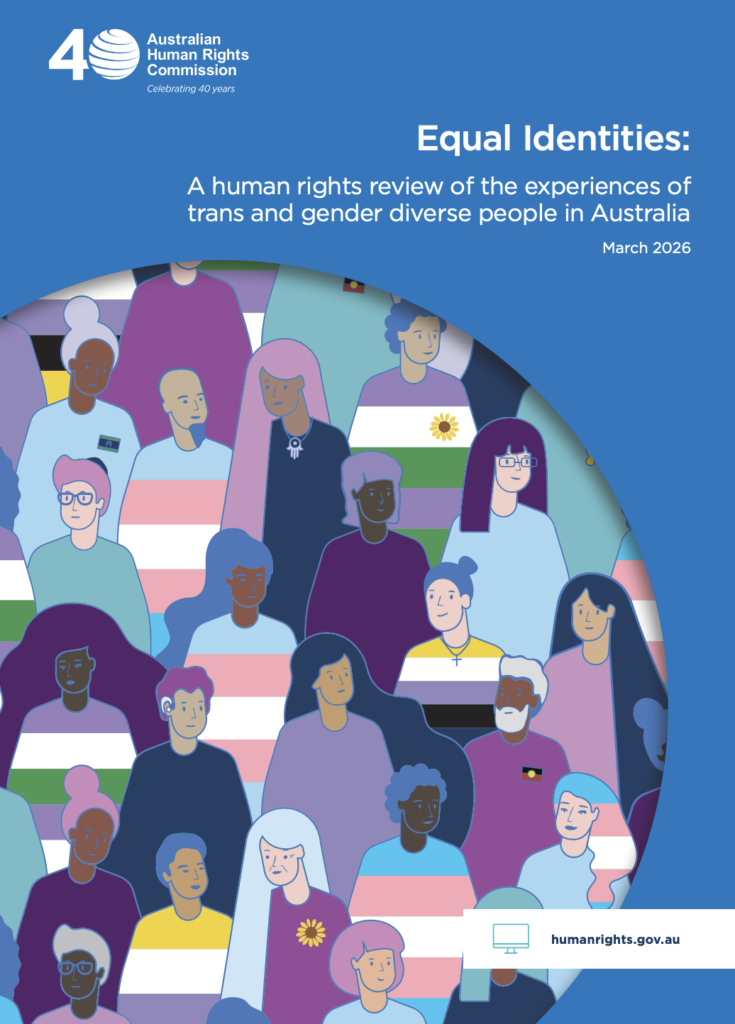
Women Speak Tasmania has carefully reviewed the Australian Human Rights Commission’s March 2026 report, Equal Identities – A human rights review of the experiences of trans and gender diverse people in Australia. While the report claims to advance human rights, its 19 recommendations would seriously undermine the sex-based rights of women and girls in Australia — rights that are protected under the international Convention on the Elimination of All Forms of Discrimination Against Women (CEDAW).
What the AHRC Report Says About Sex and Gender
In its glossary (p. 14), the AHRC states clearly:
“Gender is distinct from biological sex. Sex is defined by chromosomes, hormones and reproductive anatomy. Gender identity is an internal sense of self.”
This definition correctly recognises that biological sex is a material reality and that gender identity is purely subjective — “how a person feels about themselves”.
The Central Contradiction
Despite acknowledging the biological distinction in its glossary, the AHRC then chooses to ignore it. Every substantive recommendation in the report elevates gender identity (an internal sense of self) above biological sex in law, policy, data collection, services, sports, and healthcare.
This is classic institutional double-speak: the AHRC tells the public one thing, but recommends policies that do the exact opposite.
Key Recommendations That Undermine Women’s Rights
The report makes 19 recommendations. The most concerning for women and girls are:
- Recommendation 7: All government bodies must collect data on gender (not sex), including gender identity from everyone.
- Recommendation 12: End pauses on puberty suppressants and other hormone therapies for children. Rely on Gillick competence (a child’s perceived capacity to consent).
- Recommendation 13: Repeal Section 43A of the Sex Discrimination Act 1984 (Cth) — the section that currently protects organisations from being forced to record “neither male nor female” or self-identified gender in official records.
- Recommendations 14–19: Expand anti-discrimination and vilification laws, review and roll back religious and other exemptions, and enforce “inclusive” policies in single-sex spaces, sports, education, crisis accommodation, shelters, and prisons.
How These Recommendations Conflict with CEDAW
Australia is legally bound by CEDAW, the international treaty designed to eliminate discrimination against women on the basis of sex.
CEDAW Article 1 defines discrimination against women as:
“any distinction, exclusion or restriction made on the basis of sex which has the effect or purpose of impairing or nullifying the recognition, enjoyment or exercise by women… on a basis of equality of men and women.”
CEDAW uses the word “sex” (biological) throughout and never mentions “gender identity”. It explicitly allows sex-based distinctions and special measures to protect women’s privacy, safety, dignity, and fairness (Articles 2, 3, 4, 5, 10, 12).
If governments follow the AHRC’s recommendations, they will actively erase women’s rights under CEDAW:
- Repealing Section 43A would remove legal protection for binary sex data collection. Organisations could be sued for maintaining male/female records only. This directly undermines CEDAW’s requirement for accurate sex-disaggregated data to monitor and address discrimination against women.
- Forcing “inclusive” policies in single-sex spaces, shelters, prisons, and sports would allow biological males who identify as women to access female-only areas. This removes the sex-based protections CEDAW permits to safeguard women from male-pattern violence and physical advantage.
- Mandating gender data over sex would make female-specific needs (violence statistics, health outcomes, sports equity) invisible — the opposite of CEDAW’s purpose.
The Attack on Children’s Right to Natural Puberty
The AHRC’s Recommendation 12 is particularly troubling. It calls to end any pauses on puberty blockers and hormone therapies for children and to rely on self-identification and Gillick competence.
Puberty is a natural, healthy stage of physical and sexual development. Medicalising healthy children with puberty blockers interferes with bone density, fertility, sexual function, and cognitive development. This recommendation contradicts the UN Convention on the Rights of the Child, which guarantees every child the right to the highest attainable standard of health and normal physical development.
By prioritising an internal sense of self over biological reality, the AHRC is willing to deny girls (and boys) their right to experience natural puberty — a serious violation of children’s rights.
Women Speak Tasmania’s Position
Women Speak Tasmania believes:
- Biological sex is real, binary, and immutable.
- Woman is a distinct sex class — adult human female — and this category must be protected in law based on material reality, not an internal feeling.
- Single-sex spaces, sports, shelters, prisons, and data collection exist to protect women’s and girls’ privacy, dignity, fairness, and safety.
- Tasmania must add biological sex (male and female) as a standalone protected attribute in the Anti-Discrimination Act 1998.
The AHRC report publicly admits the biological distinction we are fighting for, yet its recommendations systematically erase it. Following the AHRC would move Tasmania further away from our obligations under CEDAW and harm the very women and girls the Convention was written to protect.
We call on the Tasmanian Government to reject the AHRC’s recommendations and instead deliver the clarity Tasmanian women deserve by adding biological sex to our Anti-Discrimination Act.
Resources:
Australia Human Rights Commission. A human rights review of trans and gender diverse experiences in Australia. March 2026. –https://humanrights.gov.au/resource-hub/by-resource-type/reports/lgbtqia/equal-identities
United Nations General Assembly resolution 34/180. Convention on the Elimination of All Forms of Discrimination against Women New York, 18 December 1979. – https://www.ohchr.org/en/instruments-mechanisms/instruments/convention-elimination-all-forms-discrimination-against-women
United Nations. Convention on the Rights of the Child –https://www.ohchr.org/en/instruments-mechanisms/instruments/convention-rights-child