
At Women Speak Tasmania, we have spent years fighting to protect women’s hard-won single-sex spaces. The evidence is clear, the data is consistent, and the lived reality for girls and women is being ignored in the rush toward “inclusion.”
The Performative Hypocrisy of Politicians
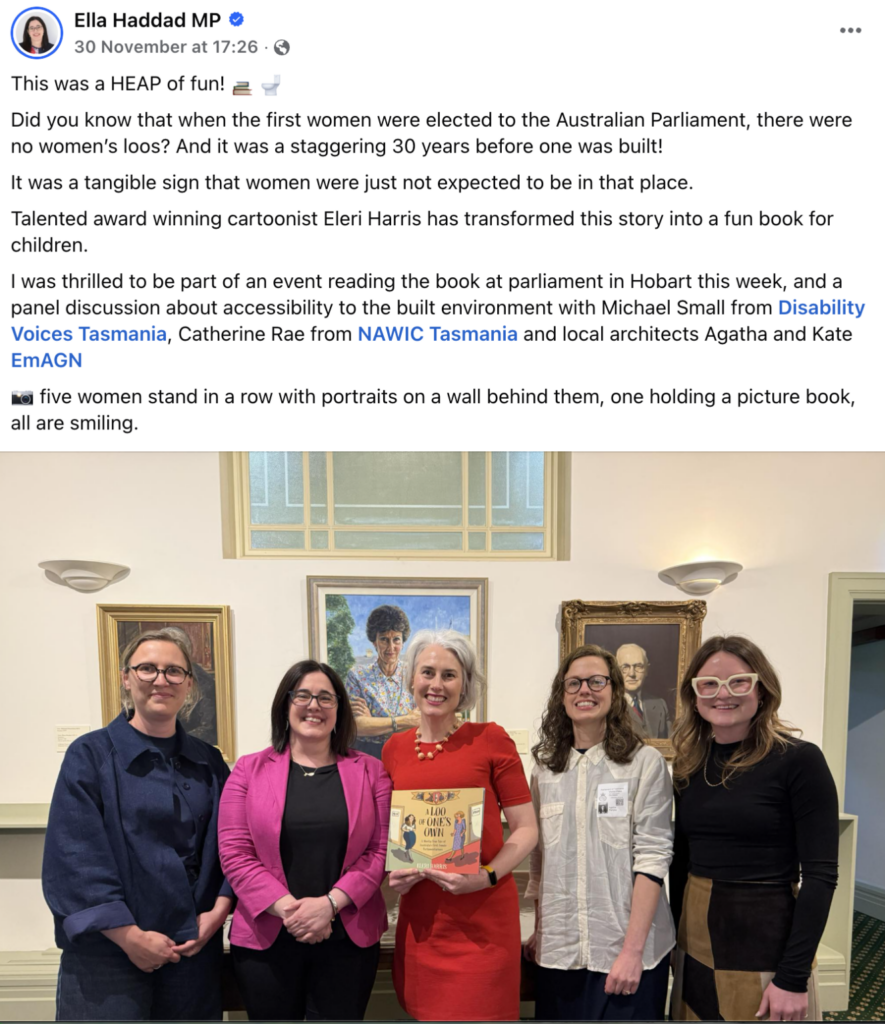
On 30 November 2025, Labor MP Ella Haddad proudly posted about an event in Hobart Parliament House celebrating cartoonist Eleri Harris’s children’s book A Loo of One’s Own. The book tells the story of how the first women elected to the Australian Parliament had no women’s toilets — and it took a staggering 30 years of campaigning before one was built. Haddad called it “a tangible sign that women were just not expected to be in that place.” She smiled in photos alongside other women, holding the book, praising the fight for female-only facilities.
Yet just months later, in March 2026, the brand-new Northern Suburbs Community Recreation Hub in Mowbray opened its doors — a $62 million taxpayer-funded marvel with netball courts, indoor climbing, high ceilings, and spaces for families, children, and the whole community. And what did the Tasmanian Government and City of Launceston decide? Not a single single-sex toilet or changeroom for women, men, or disabled people. Every facility is gender-neutral.
For many women, this represents a troubling contradiction. The very sex-based facilities previous generations fought to secure are now being removed or redesigned in ways many feel diminish the importance of privacy, dignity, and clear sex-based boundaries.
The Northern Hub: A Glaring Omission in a Multimillion-Dollar Facility
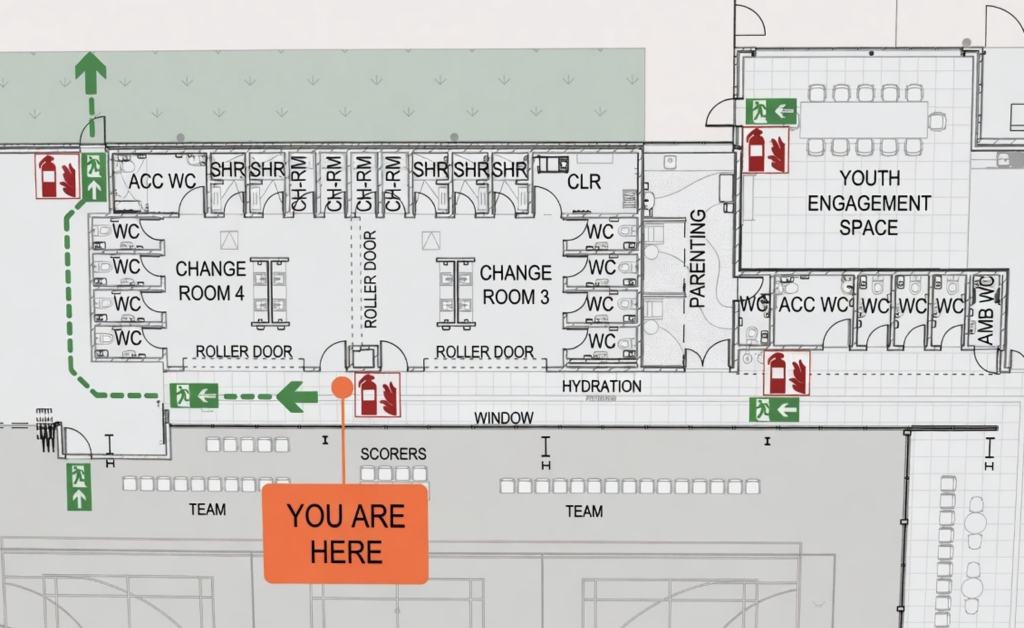
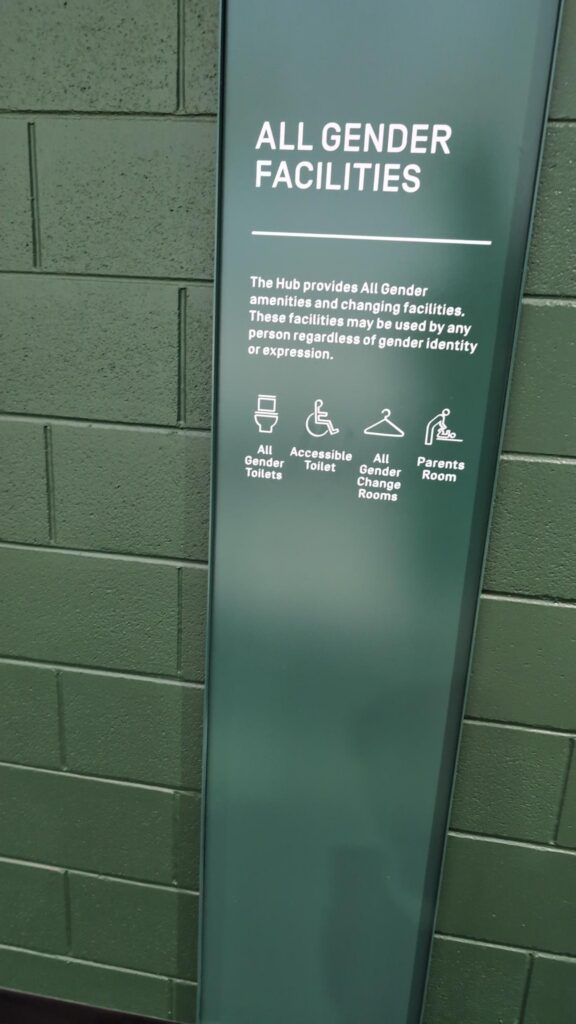
The Hub opened on 28 March 2026. It is over 10,000 square metres of state-of-the-art recreation space — exactly the kind of high-use, busy environment where families, school groups, sports teams, and after-school programs gather. Official project documents confirm the design: six all-gender DDA-compliant amenities, all-gender changerooms (including for multi-purpose courts), and individual self-contained cubicles (toilet + shower + change in one locked room) opening onto circulation spaces.
Proponents say: “It’s just single cubicles — what’s the problem?”
The problem is not the physical walls. It is the removal of sex-based boundaries and the psychological and safety impact this has on women and girls.
Women are often less likely to challenge suspicious or inappropriate behaviour in spaces where sex-based boundaries are unclear. In traditional female-only areas, a male presence is immediately identifiable and socially challengeable. In mixed-sex spaces, that distinction becomes less obvious, potentially weakening the social deterrents that previously existed.
Many women and girls also report discomfort emerging from intimate spaces into shared mixed-sex environments, particularly in busy sporting or recreational settings. Some men express similar discomfort, worrying about causing unease or misunderstanding in spaces traditionally separated by sex.
In sporting environments, female changerooms have historically provided not only privacy, but also a sense of camaraderie and comfort among women and girls. Critics argue that fully mixed-sex arrangements can alter those dynamics in ways policymakers often overlook.
Concerns have also been raised internationally about voyeurism and inappropriate recording in mixed-sex facilities, particularly given the widespread availability of smartphones and concealed recording devices.
Women Speak Tasmania wrote to Mayor Matthew Garwood, the Launceston City Council and Minister for Sport Nick Duigan regarding these concerns and encouraged residents to contact local representatives directly (you can find some templates on our Facebook page).
The National Construction Code 2025: Optional, Not Mandatory
During the public consultation period for NCC 2025, women’s groups — including ours — made it crystal clear: single-sex spaces are essential. Women take longer to use facilities (menstruation, pregnancy, childcare, medical needs). We need more, not fewer, female toilets and changerooms.
Yet the final code introduced an optional Deemed-to-Satisfy pathway for all-gender facilities. It does not require councils or developers to eliminate single-sex provision. Separate male and female facilities remain the expected standard, with all-gender options allowed only as a limited voluntary substitution.
Critics argue that the City of Launceston and Tasmanian Government chose to move beyond what the code required, without sufficiently engaging with women concerned about the implications for privacy, safety, and accessibility.
The Evidence: UK Leisure Centres Show the Real Risks
The most detailed data comes from the UK, where mixed-sex “changing village” designs have been trialled for over a decade:
- 2017–2018 Sunday Times / UK councils FOI: 134 complaints of sexual assaults, voyeurism, or harassment in pool and leisure-centre changing rooms. 120 (≈90%) occurred in unisex/mixed facilities — only 14 in single-sex spaces. Two-thirds of sexual attacks were in unisex areas, many involving phones or hidden devices.
- December 2025 Women’s Rights Network FOI (257 leisure centres): 16 rapes, 80 sexual assaults, and 65 voyeurism incidents — roughly three serious sex crimes per week. The large majority were in mixed-sex changing areas, with female victims the clear majority.
Supporters of all-gender facilities note that many such spaces operate without incident and argue that privacy-focused design can address concerns effectively. However, critics maintain that design alone cannot fully account for social behaviour, psychological comfort, or vulnerability in intimate public settings.
Schools: The Same Pattern, the Same Harm
The push for gender-neutral toilets is now reaching Tasmanian schools. On 27 March 2026, Lindisfarne Primary School announced that from next term, toilets in the Upper Primary block will transition to “non-gendered, individual-use toilets” — fully enclosed and private, with some marked for sanitary disposal.
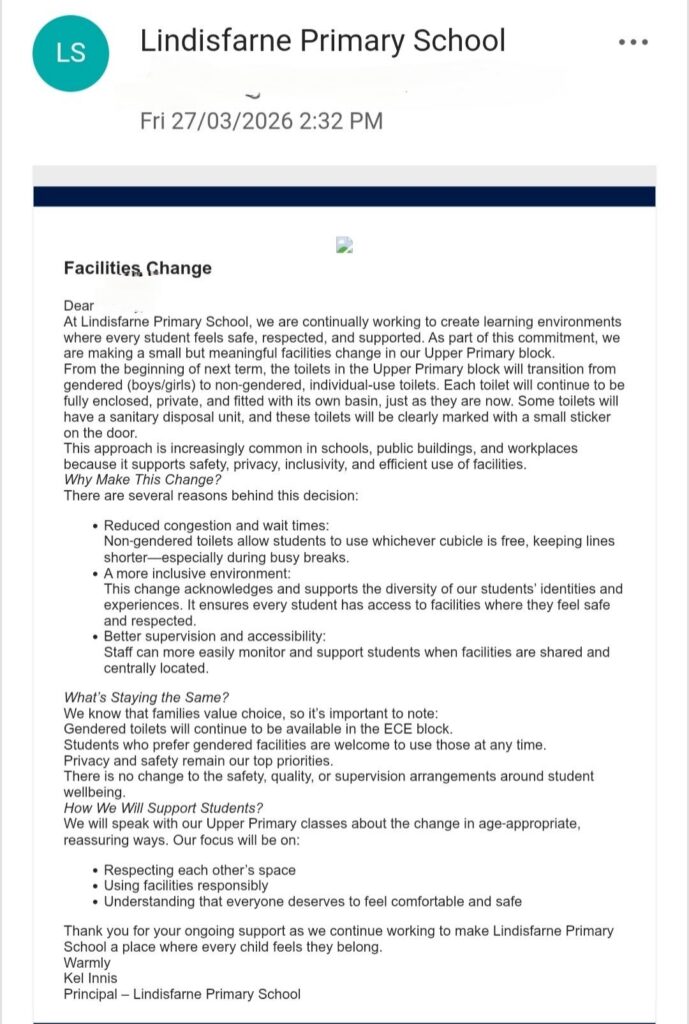
The school letter emphasises reduced congestion, inclusivity, and better supervision. It reassures parents that gendered toilets remain in the ECE block and that privacy and safety are top priorities.
But evidence from the UK and elsewhere shows what happens when single-sex options disappear:
- Girls stop using the toilets altogether rather than share with boys. They hold their urine all day, skip drinking, or miss school.
- This leads to urinary tract infections (UTIs), bladder issues, and long-term health problems. UK politicians (including Kemi Badenoch in 2024) and doctors have publicly linked gender-neutral school toilets to increased UTIs in girls.
- Studies (e.g., Avon Longitudinal Study) confirm that poor school toilet environments and bullying are directly associated with lower urinary tract symptoms in adolescent girls.
- The historical term “urinary leash” — once describing how lack of public toilets kept Victorian women tied to the home — is now being revived. Today it describes how lack of safe single-sex facilities keeps modern girls and women from fully participating in public life, sport, and education.
Critics argue schools should carefully monitor the impact of such policies and remain open to reviewing arrangements if student wellbeing concerns emerge.
The Psychological and Social Dimension
Much of the public discussion around all-gender facilities focuses heavily on physical design, compliance standards, and architectural layouts.
But many women argue the debate also involves psychological and social realities that are harder to quantify.
Some women and girls report feeling more vulnerable in mixed intimate spaces. Some men express discomfort about entering spaces traditionally separated by sex. Sporting groups may also lose aspects of the privacy and social bonding historically associated with single-sex changerooms.
Critics argue these concerns are too often dismissed as irrational or outdated rather than treated as legitimate aspects of human behaviour and social interaction.
Inclusion Should Not Mean Replacement
Women Speak Tasmania supports the availability of additional all-gender or family facilities for people who need them, including transgender individuals, parents with young children, and some disabled users.
However, many women object when all-gender facilities replace rather than supplement single-sex spaces.
Critics argue that genuine inclusion should involve accommodating diverse needs without removing longstanding safeguards relating to privacy, dignity, and safety for women and girls.
Women fought for decades to secure access to appropriate public facilities. Many Tasmanians are now asking why those hard-won protections appear to be quietly disappearing from new public infrastructure projects.
What You Can Do
- Contact local councillors, the Mayor, and relevant ministers to express your views.
- Request a review of the Northern Hub facilities and consideration of additional female-only and male-only spaces.
- Ask for transparent reporting of any safety or privacy incidents.
- Share community concerns respectfully and constructively.
- Support ongoing public discussion about balancing inclusion, accessibility, and sex-based protections.
Women’s safety and privacy are not optional. Single-sex toilets and changerooms are a basic safeguard that benefits everyone — women, girls, men, and boys. It is time Launceston listened.