Introduction
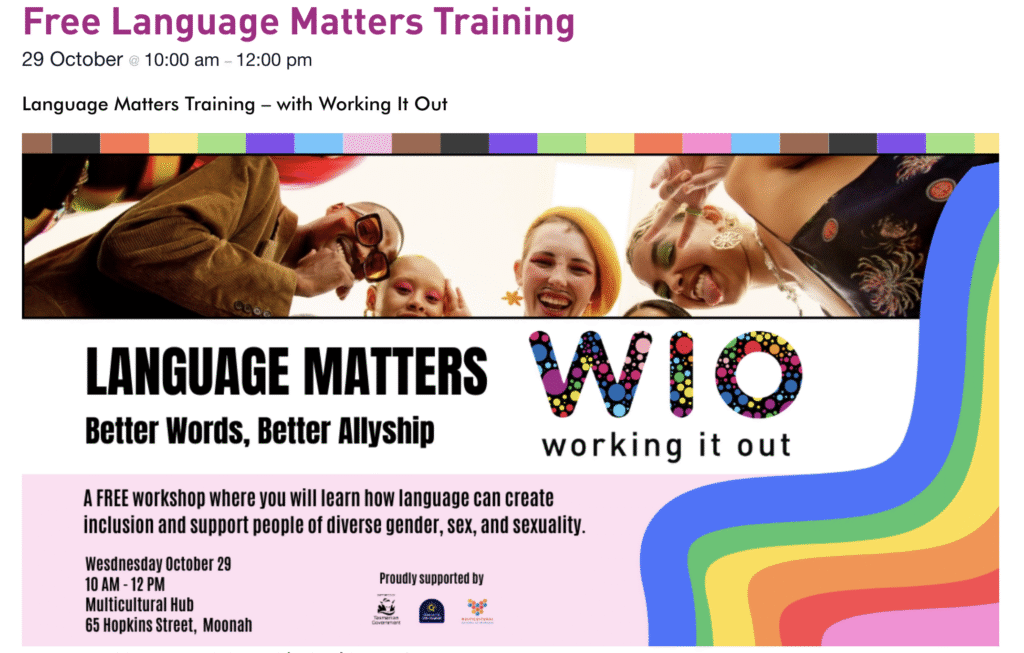
The following is an account by Emma Clarke of a Tasmanian Government-funded session run by Working It Out (WIO), titled “Language Matters”. The session was aimed at parents and focused on inclusive language, LGBTQIA+ terminology, and gender identity. Clarke attended to observe the session and provides a detailed account of her experience, raising concerns about the content and approach.
Emma Clarke’s Account:
Working it Out (WIO) describes itself as Tasmania’s only dedicated LGBTIQ+ support, advocacy and education service. WIO receives government funding to run a number of activities, including training on “inclusive language”. I went along to one of these training sessions, and this article outlines my experience:
The training session was on a weekday in the morning, which meant it was difficult for people working 9–5 jobs to attend. There were 14 people in attendance, including me, and the audience looked to be 100 per cent female. Specifically, attendees were overwhelmingly young women that looked to be in their twenties.
The presenter was a woman with short hair and wearing comfortable clothes, and at one point she mentioned she was a lesbian. The training commenced with the usual irresponsible talk of the high rates of suicide for LGBTQIA+ youth based on dodgy statistics. The presenter said WIO had been running its services for a long time, and at the start it was overwhelmingly ‘binary’ lesbians and gay men coming in for support, but that now it had completely flipped and the TQ part of the acronym dominated.
We then had a very lengthy run-through of the LGBTQIA+ acronym, which is worth going through in detail:
- L for lesbian: defined by WIO as a woman sexually or romantically attracted to other women.
- G is for gay: usually refers to men sexually or romantically attracted to other men, but women can use the term too. For gay and lesbian, no definition of women and men were given, and there was no mention of same-sex attraction.
- B is for bisexual: this is the letter where things start to go a bit pear-shaped. The presenter mentioned that the bi usually meant a binary situation, attracted to both. But we have pansexual now, which means attraction to all genders, and basically means the same thing as bisexual. So bisexual somehow no longer means attraction to both sexes.
- Trans: someone whose gender identity is different to the gender they were assigned at birth. This is where the misinformation really ramped up, with the presenter talking about how when babies are born, the medical professionals take a look at your body and assign a gender identity (they’re not even assigning a sex now!). But children will know between the ages of 2–4 if that ‘assignment’ was right or wrong and whether or not they are born in the wrong body. Any parent would know this is all nonsense, and that instead sex is observed and recorded at birth (almost always confirming the sex observed in utero), and that pre-schoolers are starting to understand the difference between male and female bodies and which one they have, but that is not evidence of a gender identity. The presenter also said that everyone has a gender identity, and if you are not trans then you are cis, and we should be using cis for all non-trans people, even if they don’t like it. The presenter inferred the opposition to cis was just ignorance, and there was no legitimate reason to oppose it.
- Q is for queer/questioning: the presenter talked about using queer as a way of avoiding the unwieldy acronym, or for those who don’t want to label themselves too restrictively.
- I is for intersex: lots of misinformation in this section. The presenter said intersex conditions are quite common and babies are born at the Royal Hobart Hospital all the time with ambiguous genitalia – these cases are actually incredibly rare. While there is a genuine issue of operations on non-consenting minors, this does not occur for the overwhelming number of people with what are more actually referred to as DSDs. It also seems that the I is in the acronym not because these people with specific medical conditions belong in the rainbow community, but rather to give cover to the ‘sex is a spectrum’ myth.
- A is for asexual: those that aren’t attracted to other people sexually and/or romantically. It is still incredibly unclear what, if any, discrimination such people might encounter. The presenter talked about expectations that you will hook up with others or find a long-term partner, which really does seem like drawing a long bow in regards to societal oppression.
- + is for…whatever you want: non-binary, pansexual, anything not captured by the increasingly large number of letters that preceded the plus.
Getting through the acronym took a full hour, which was half the time allocated for the session. In the second half, the presenter went through some scenarios, such as your homophobic uncle victim-blaming you for getting bullied, and a woman setting boundaries by refusing to go into the toilet when a male is in there. One of these things is not like the other. Once again, women’s desires for single-sex spaces and services was depicted as a situation where she had baseless fears, and an audience member helpfully pointed out that ‘she just needed to be educated’ so she could understand how wrong and harmful her views were. It was insultingly condescending and patronising, and even more disappointing that this was coming from other women.
We then got to watch a video from ACON (an even more well-resourced LGBTQIA+ organisation based in NSW) on the importance of pronouns. Interestingly, the video stated each speaker’s sex, although it was unnecessary as you could tell which was which with ease. Then there were some more quotes about how much it hurt to be misgendered, from feeling like you were getting a thousand papercuts a day to practically killing you. All focused on how the trans-identified person feels, and nothing about compelled speech or a wholesale and radical changing of how the English language works.
We then finished with a brief overview of anti-discrimination laws, pointing out that Tasmanian law protects you from discrimination on the grounds of gender and sexuality. The presenter made a slip and suggested that this law protects you from sexism, which is clearly not true, as sex isn’t a protected characteristic in the Tasmanian law. She also had the gall to talk about changing social norms, and that back a few decades ago it was legal to fire women when they got married or were pregnant. That was clearly a case of sex discrimination, and the reason our federal Sex Discrimination Act was enacted in the first place. But in our brave new world where gender identity is all-important and sex is irrelevant, we don’t need to worry about discrimination against AFABs (assigned female at birth).
The session ended with a reassurance that if you knew someone who had missed out on the session, that WIO would be running some more. It has funding from the Tasmanian Department of Premier and Cabinet to run these sessions. So, the taxpayers of Tasmania pay for WIO to spread misinformation about gender identity at a time when the Tasmanian state budget is in crisis.
In Conclusion
This account underscores the urgent need for open, informed debate about gender identity policies and single-sex rights in Tasmania. Tasmanian taxpayers are funding sessions in which young people are led through ideological frameworks that sideline biological sex and challenge freedom of speech.
At Women Speak Tasmania, we believe the public deserves better. It’s time for transparency, accountability, and the space to ask real questions. Together, we’re standing up for women’s voices — because when discussion is silenced, democracy suffers.