In recent months, a debate has emerged in Tasmania about what primary-school children are being taught regarding bodies, relationships, and gender. At the centre of the discussion is the state’s “Growing Up Program” (GUP), a relationships and protective-behaviours curriculum delivered in many primary schools. The issue gained wider attention after One Nation Senator Pauline Hanson publicly described an experience involving her family and raised broader questions about parental knowledge and consent.
Women Speak Tasmania has been raising concerns about this program, our focus is not on excluding or marginalising any child, but on whether lessons involving sensitive concepts are age-appropriate, transparent to parents, and consistent with biological teaching.
A Parent’s Account
The latest controversy began in mid-2025 when Lee Hanson, a Tasmanian resident and mother of two primary-school children, contacted her child’s school following a classroom session. According to her account, her seven-year-old son came home asking unexpected questions about male and female bodies and about whether people could choose to be a boy or a girl.
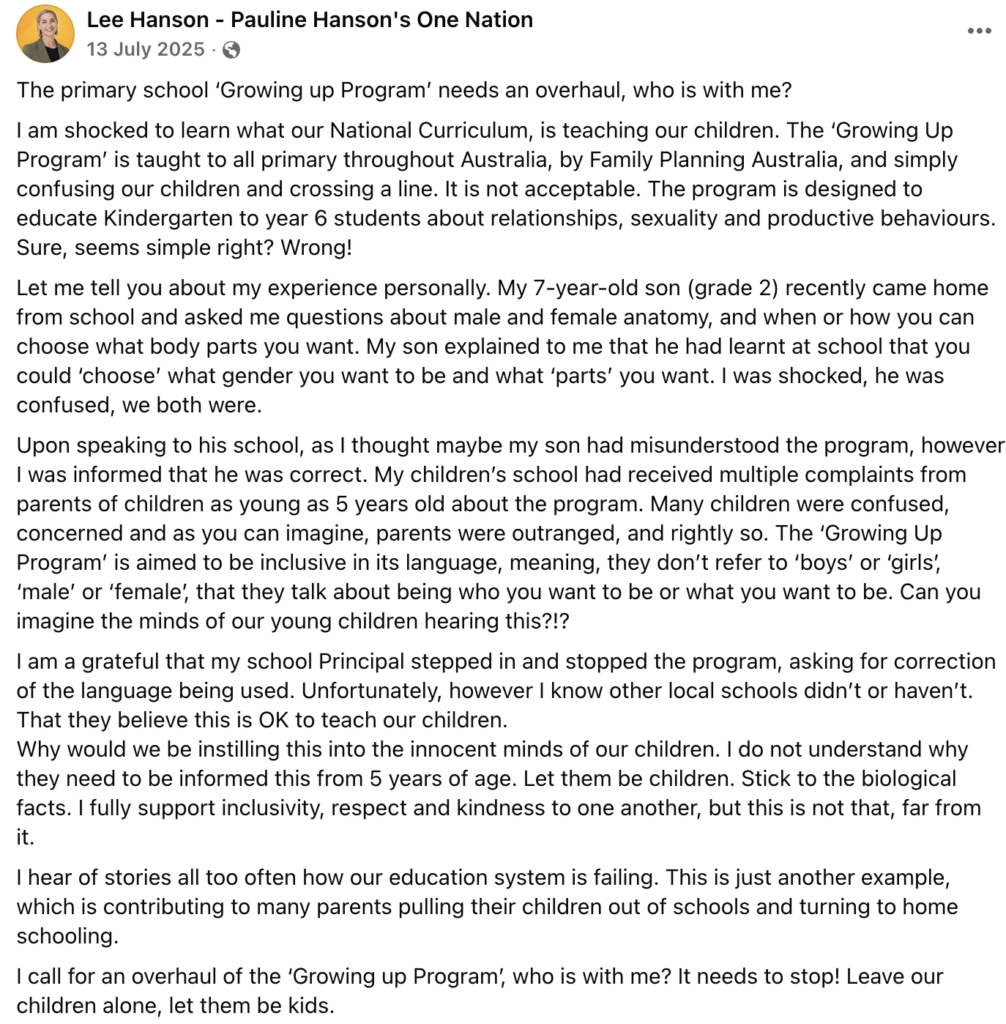
Lee Hanson says she sought clarification from the school and was informed the lesson formed part of a scheduled program. She later described feeling surprised and concerned by both the content and the lack of prior detail provided to parents. She also reported that other parents had contacted the school with similar questions.
Senator Pauline Hanson raised the matter in the Senate, arguing the lesson reflected a broader shift in classroom teaching about sex and gender. Her speech brought national attention to what had previously been a local school matter and sparked widespread public discussion.
Public Reaction
Reactions were strongly divided. Some parents expressed support, saying they too wanted clearer notice and the ability to opt out of sensitive material. Others argued such programs help children understand personal safety, prevent bullying, and support students who feel different from their peers.
The dispute quickly moved beyond one family’s experience and became part of a wider conversation about parental authority, school responsibilities, and how early complex social topics should be introduced.
What Is the Growing Up Program?
The Growing Up Program is Tasmania’s primary-school relationships and protective-behaviours curriculum. It is delivered by organisations including Family Planning Tasmania and Working It Out and is partly government funded. The program covers:
- body safety and personal boundaries
- respectful relationships
- early puberty education (from later primary years)
- inclusion and anti-bullying messages
Supporters say the program helps children identify unsafe situations, reduces bullying, and creates respectful school environments. Education authorities also state it aligns with the Australian Curriculum’s health and physical education framework.
However, concerns raised by parents and advocacy groups focus on language and presentation. The program uses inclusive terminology — for example describing “people with a penis” or “people with a vulva” rather than strictly “boys” and “girls.” It also introduces the idea that some individuals may feel different from their sex assigned at birth.
Critics argue these concepts may be confusing for younger children and that parents should be fully informed beforehand. They also question whether all material is suitable for early primary school students.
Transparency and Consent
The central issue emerging from this debate is not simply curriculum content but process. Many parents say they were not provided detailed lesson materials in advance and did not realise discussions about gender identity might occur in early primary years.
Women Speak Tasmania believes schools should:
- provide clear outlines of lesson content before delivery
- allow parents to review teaching materials
- offer straightforward opt-out arrangements for sensitive topics
Greater transparency, in our view, supports cooperation between families and schools and prevents misunderstandings.
A Broader Question
This discussion reflects a wider societal question: what is the appropriate balance between school-based education and parental responsibility? Schools have a duty to protect children and promote respectful behaviour, but parents also expect involvement in decisions affecting their child’s development and wellbeing.
Regardless of differing views about gender identity, many families agree that communication between schools and parents should be strengthened.
Moving Forward
We encourage respectful dialogue rather than hostility. The goal should be clarity, not conflict. Parents, educators, and policymakers all share an interest in children’s wellbeing and education.
We also encourage families to speak directly with their schools and the Department of Education to obtain curriculum information and discuss concerns.
Children learn best when families and schools work together. Clear communication, transparency, and age-appropriate teaching can help rebuild trust and ensure confidence in the education system.