In 2018, several Tasmanian women’s organisations publicly criticised Women Speak Tasmania (WST) for warning that proposed amendments to the Justice and Related Legislation (Marriage Amendments) Bill 2018—which introduced sex self-identification into Tasmanian law—would erode women’s rights and compromise safeguarding.
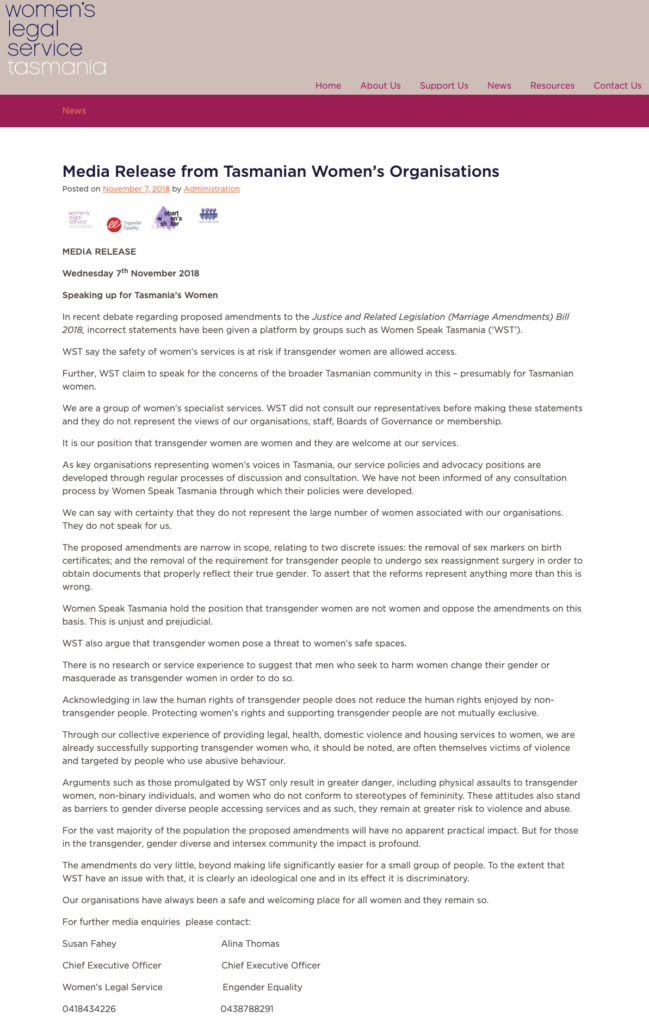
At the time, these organisations dismissed our concerns as “ideological” and “discriminatory,” insisting that recognising gender identity in law would have no negative impact on women or the wider community.
Seven years on, WST has compiled a comprehensive evidence file, the Dossier on the Impacts of Tasmania’s Sex Self-ID Laws on Women, Girls, Families, and LGB People. The evidence demonstrates that the consequences we cautioned against are now an undeniable reality.
Key Impacts of Sex Self-ID in Tasmania
- Erosion of Women’s Spaces and Services: Female-only spaces—refuges, sports, changing rooms, and prisons—have been opened to males who self-identify as women, undermining privacy, fairness, and safety.
- Suppression of Women’s Speech: Women who raise legitimate concerns about the impacts of self-ID have faced vilification, professional risk, and legal threats under anti-discrimination law.
- Damage to Safeguarding: Schools and community services have been pressured to prioritise gender identity ideology over child safeguarding principles, compromising protections for vulnerable girls and young people.
- Impacts on LGB People: Young people, particularly same-sex attracted girls, are being encouraged down irreversible medical pathways rather than supported in their identities.
- Loss of Sex-Based Data: With sex conflated with gender identity in official records, policymakers and researchers are unable to accurately assess sex-based inequalities, including in health, crime, and domestic violence.
Why the 2018 Claims Were Wrong
The 2018 media release by Tasmanian women’s organisations argued that:
- “Transgender women are women.”
- “There is no research or service experience to suggest that men who seek to harm women change their gender or masquerade as transgender women.”
- “Protecting women’s rights and supporting transgender people are not mutually exclusive.”
In hindsight, these assurances were not supported by evidence and have failed to account for the real-world consequences. Women’s services have in fact been placed in impossible positions, forced to either compromise their safeguarding responsibilities or face legal challenge. Far from being “narrow in scope,” the amendments have reshaped the legal and social framework of Tasmania in ways that profoundly undermine sex-based rights.
Our Position Today
Women Speak Tasmania was correct in 2018 to warn of these risks. We reiterate today:
- Sex matters. Women and girls require sex-based protections in law and policy.
- Safeguarding principles cannot be replaced by ideology.
- True inclusivity means recognising the rights of all, without erasing the hard-won rights of women and girls.
The Tasmanian Parliament must now revisit the consequences of sex self-ID and ensure that the rights, safety, and dignity of women and girls are fully restored in law.