
Recently, concerned educators and parents have raised alarms about the content of the Respectful Relationships Education (RRE) Years 11–12 document. While its stated aim is to prevent domestic violence and promote healthy relationships, the material contains highly sensitive content on sexuality, violent behaviours, and pornography that may in fact undermine safeguarding principles.
Troubling Teaching Methods
The booklet encourages teaching strategies such as role play, peer discussion, and the reading or hearing of true stories of sexual abuse. On pages 35–36, for example, students are instructed to:
“Arrange themselves in groups and role-play the discussion that could take place between Max and Sam as they decide whether they both want to have sex. Ask volunteers to swap roles to demonstrate different courses of action for each character.”
One teacher commented:
“During these role plays, students are left on their own with no oversight or guidance regarding discussions, outcomes, or definitions. With trauma-informed practice now guiding classrooms, how can teachers possibly safeguard students when they are broken into small groups out of sight, without the ability to provide trigger warnings, interruptions, or follow-ups? These activities are unethical and undermine safeguarding.”
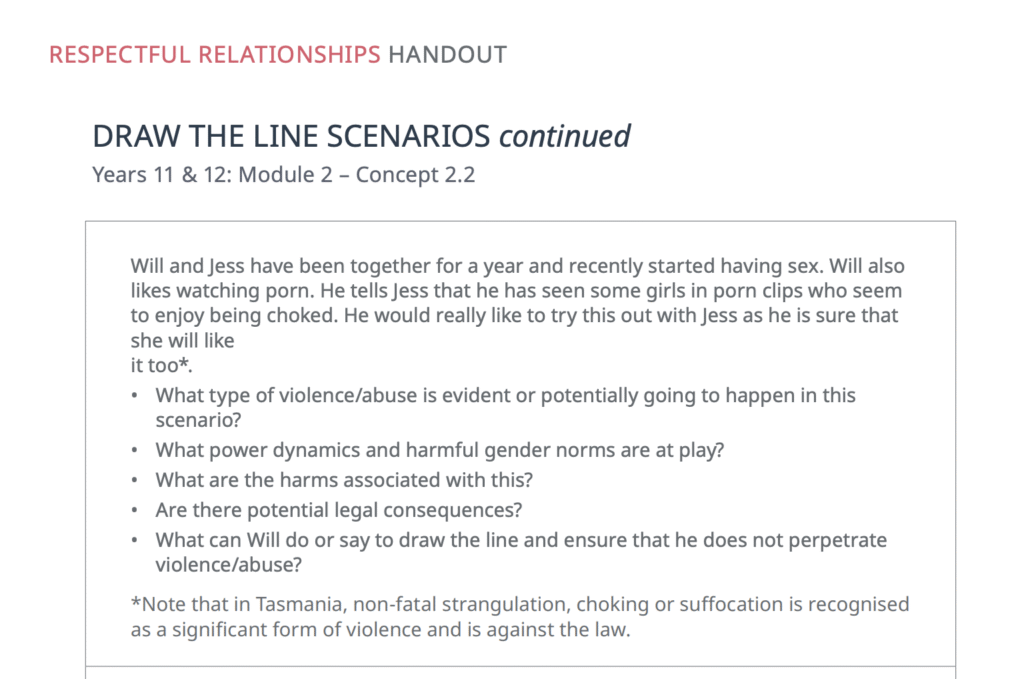
At the back of the booklet, a handout called Draw the Line Scenario even includes mention of strangulation during sex—material that many teachers and parents believe is wholly inappropriate for a classroom setting.
Safeguarding Concerns
How can teachers ethically navigate such discussions, especially without knowing if students in their care are survivors of sexual assault, or if they come from cultural or religious backgrounds where such topics may cause deep distress? The risk of re-traumatising students is clear, yet the program does not provide adequate safeguarding strategies.
The concerns are not confined to Years 11–12. In the RRE Years 7–10 resource, page 74 directs students to the website The Line, which contains articles such as “How much do you know about porn?” and “Sex miseducation: Is porn bad for you?”

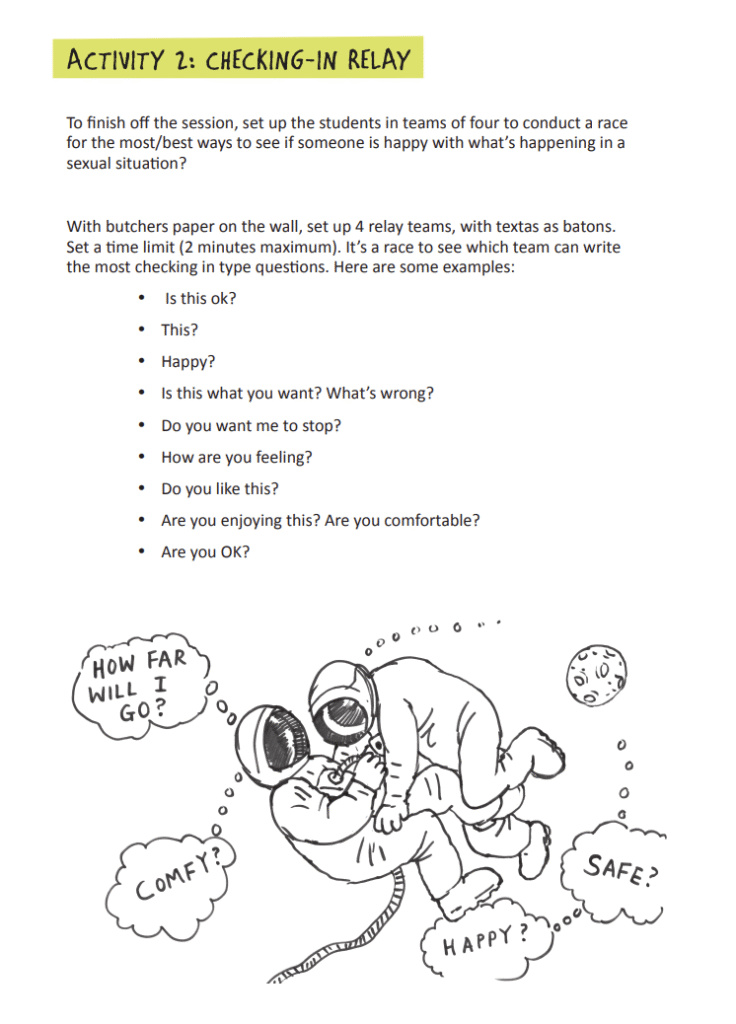
Another example is “Source Activity 2: Checking in Relay – Love, Sex and Relationships.” Here, students are asked to practice sexual dialogue in role-play scenarios—such as a “waiter offering food choices” or in a relay race.
One parent summed it up:
“Why does the Tasmanian Education Department entangle the worthy goal of preventing violence with activities that border on sexual grooming? Why are children as young as 14 being directed to inappropriate content on pornography?”
The Impact of Pornography on Young People
It is a well-documented fact that the human brain does not fully develop its prefrontal cortex—the area responsible for impulse control and decision-making—until around age 25. Early exposure to pornography has been shown to reduce grey matter in this part of the brain, impairing self-control and decision-making, and increasing vulnerability to addictive behaviours.
Research supports these concerns. The Australian Institute of Family Studies report The Effects of Pornography on Children and Young People concluded that:
- “Pornography may strengthen attitudes supportive of sexual violence and violence against women.”
- “Pornography use can shape sexual practices and is associated with unsafe sexual health practices such as not using condoms and unsafe anal and vaginal sex.”
Conclusion
It is commendable that the Department for Education, Children and Young People is attempting to tackle domestic violence and sexual assault among young people. However, in doing so, it appears to have overstepped safe boundaries and placed both students and teachers in untenable positions.
Role plays involving sexual negotiation, exposure to porn-related content, and discussions of violent sexual practices are not appropriate for the classroom. They risk retraumatising survivors, confusing vulnerable students, and exposing children to material well beyond their developmental stage.
If the goal is to protect children and reduce harm, then safeguarding must come first.
References:
https://aifs.gov.au/research/research-reports/effects-pornography-children-and-young-people
https://www.ncbi.nlm.nih.gov/pmc/articles/PMC10015350
https://www.sciencedirect.com/topics/medicine-and-dentistry/prefrontal-cortex