
In 2019, Hobart City Council debated whether to display posters in public toilets supporting trans and gender-diverse people.
The initiative was introduced by Councillor Holly Ewin in May 2019. Cr Ewin argued that displaying posters would show solidarity with Hobart’s queer community at a time of heightened debate over gender, birth certificates, and marriage law reforms. Mock-up designs were circulated with lighthearted messages such as: “Do you think someone is using the wrong bathroom? Here’s what you can do: go about your business, respect them and their identity.”
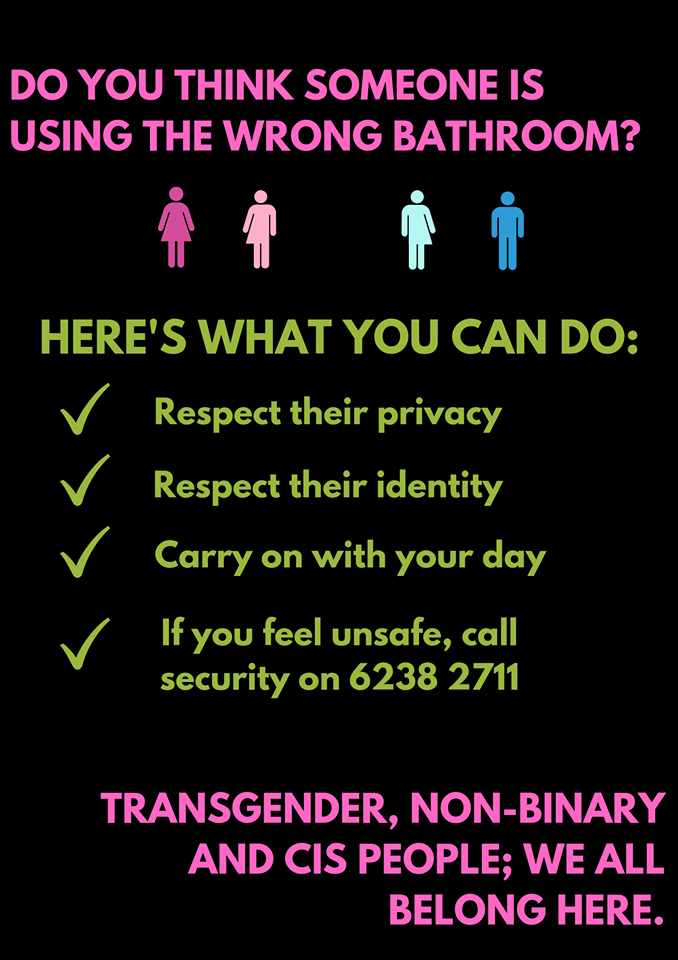
Supporters of the proposal highlighted the discrimination, harassment, and violence faced by trans and gender-diverse people, noting the importance of fostering inclusivity and safety in public spaces.
Council Debate and Amendments
The Parks and Recreation Committee first considered the proposal on 6 June 2019. Members of Women Speak Tasmania (WST) and their supporters attended, calling for public consultation and inclusion of women’s groups in the design process. The Committee resolved to defer the decision until the full Council meeting on 17 June.
At the June meeting, the Council passed an amended motion. Instead of permanent posters, the signs would be installed temporarily as part of an annual program. The final motion also required that the design process include consultation with Working It Out, Transforming Tasmania, and Women Speak Tasmania.
This amendment drew controversy. Some councillors, along with activists such as Rodney Croome, opposed WST’s involvement, arguing that the group had previously expressed views critical of trans inclusion. Others supported their involvement on the basis of balance and community representation.
Community Perspectives
- Supporters of the posters, including Cr Ewin, argued that the Council had a responsibility to provide visible support for the queer community and to promote safe and inclusive public facilities.
- Critics, including WST, raised concerns about women’s rights and single-sex facilities, arguing that women should have input into decisions about signage that might affect their access and sense of safety. They also suggested that investment in dedicated unisex facilities would be a better solution.
WST also highlighted the specific needs of women in public toilets, such as menstruation, pregnancy, childcare, and the need for privacy and security, particularly for survivors of harassment or assault.
Outcome
After several weeks of debate, the Council resolved that the posters would not be permanent but instead rotated annually as part of a broader diversity program.
Ultimately, the posters were installed only on a temporary basis. No record has since been found of a permanent rollout.
Conclusion
The debate over Hobart’s gender-inclusive toilet posters illustrates the challenges local councils face when navigating competing rights and perspectives. While the initiative aimed to promote inclusion for gender-diverse people, it also highlighted concerns about consultation, women’s safety, and the balance of representation in decision-making. The final compromise—temporary posters with shared input—was a reflection of these tensions.