
On 5 September 2019, the day Tasmania’s self-identification laws came into effect, ABC Radio Hobart’s Mornings program featured an interview between host Leon Compton and Roen Meijers, one of the first four people to amend their birth certificate. The discussion centred on personal experiences and celebrations at the Rosny Births, Deaths and Marriages office, including cupcakes and champagne.
Emphasis on Personal Experience
The segment framed the reforms primarily as a story of individual affirmation and social progress. Meijers highlighted Tasmania’s pioneering status:
“Tasmania is the first place in the world where we have the full package. We have everything, and we have the world’s best anti-discrimination legislation.”
This personal narrative was compelling but overshadowed broader policy analysis.
Discussion of Concerns and Opposition
Host Leon Compton briefly acknowledged criticisms and warnings of unintended consequences. Meijers responded that concerns were unfounded, citing the small initial number of applicants and minimal impact on others.
However, the interview did not substantively explore key issues raised during parliamentary debates, such as implications for sex-based rights, accurate data collection on biological sex, women’s single-sex services and spaces, sports fairness, or statistical integrity. Critics’ perspectives received little airtime.
Explaining “Non-Binary” and the Scope of Changes
When asked about non-binary identity, Meijers described gender as a spectrum and emphasised acceptance over understanding:
“I think the first important thing to know is that you don’t have to understand it, you just have to accept it.”
This explanation aligns with the legislation’s gender-identity framework but leaves critical questions unaddressed. The reforms allow individuals to self-declare their gender (including non-binary markers) via statutory declaration, without medical or surgical requirements, and permit the complete removal of gender markers from birth certificates.
This represents a substantial departure from recording immutable biological sex — a foundational element in many areas of law and policy affecting women’s rights, safeguarding, and data collection. Alternative views, such as those distinguishing biological sex from gender identity or advocating for sex-based legal categories to protect single-sex provisions, were not presented.
Was This Balanced Media Framing?
As public broadcaster content on a significant legislative change, the interview leaned heavily into human-interest storytelling while providing limited investigative scrutiny or viewpoint diversity. Supporters may see it as appropriately celebratory; however, from the perspective of women’s sex-based rights organisations like Women Speak Tasmania — which were not invited to contribute — it exemplifies sympathetic framing that sidelined legitimate concerns about impacts on female-only spaces, services, and rights grounded in biological sex.
This pattern in early coverage prioritised individual stories of inclusion over rigorous examination of longer-term legal, social, and policy consequences. Such one-sided presentation risks undermining public understanding and informed debate on reforms that affect the entire community, particularly women and girls.
WST will continue to advocate for evidence-based policy, transparency, and the primacy of biological sex in law where it matters for fairness, safety, and privacy. Comprehensive media coverage that includes sex-based rights perspectives is essential for democratic accountability.
Source: ABC Hobart Tasmania Mornings with Leon Compton 05.09.19
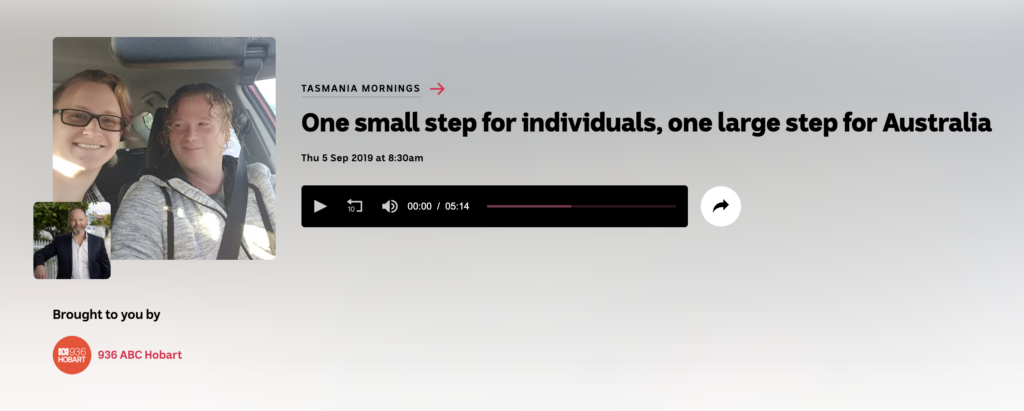
Transcript: Roen Meijers Interview on ABC Hobart Tasmania Mornings
Interviewer: Leon Compton
Guest: Roen Meijers
Date: 05 September 2019
Duration: ~5 minutes
Roen Meijers: We’re heading over to the Births, Deaths and Marriages registry over in Rosny. And we’re really excited about it.
Leon Compton: Roen, tell me what’s going to happen this morning.
Roen Meijers: So, four of us today are going to finally get to change our birth certificates to reflect who we really are. But because this is such a historic day — not just in Australian law, but international law — we’re having a bit of a party as well. Cupcakes and bubbly, and everyone who’s available is getting together to celebrate.
Leon Compton: You talk about the significance of this in national and international law. How significant is it, Roen?
Roen Meijers: There are other countries in the world that have given people the option of putting anything they like as their gender on their birth certificate, and there are other countries that don’t necessarily force you to have gender on your birth certificate. But Tasmania is the first place in the world where we have the full package. We have everything, and we have the world’s best anti-discrimination legislation. That’s the significance nationally and internationally.
Leon Compton: Let’s talk about how significant it is for you personally, Roen. How long has the journey been to fight for the legislation that’ll allow today to be possible?
Roen Meijers: If you look at Martine Delaney, she’s been fighting publicly for this for 15 years or more. The actual formal campaign for this specific reform, we started up in June last year. So it’s been a bit of a marathon for us.
Leon Compton: And talk about what it will mean for you personally. You’ve felt misgendered all of your life. What is that like?
Roen Meijers: Yeah. So for me personally — it’s different for everyone — but for me personally, it was just this pervasive sense of something being wrong. I didn’t understand what it was. I didn’t know what it was. But without that language to describe it, and without that validation, I felt like I was the one that was wrong. And today is the recognition that finally, I’m not the one that’s wrong. There’s nothing wrong with me. And this is a government and our society acknowledging that I’m fine. And that’s so meaningful for me.
Leon Compton: What is the change that you’re going to make to your birth certificate, Roen?
Roen Meijers: So I’m changing my birth certificate so that it says my gender is non-binary. I did have the option of changing it so that my gender just wasn’t there, which would technically be a bit safer for me. But I wanted to be visible. I wanted to make the point that this is a thing, that’s okay. And if that’s who you are, then that’s fine.
Leon Compton: What does non-binary actually mean? Can you explain this to the great many Tasmanians that will sort of never come into personal contact, never have a chance to meet you or someone experiencing what you’re experiencing?
Roen Meijers: Yeah, I think the first important thing to know is that you don’t have to understand it, you just have to accept it, because fundamentally it’s really tricky to understand if it’s not you. But the really simple way of putting it is that if you look at the world as a bit of a spectrum — nothing is simple, nothing is black and white, and neither is gender. Most people are female or male, most people, but some people aren’t entirely one or the other. Some people are somewhere in the middle. There are millions of ways to be somewhere in the middle. And for me, it means yeah, somewhere in the middle, a little bit left of centre.
Leon Compton: And so how will life change for you, officially recognised as non-binary with that mark on your birth certificate?
Roen Meijers: It means that I’m never gonna have to argue with a system again to prove that I am who I am. I can just show them my birth certificate and say, “Listen, look, there’s the proof. You can’t tell me that this isn’t who I am.” I’m very lucky because my family is supportive, my partner is supportive, my workplace is supportive. So for me, functionally not that much will change day to day. But for people who don’t have that privilege, it will be life-changing.
Leon Compton: It’s been opposed by the Tasmanian government at every step of the way, the legislation that you’ll be using a little later this morning. There are those in the community that regard this as controversial and warn of unintended consequences. What is your response to that?
Roen Meijers: My response to that would be to point out that this is the very first day it’s possible. You would expect an enormous rush, but there’s four people. And those four people aren’t going to go on and hurt anyone. They’re not going to go out and become predators or change the world or anything fundamentally. We’re just going to be a bit happy about ourselves. And there are so few of us, comparatively. These ideas about unintended consequences — they’re needless fear-mongering over what really doesn’t affect anyone but us. No one else will be impacted by me changing my birth certificate but me.