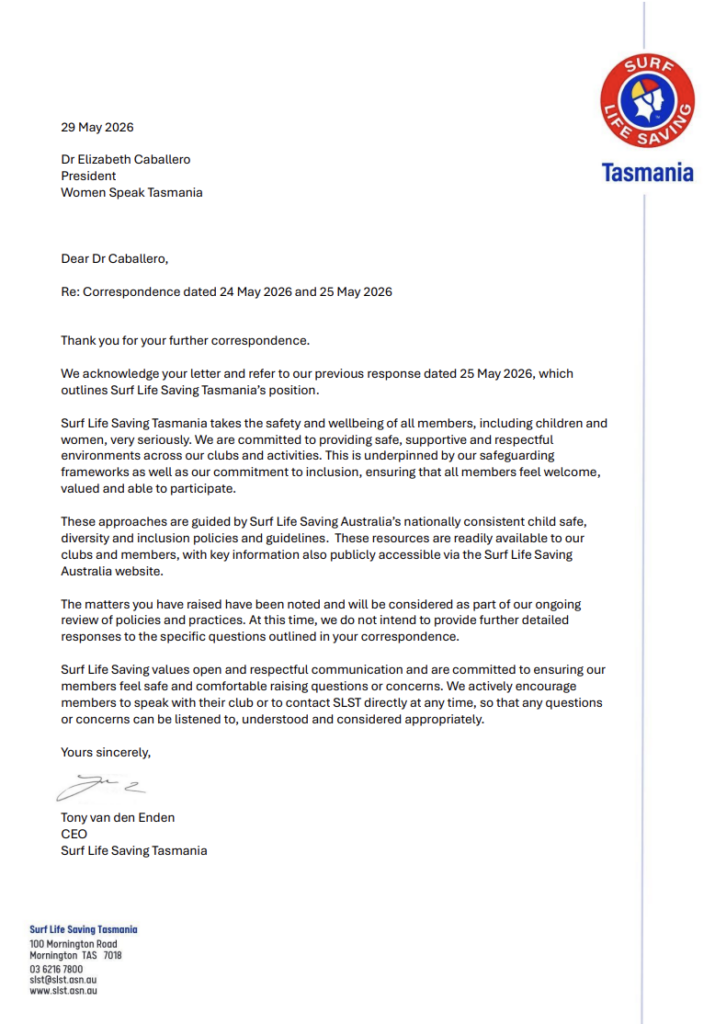
Letter sent to the Board of Directors of Surf Life Saving Tasmania on 24.05.26
Dear Members of the Board,
Re: Duty of Care and Safeguards for Women and Girls in Surf Life Saving Tasmania – Implications of the IRB Training for Women in Lifesaving Program
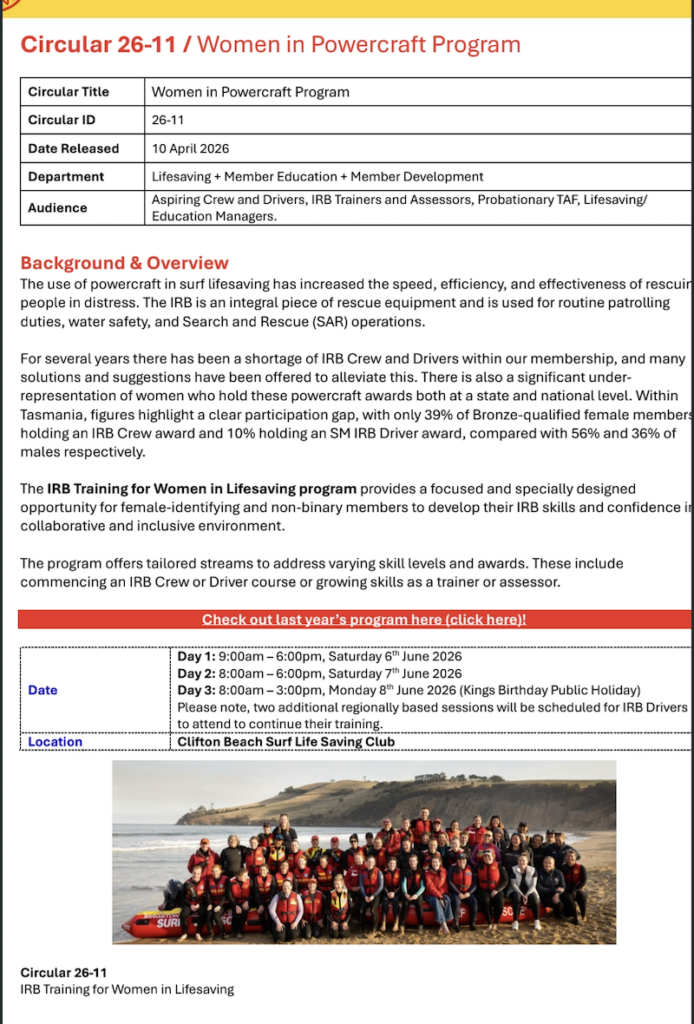
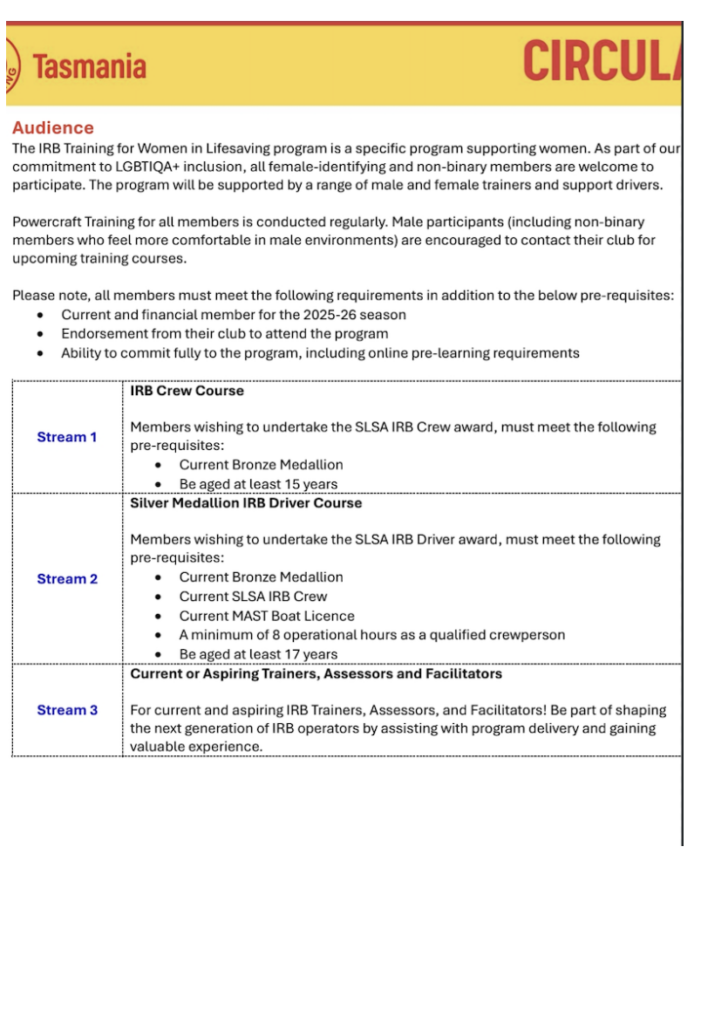
Women Speak Tasmania writes regarding concerns raised by female members of Surf Life Saving Tasmania about recent communications and programs, including the IRB Training for Women in Lifesaving Program (Circular 26-11). We note and support the legitimate questions previously raised with the Board by Lee Hanson on 20 April 2026.
Our primary focus is the legal duty of care owed by Surf Life Saving Tasmania to its female members, young girls, and children, particularly in relation to safety, privacy, dignity, and safeguarding expectations in single-sex spaces and physically demanding activities.
Surf Life Saving organisations operate under a duty of care to protect participants from foreseeable risks to their safety and wellbeing. This sits alongside obligations under the Sex Discrimination Act 1984 (Cth), which includes protections against discrimination on the basis of sex and exemptions permitting single-sex activities and facilities in certain circumstances, including where strength, stamina, physique, safety, privacy, or competitive fairness may be relevant.
Surf lifesaving activities — particularly IRB (Inflatable Rescue Boat) and powercraft training, operational environments, and associated facilities — may engage these considerations because they involve physically demanding rescue and training activities in variable ocean conditions, may involve shared or sex-segregated changing facilities, and frequently involve children and families through Nipper and community participation programs.
We are concerned that the current framing of the IRB program (which welcomes “female-identifying and non-binary members”) may create uncertainty about how lawful sex-based provisions and safeguarding expectations are being interpreted and applied in practice.
In particular, if individuals of the opposite sex are permitted access to women’s changerooms or female-designated training environments, this may raise questions regarding privacy, dignity, safeguarding, and member confidence for female participants.
Accordingly, we respectfully request clear written responses to the following questions:
- How does SLST ensure compliance with its duty of care to female members when implementing gender-identity-inclusive policies in changerooms and other potentially intimate or vulnerable spaces?
- What practical safeguards and policies are in place to maintain single-sex spaces for women and girls where privacy and safety considerations are relevant, consistent with applicable provisions and exemptions under the Sex Discrimination Act 1984?
- How does SLST distinguish between:
- eligibility to participate in female-focused training initiatives;
- access to changing and shower facilities; and
- safeguarding obligations relating to children and vulnerable participants?
- What provisions exist for female members and parents who are uncomfortable with mixed-sex arrangements in changing facilities or training environments, and how will their concerns be accommodated without disadvantage?
- Has Surf Life Saving Tasmania undertaken any formal risk assessment, legal review, safeguarding assessment, or member consultation before implementing this program framework, and if so, will this information be made available to members?
- How will SLST transparently communicate these arrangements and policies to all members to maintain confidence and trust in the organisation?
We believe that encouraging greater female participation in powercraft is a worthwhile objective. However, this should be advanced in a way that preserves lawful sex-based protections, maintains member confidence, and ensures that the privacy, dignity, and safety expectations of women and girls are appropriately considered.
We urge the Board to provide a detailed and timely response to these matters, particularly given the imminent next round of IRB training in early June 2026.
Thank you for your attention. We look forward to your substantive reply within the next 14 days.
Sincerely,
Yours sincerely,
Dr. Elizabeth Caballero
Retired General Practitioner
President, Women Speak Tasmania
Attached: IRB Training for Women in Lifesaving Program (Circular 26-11)
Response from Tony van den Enden, CEO Surf Life Saving Tasmania on 25.05.26
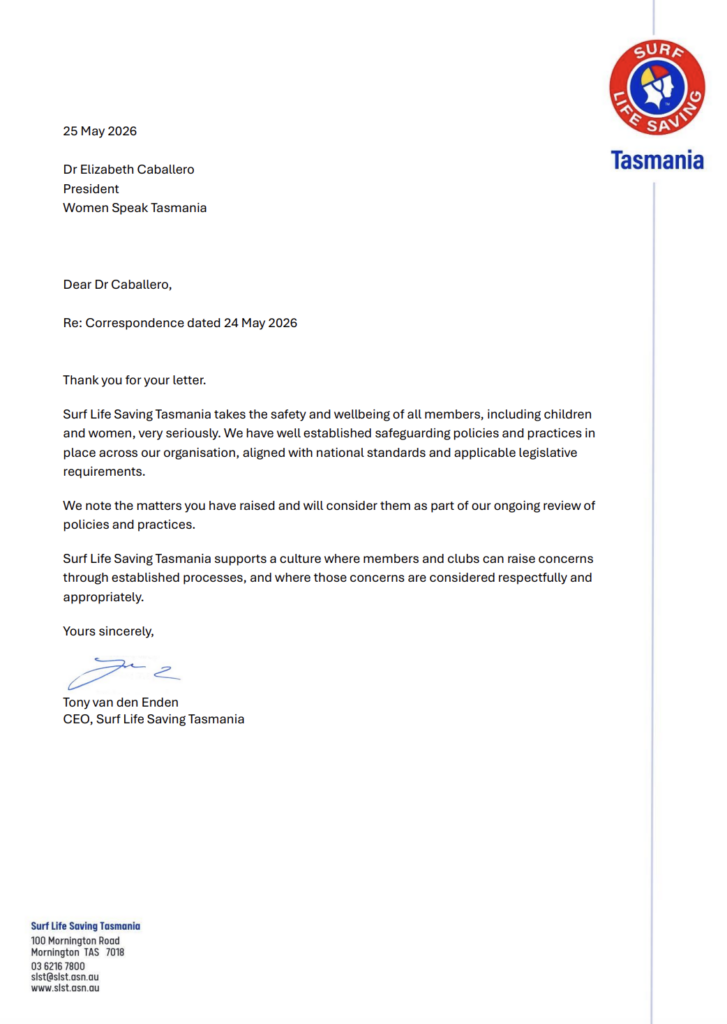
Reply to the CEO and the Board of Directors on 25.05.26
Dear Members of the Board,
Thank you for your reply dated 25 May 2026.
While we note your statement that Surf Life Saving Tasmania takes safety and wellbeing seriously, your response does not address the specific questions raised in our letter of 24 May regarding duty of care, single-sex spaces, changing facilities, and the IRB Training for Women in Lifesaving Program.
For the avoidance of doubt, we respectfully reiterate our request for clear written responses to the following questions by close of business on Friday, 29 May 2026:
- How does SLST ensure compliance with its duty of care to female members when implementing gender-identity-inclusive policies in changerooms and other potentially intimate or vulnerable spaces?
- What practical safeguards and policies are in place to maintain single-sex spaces for women and girls where privacy and safety considerations are relevant, consistent with applicable provisions under the Sex Discrimination Act 1984?
- How does SLST distinguish between eligibility to participate in female-focused training initiatives, access to changing and shower facilities, and safeguarding obligations relating to children and vulnerable participants?
- What provisions exist for female members and parents who are uncomfortable with mixed-sex arrangements in changing facilities or training environments, and how will their concerns be accommodated without disadvantage?
- Has Surf Life Saving Tasmania undertaken any formal risk assessment, legal review, safeguarding assessment, or member consultation before implementing this program framework, and if so, will this information be made available to members?
- How will SLST transparently communicate these arrangements and policies to all members to maintain confidence and trust in the organisation?
Given the imminent IRB training scheduled for early June, we would appreciate your detailed response at your earliest convenience.
Thank you for your attention to this important matter.
Sincerely,
Dr. Elizabeth Caballero
Retired General Practitioner
President | Women Speak Tasmania
Response from Tony van den Enden, CEO Surf Life Saving Tasmania on 29.05.26