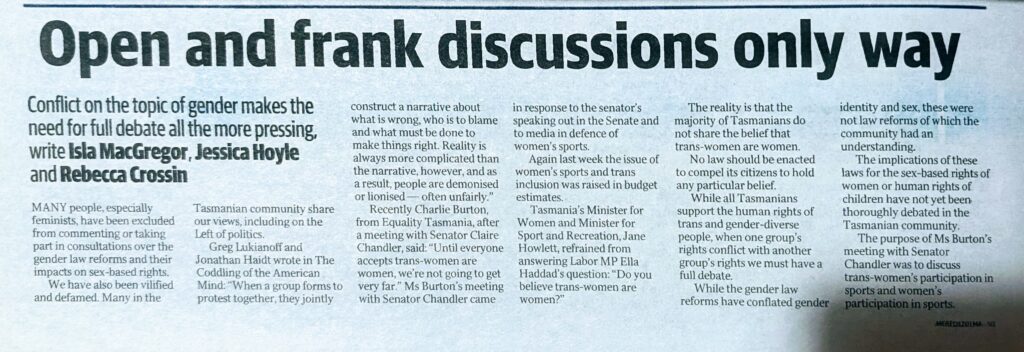
Conflict on the topic of gender makes the need for full debate all the more pressing, write Isla MacGregor, Jessica Hoyle and Rebecca Crossin
MANY people, especially feminists, have been excluded from commenting or taking part in consultations over the gender law reforms and their impacts on sex-based rights.
We have also been vilified and defamed. Many in the Tasmanian community share our views, including on the Left of politics.
Greg Lukianoff and Jonathan Haidt wrote in The Coddling of the American Mind: “When a group forms to protest together, they jointly construct a narrative about what is wrong, who is to blame and what must be done to make things right. Reality is always more complicated than the narrative, however, and as a result, people are demonised or lionised — often unfairly.”
Recently Charlie Burton, from Equality Tasmania, after a meeting with Senator Claire Chandler, said: “Until everyone accepts trans-women are women, we’re not going to get very far.” Ms Burton’s meeting with Senator Chandler came in response to the senator’s speaking out in the Senate and to media in defence of women’s sports.
Again last week the issue of women’s sports and trans inclusion was raised in budget estimates.
Tasmania’s Minister for Women and Minister for Sport and Recreation, Jane Howlett, refrained from answering Labor MP Ella Haddad’s question: “Do you believe trans-women are women?”
The reality is that the majority of Tasmanians do not share the belief that trans-women are women.
No law should be enacted to compel its citizens to hold any particular belief.
While all Tasmanians support the human rights of trans and gender-diverse people, when one group’s rights conflict with another group’s rights we must have a full debate.
While the gender law reforms have conflated gender identity and sex, these were not law reforms of which the community had an understanding.
The implications of these laws for the sex-based rights of women or human rights of children have not yet been thoroughly debated in the Tasmanian community.
The purpose of Ms Burton’s meeting with Senator Chandler was to discuss trans-women’s participation in sports and women’s participation in sports.
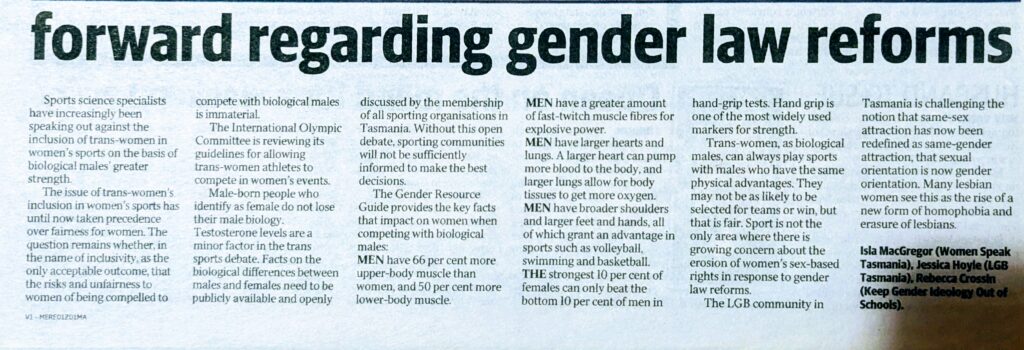
Sports science specialists have increasingly been speaking out against the inclusion of trans-women in women’s sports on the basis of biological males’ greater strength.
The issue of trans-women’s inclusion in women’s sports has until now taken precedence over fairness for women. The question remains whether, in the name of inclusivity, as the only acceptable outcome, that the risks and unfairness to women of being compelled to compete with biological males is immaterial.
The International Olympic Committee is reviewing its guidelines for allowing trans-women athletes to compete in women’s events.
Male-born people who identify as female do not lose their male biology. Testosterone levels are a minor factor in the trans sports debate. Facts on the biological differences between males and females need to be publicly available and openly discussed by the membership of all sporting organisations in Tasmania. Without this open debate, sporting communities will not be sufficiently informed to make the best decisions.
The Gender Resource Guide provides the key facts that impact on women when competing with biological males:
MEN have 66 per cent more upper-body muscle than women, and 50 per cent more lower-body muscle.
MEN have a greater amount of fast-twitch muscle fibres for explosive power.
MEN have larger hearts and lungs. A larger heart can pump more blood to the body, and larger lungs allow for body tissues to get more oxygen.
MEN have broader shoulders and larger feet and hands, all of which grant an advantage in sports such as volleyball, swimming and basketball.
THE strongest 10 per cent of females can only beat the bottom 10 per cent of men in hand-grip tests. Hand grip is one of the most widely used markers for strength.
Trans-women, as biological males, can always play sports with males who have the same physical advantages. They may not be as likely to be selected for teams or win, but that is fair. Sport is not the only area where there is growing concern about the erosion of women’s sex-based rights in response to gender law reforms.
The LGB community in Tasmania is challenging the notion that same-sex attraction has now been redefined as same-gender attraction, that sexual orientation is now gender orientation. Many lesbian women see this as the rise of a new form of homophobia and erasure of lesbians.
Isla MacGregor (Women Speak Tasmania), Jessica Hoyle (LGB Tasmania), Rebecca Crossin (Keep Gender Ideology Out of Schools).
Source: Transcript of the newspaper article (The Mercury, November 6, 2021)