In a deeply troubling example of regulatory overreach, the Australian Health Practitioner Regulation Agency (AHPRA), acting through the Medical Board of Australia, has imposed sweeping conditions on respected academic psychiatrist Andrew Amos.
On 26 February 2026, Dr Amos — a Fellow of the Royal Australian and New Zealand College of Psychiatrists (FRANZCP) and a medical graduate of the University of Queensland (2007) — was prohibited from engaging in any social media discussion relating to “gender medicine, gender identity and/or expression, and transgender persons.”
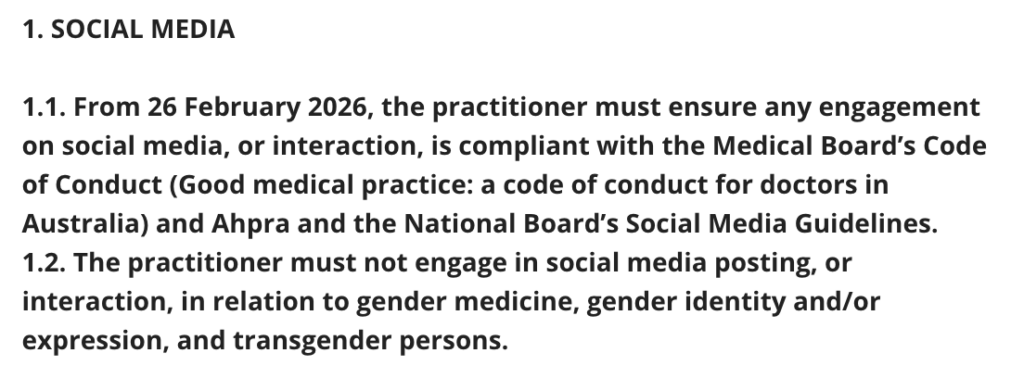
The restriction reportedly applies across all platforms, including X (formerly Twitter), LinkedIn, Reddit, blogs and professional forums. He is required to provide AHPRA with details of his social media accounts and to demonstrate compliance if requested.
At the same time, his clinical practice has been restricted. The conditions reportedly prohibit him from engaging in direct or indirect patient contact and confine him to non-clinical roles such as academic, administrative or research work.
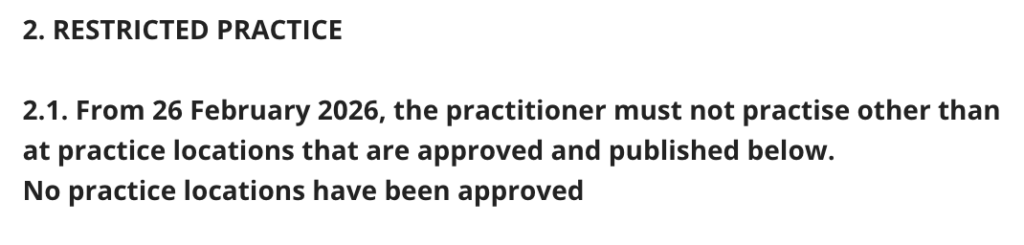
These measures were imposed under the Medical Board’s “immediate action” powers — a mechanism that does not require a completed investigation or formal finding of misconduct before restrictions are applied.
The Path to Restrictions: A Timeline
1. Academic and Public Advocacy
Dr Amos has publicly criticised aspects of the gender-affirming model of care for minors, arguing that it departs from traditional psychiatric practice by affirming self-declared identity without sufficiently robust diagnostic exploration.
In media interviews and commentary he described gender dysphoria as a psychiatric condition and questioned whether some cases might overlap with other mental health presentations. His comments attracted strong criticism from clinicians and activists, and the RANZCP issued a public statement affirming that being transgender is not, in itself, a mental illness.
Dr Amos has also published academic work questioning the strength of the evidence base underpinning paediatric gender-affirming interventions.
2. Social Media Posts and Complaints (2024–2025)
According to reporting in The Australian (March 2, 2026), four complaints were made to AHPRA.
These reportedly related to:
- Posts on X asserting that there is no reliable evidence that trans identification can be clearly differentiated from psychosis.
- Comments suggesting that doctors who affirm what he termed “gender delusions” may be exposing patients to harm.
- A post referring to men inducing lactation as “narcissistic.”
- An exchange with UK academic Stephen Whittle in which Dr Amos allegedly referred to Professor Whittle as a woman pretending to be a man.
Complainants reportedly alleged that his comments could discourage transgender people from seeking care or contribute to psychological distress.
3. Immediate Action: February 26, 2026
On 26 February 2026, AHPRA and the Medical Board imposed conditions citing a “reasonable belief” of serious risk to the public — the statutory threshold required under the National Law to take immediate action.
Dr Amos declined to comment publicly.
Supporters, including psychiatrist Jillian Spencer, have expressed concern that the decision may have a chilling effect on professional debate within psychiatry.
AHPRA has stated that healthcare must be delivered free from discrimination and that practitioners’ freedom of expression is respected provided it does not involve abuse, discrimination, or pose a risk to public safety. However, confidentiality provisions prevent detailed public explanation of the case.
A Wider Policy Context
The restrictions occur amid broader debate in Queensland and internationally regarding paediatric gender medicine.
In 2025, the Queensland Government announced a pause on the initiation of puberty blockers and cross-sex hormones for new under-18 patients in the public system.
Internationally, the UK’s Cass Review (2024), commissioned by NHS England, concluded that the evidence base for puberty blockers and hormone treatment in minors is limited and recommended a more cautious, multidisciplinary approach.
Dr Amos’s critics argue that his language has been harmful and stigmatising. His supporters argue that raising concerns about emerging medical practices is part of legitimate scientific discourse — particularly in areas undergoing active policy reassessment.
Suicide Risk and Public Claims
Some critics have suggested that non-affirming approaches increase suicide risk.
The Cass Review examined available data and found that while young people presenting to gender services often have high rates of mental health comorbidities, the absolute suicide rate in this cohort is low. The Review concluded that evidence that medical transition reduces suicide risk is currently insufficient.
Transgender individuals may experience elevated rates of distress and suicide attempts compared with the general population. However, causation is complex and multifactorial, involving trauma, social exclusion, and co-occurring psychiatric conditions. There is no high-quality evidence isolating misgendering alone as a direct causal factor in suicide.
This complexity underscores the need for careful, evidence-based discussion rather than rhetorical escalation.
Regulatory Oversight Sought
Women Speak Tasmania lodged a formal complaint with AHPRA on 2 March 2026, raising concerns regarding:
- The proportionality of content-based speech restrictions.
- Transparency in the exercise of immediate action powers.
- The potential chilling effect on lawful professional debate.
AHPRA responded that confidentiality provisions prevent comment on individual regulatory matters.
The matter was escalated to the National Health Practitioner Ombudsman. The Ombudsman declined to investigate on the basis that only the affected practitioner (or their authorised representative) may pursue the complaint further, but confirmed that the concerns would be recorded for monitoring purposes.
Why This Matters
Regulators have a clear duty to protect the public. But public protection must be balanced with proportionality, procedural fairness, and the preservation of open scientific discourse.
The gender medicine debate is not settled. Governments, health departments, and independent reviews are actively reassessing clinical frameworks. In such an environment, suppressing one side of the debate risks narrowing scientific inquiry.
Whether one agrees or disagrees with Dr Amos’s views, the precedent set by broad speech prohibitions imposed prior to a completed investigation raises serious questions about the future of professional debate in medicine.
Medicine advances through evidence, scrutiny, and open disagreement — not through silence.