
Tasmanian international and national cycling competitor Jodie Willett took a stand that made headlines. She resigned from her membership of AusCycling, saying she could not continue under a policy that allowed trans-identified males to compete in the women’s category. Willett wrote to the organisation explaining that until AusCycling and the Union Cycliste Internationale (UCI) created a separate category for transgender athletes, she would step back. Since then, the UCI and other sporting bodies such as FINA and the IAAF have reversed course and restricted elite women’s categories to those who have not undergone male puberty.

For Willett, however, the problem runs deeper. In her own words, “no scientific study can compare the athletic performance of a man who has taken hormones for 2 years, to the fictional woman he ‘would’ have been had he been born with two X chromosomes.” She argues that women are not defined simply by testosterone levels, and that lowering hormone thresholds does not erase the physical advantages gained through male puberty.
Here in Tasmania, concerns like these are not limited to elite athletes. Women have spoken up across a range of community sports — soccer, netball, cycling, even ten-pin bowling and lawn bowls — to say that they feel uncomfortable, sidelined or simply demotivated when trans-identified males compete in what they believe should be women’s divisions. Some women are quietly stepping back from sport altogether. They are not always protesting loudly or making headlines, but their absence is a warning sign. When women self-exclude, participation suffers, and the pipeline of talent that feeds into competitive sport begins to dry up.
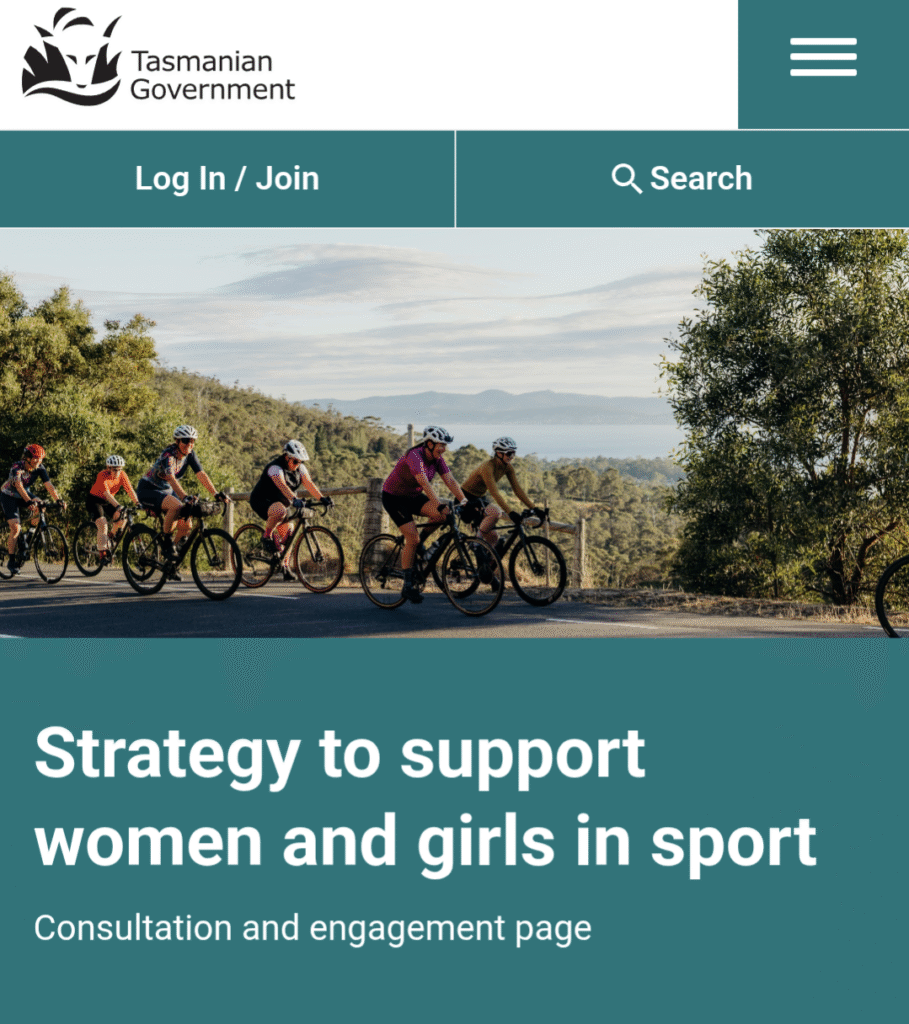
This matters because the Tasmanian Government has been working on a Women and Girls in Sport Strategy, which aims to grow participation, remove barriers and ensure women can thrive not only as players, but as coaches, officials and leaders. Yet, if women feel the rules are no longer fair, those goals will be undermined before they even take hold. Trust in sporting organisations depends on women believing their voices are heard and their right to fair competition is respected.
The risks of ignoring these concerns go beyond the scoreboards. Safety is one issue, particularly in contact or strength-based sports where mismatched physical advantages could lead to injury. Equally serious is the risk of eroding community confidence in sport. When female athletes feel their complaints are brushed aside, they lose faith in the system. Clubs can become divided, volunteer numbers fall, and participation dwindles. If these patterns continue, Tasmania could see fewer women and girls taking part in sport at all levels — and that will inevitably weaken the competitive future of women’s sport in the state.
What’s needed now is a balanced approach that puts fairness front and centre. Women and girls deserve categories they can call their own, without fear of reprisal for saying so. Sports bodies should listen closely to grassroots concerns and be transparent about how policies are working in practice. Government, too, has a role to play in giving legal clarity to ensure female-only categories are not just permitted, but protected.
The case of Jodie Willett shows that this debate is not abstract. It is about real women making hard choices about whether to stay in the sport they love. If Tasmania is serious about supporting women and girls in sport, then fairness and safety cannot be treated as optional extras. They are the foundations that will determine whether women’s sport continues to grow — or whether it begins to wither.
It is time for sporting bodies and government alike to act decisively: guarantee single-sex categories in women’s sport, listen to the voices of female athletes at every level, and ensure that fairness is protected for generations to come.