
On Saturday 29 August 2026, women gathered outside the Old Bailey in London for a protest organised by the grassroots organisations No Men in Women’s Prisons and 199 Days Later
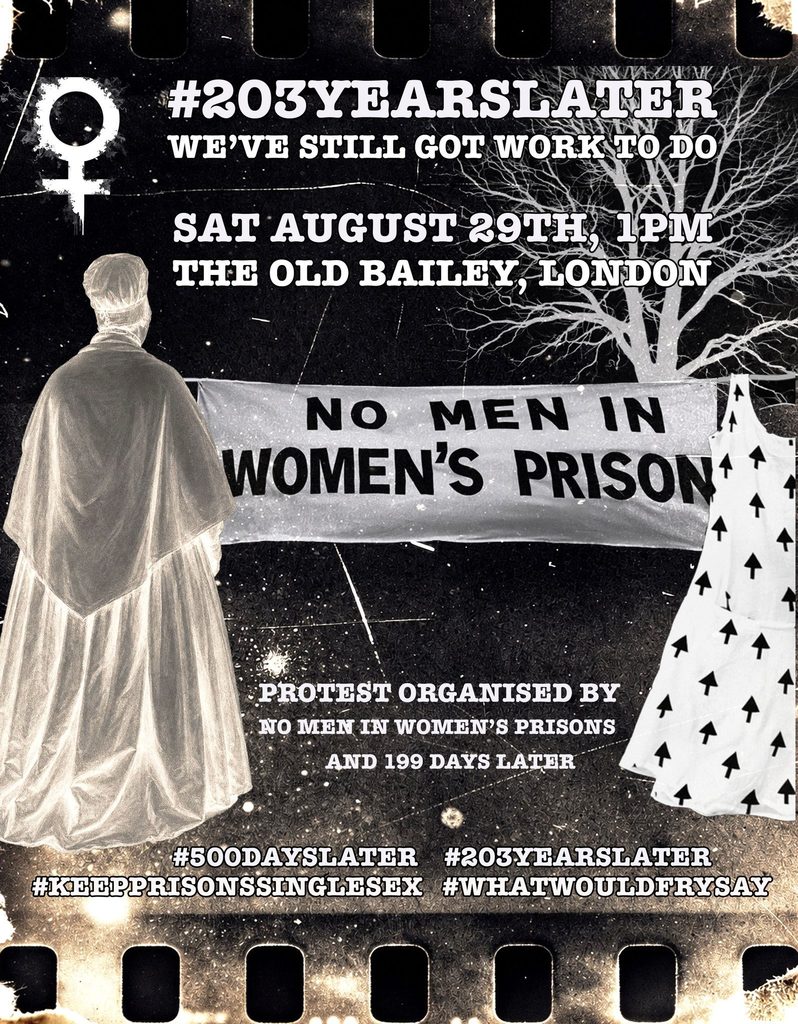
The protest was centred on a simple question: why are men still being housed in women’s prisons?
The location itself carried historical significance. The Old Bailey stands on the site of the former Newgate Prison, where Elizabeth Fry encountered women and children living in appalling prison conditions. The organisers connected the protest with the 1823 Gaols Act, which established the separation of male and female prisoners, and with the continuing campaign to keep the women’s prison estate single-sex.
But this was not only a London protest.
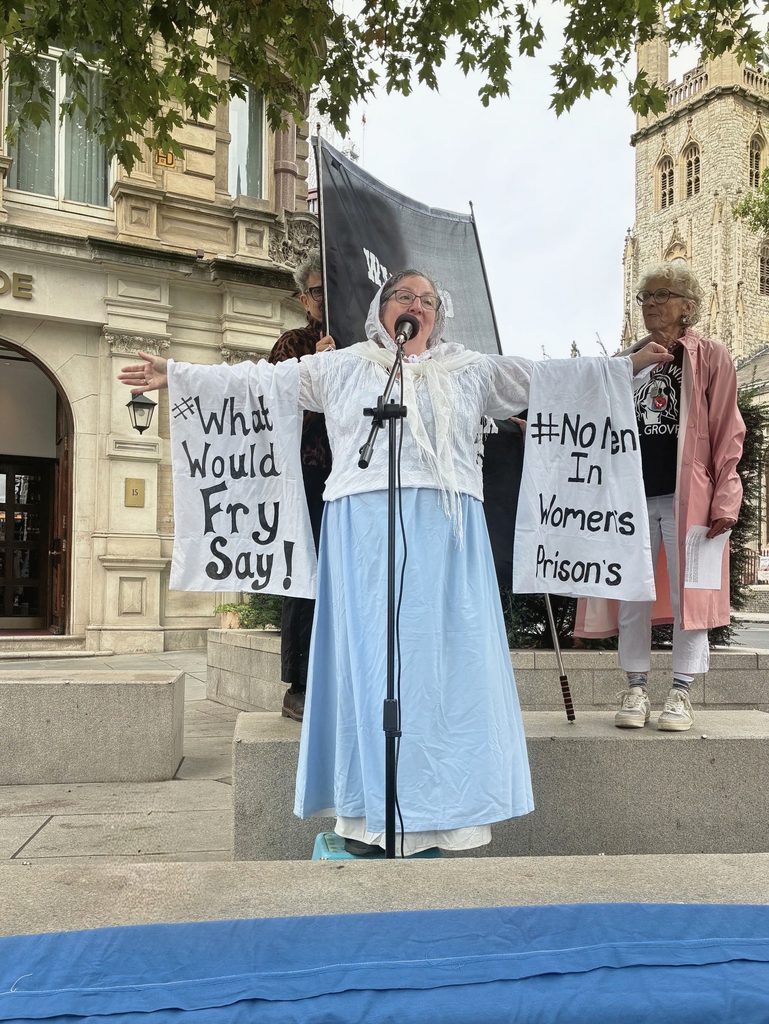
Women from other countries were invited to contribute their experiences of what is happening in their own prison systems. Speeches from women in different countries were read at the rally, making the event part of a growing international discussion about the treatment and protection of female prisoners.
A global issue
The question of male prisoners being housed in women’s prisons is not confined to Britain.
In England and Wales, official prison statistics show that transgender prisoners are held across both men’s and women’s establishments. As at 31 March 2025, HMPPS recorded 339 transgender prisoners, with 64 in women’s establishments.
The issue has also become part of a wider legal debate in the United Kingdom. In April 2025, the UK Supreme Court ruled in For Women Scotland Ltd v Scottish Ministers that the words “man”, “woman” and “sex” in the Equality Act 2010 refer to biological sex. The Court also confirmed that transgender people remain protected under the Act through the separate protected characteristic of gender reassignment.
For women’s rights campaigners, however, the legal position has not resolved the practical question of what protections should apply inside women’s prisons.
That is why grassroots groups continue to organise.
Tasmania speaks to London
Among the international contributions was one from Tasmania.
WST President Dr Elizabeth Caballero was invited to send a written speech about the situation facing women in Australian prisons. Her words were read to the London rally.
Her speech described developments across Australia, including cases in Victoria and Western Australia, the recent decision in Tasmania to refuse the transfer of a male prisoner into the women’s prison, and the Northern Territory’s decision to prohibit males from being housed in women’s prisons.
Dr Caballero also addressed a broader concern raised by women in Australia: that prison policy must recognise the particular vulnerability of female prisoners and that women’s safety, privacy and dignity should not be treated as secondary considerations.
What is happening in Australia?
Australia provides a useful illustration of why the issue is not simply a British debate.
Across Australian jurisdictions, approaches to transgender prisoners differ. Recent cases have brought questions about prison placement, risk assessment and the protection of female prisoners into public view.
Tasmania currently has no males housed in its women’s prison. This follows a recent decision not to transfer a male prisoner convicted of sexual offences into the state’s women’s prison.
The Northern Territory has gone further, becoming the first Australian jurisdiction to introduce an outright prohibition on males being housed in women’s prisons.
Meanwhile, other jurisdictions continue to face disputes and legal challenges concerning the placement of male prisoners who identify as women.
These differences raise an important question: should the protection of female prisoners depend on where they happen to be imprisoned?
Women prisoners cannot simply leave
Prison is different from almost every other environment in which sex-based boundaries are debated.
A woman in prison cannot choose another facility. She cannot simply leave a shared environment if she feels unsafe. She cannot choose her cellmate, her neighbours or the people with whom she may have to use communal facilities.
Female prisoners are also among the most vulnerable women in society. Many have histories of abuse, sexual violence, trauma and exploitation.
For these women, privacy and physical safety are not abstract concepts.
This is why the campaign for single-sex prisons has continued despite changes in law and policy.
A conversation that crosses borders
The significance of the London protest was therefore larger than the gathering outside the Old Bailey.
Women from Britain and other countries are increasingly sharing information about what is happening in their own prison systems. The London organisers explicitly sought international contributions, and speeches from women outside Britain formed part of the event.
For Women Speak Tasmania, being asked to contribute was an opportunity to ensure that the Australian experience — and the Tasmanian experience — was heard internationally.
The problems facing female prisoners do not stop at national borders.
Nor should the conversation about how women are protected.
WST thanks No Men in Women’s Prisons and 199 Days Later Grassroots for inviting Tasmania to take part in the London protest and for giving Australian women a voice on the international stage.
Watch the full video of the event
Enjoy the slideshow with photos and music from the event