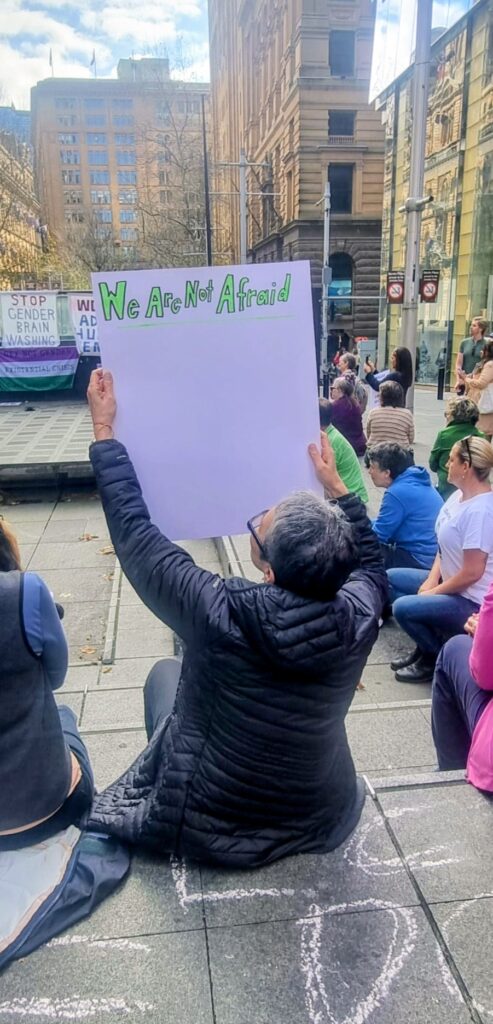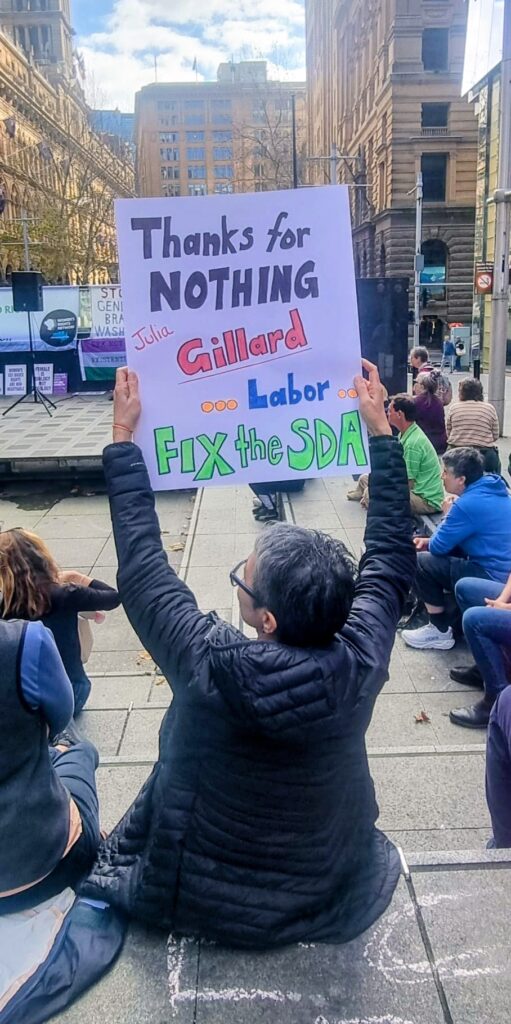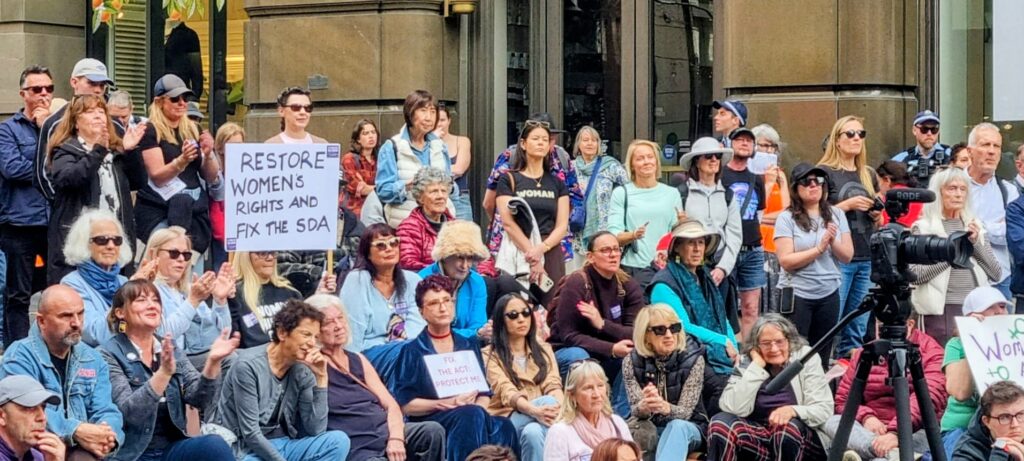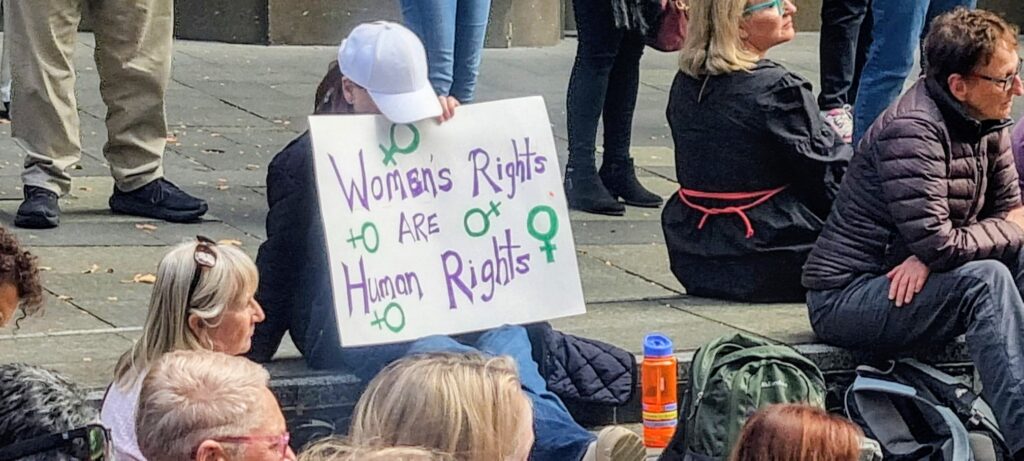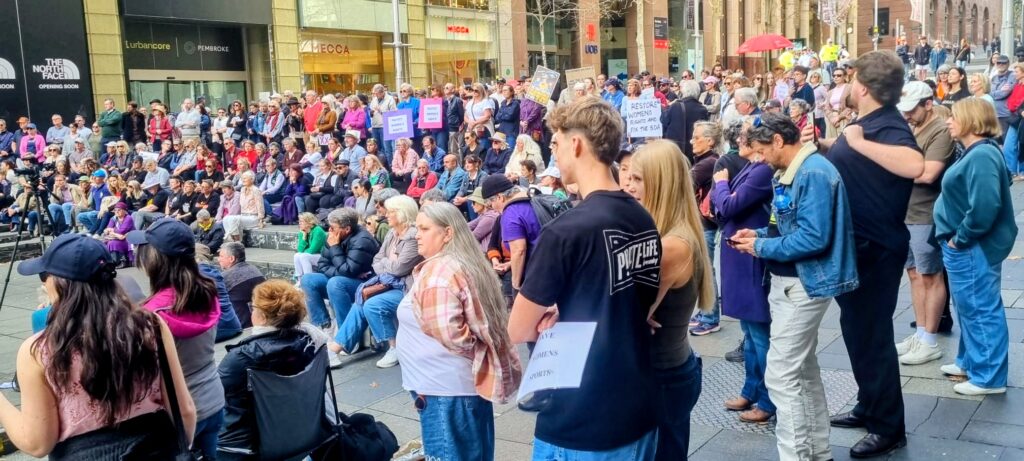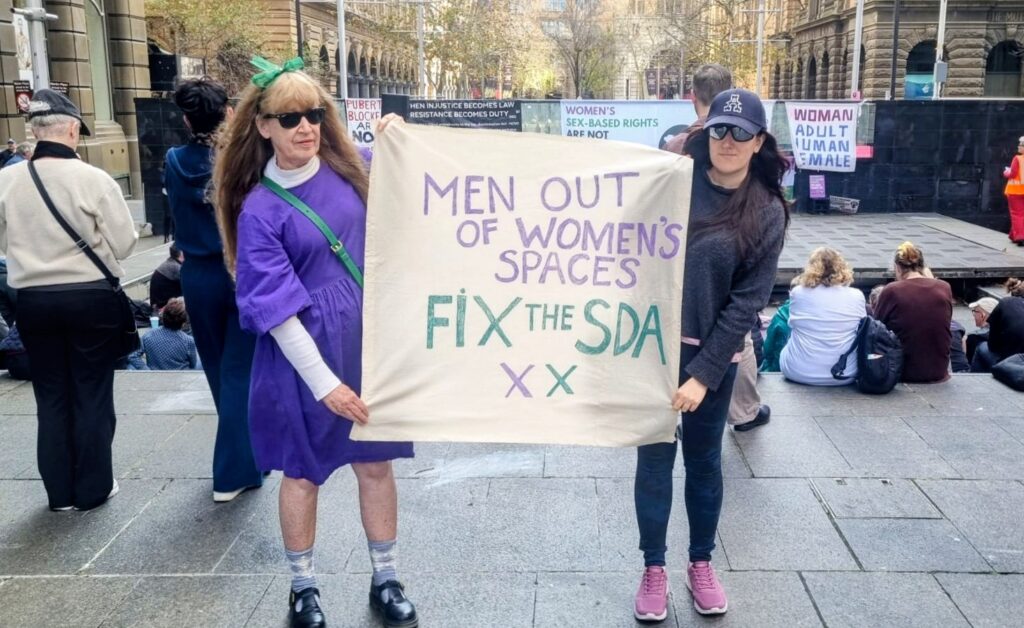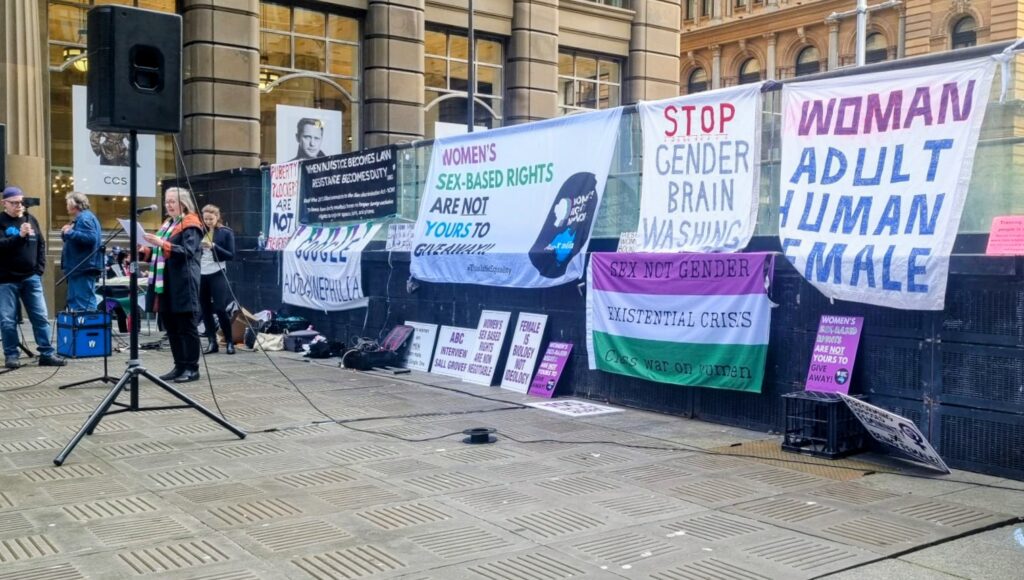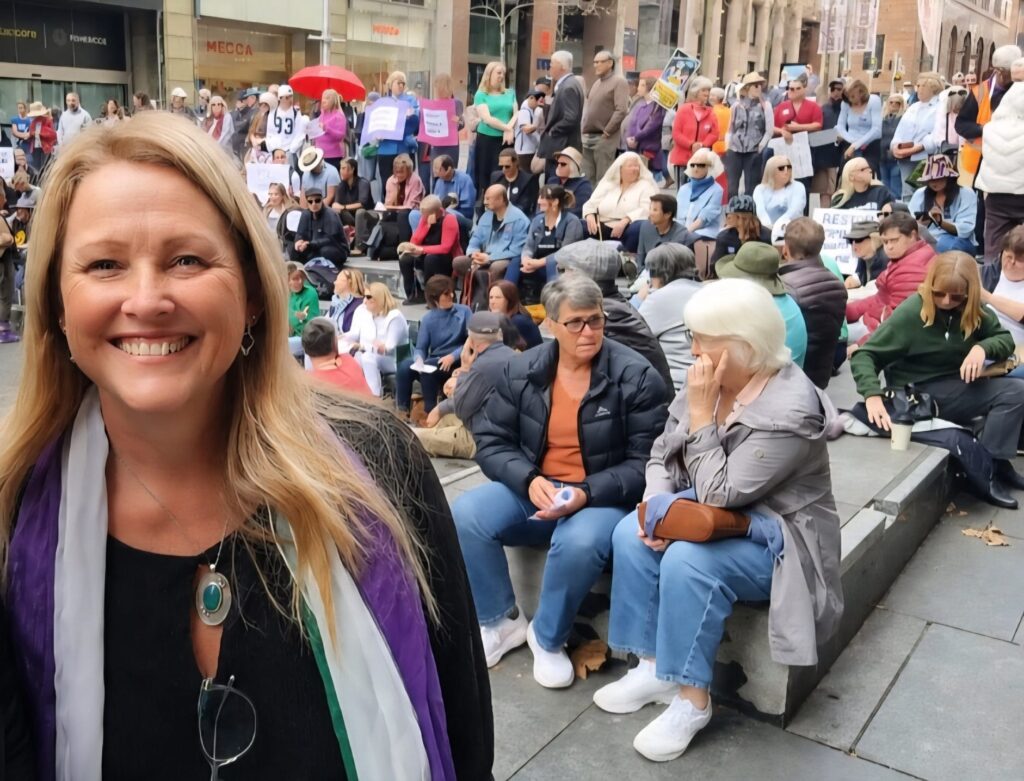
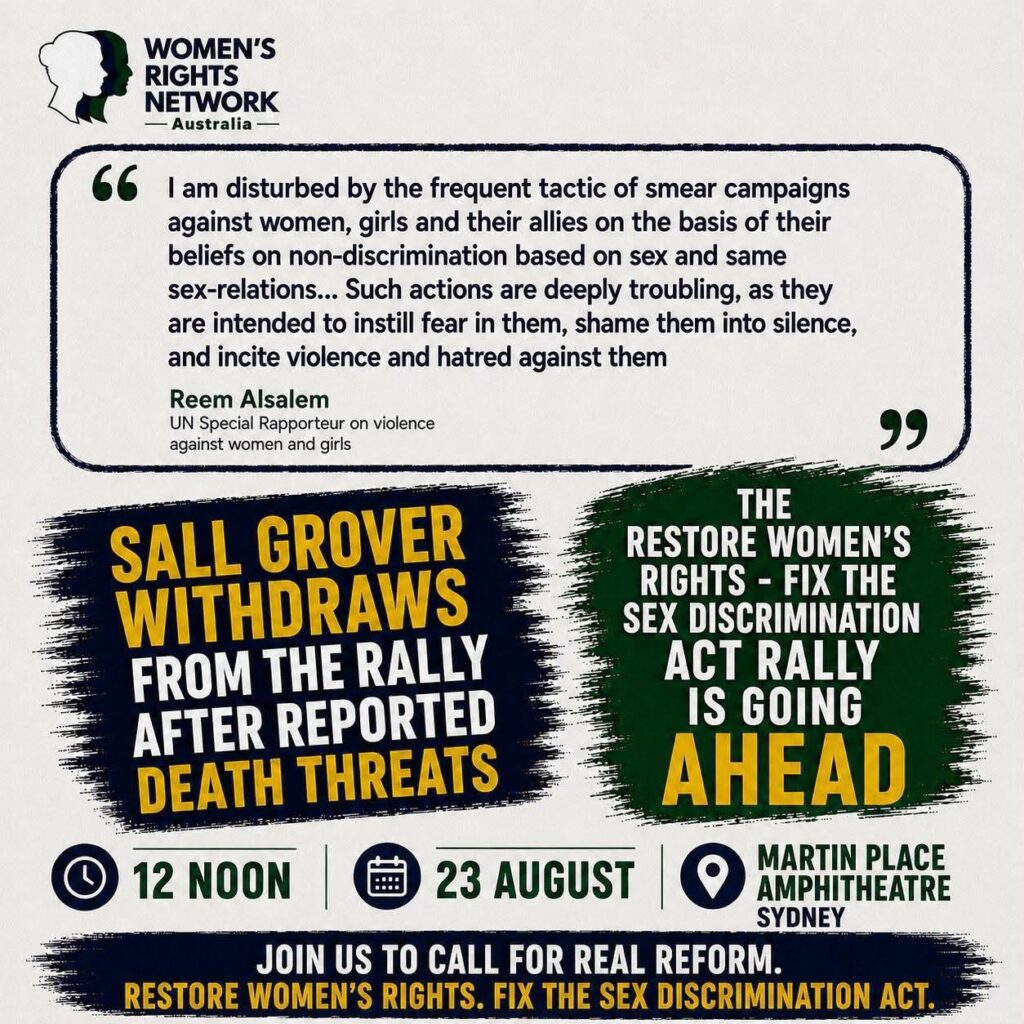
On Sunday 23 August, women and men gathered at Martin Place Amphitheatre in Sydney for the Restore Women’s Rights – Fix the Sex Discrimination Act Rally, calling for the restoration of sex-based rights in Australian law.
Organised by Women’s Rights Network Australia, with support from LGB Alliance Australia, the rally brought together academics, lawyers, campaigners and members of the public concerned about the consequences of separating sex from the legal protections intended to safeguard women.
The message was clear: women’s rights require recognition of sex.
A rally overshadowed by threats
The rally came just days after Sall Grover, founder of Giggle for Girls and one of the scheduled keynote speakers, withdrew after reported death threats.
According to The Australian, threats were sent to fellow campaigner Kirralie Smith, including a message threatening to “put a bullet” in Smith’s head and a photograph of Grover accompanied by the words “one TERF, one bullet”.
Smith reported the threat to police. Grover, a single mother, decided not to attend because she did not want to put herself or other women at risk.
The rally nevertheless went ahead.
And so did Kirralie Smith.
“We are not the threat”
Smith spoke directly about the hostility faced by women who publicly defend sex-based rights. She told the crowd that she had received the threat while in hospital and contrasted it with the legal consequences she has faced for speaking publicly about males competing in women’s sport.
Despite the threats, she stood on the stage.
“We are being gaslit, intimidated, harassed, and threatened every day online and in person for knowing what is true, for knowing what is right, and for having the guts just to stand up here and say it.”
Smith thanked the police officers present, emphasising that women were not the threat and that they needed protection from intimidation.
She finished with a clear statement of the rally’s central principle:
“Men are not women. Humans cannot change sex and women deserve sex-based spaces, services and sport.”
“It is absolutely no wonder the children are confused”
Professor Dianna Kenny focused on the impact of the post-2013 legal and institutional environment on children and adolescents.
She argued that today’s teenagers are the first generation of Australians to have grown up entirely within a culture in which gender identity has formally been separated from biological sex.
Professor Kenny observed:
“These are the children who are streaming through my door, confused about who they are.”
She questioned the consequences of exposing young people to an increasingly complex range of gender identities and argued that prioritising gender identity over biological sex can contribute to confusion and the medicalisation of young people experiencing adolescent uncertainty, gender non-conformity or body dissatisfaction.
“I have observed youth surveys of gender identity that offer young people 46 categories of gender identity. Is there any wonder why children are confused?”
Kenny called for the restoration of biological sex in law and policy and for a revision of sex education curricula in government schools.
“We require not only the urgent reinsertion of biology, reality, and logic into the Sex Discrimination Act.”
“Nothing kind or compassionate about misleading people”
Anna Kerr, Principal Solicitor of the Feminist Legal Clinic, addressed the rally from a legal and safeguarding perspective.
Kerr spoke about detransitioners and young women who, she said, had been fast-tracked into gender-affirming medical treatment.
“There’s nothing kind or compassionate about misleading people that it is possible to change sex.”
She described cases involving young women who had undergone mastectomies and other interventions, arguing that the consequences could be devastating.
Kerr rejected the characterisation of women raising these concerns as motivated by hatred:
“We’re not here to hate anyone. We are here because we care about keeping people safe.”
“The punishment of one silences thousands”
Professor Clive Hamilton focused on freedom of speech, arguing that people should not be expected to alter their speech or behaviour to conform to another person’s beliefs.
“Gender ideology is the politics of the one per cent. It demands compliance from the 99 per cent.”
Hamilton described what he sees as growing institutional and professional consequences for people who criticise gender ideology, including deplatforming, professional discipline, reputational damage and intimidation.
His warning was about the wider chilling effect:
“The punishment of one silences thousands.”
He argued that people do not need to agree with every speaker to recognise their right to participate in public debate.
“You only have to agree that voices critical of gender ideology and trans fanaticism should be heard.”
A peaceful rally for women’s rights
A counter-protest had been advertised separately by trans activist groups, but there was no substantial organised counter-protest presence apparent at the Martin Place event itself. Opposition messaging was visible in the surrounding area, including chalk markings, but the rally itself proceeded peacefully.
The focus remained on the speakers and the issues they had come to address: sex-based rights, women’s spaces, children, medicine, law and freedom of speech.
That peaceful gathering matters.
The debate over sex and gender is often portrayed as inherently hostile. Yet at Martin Place, people gathered, listened, shared their concerns and called for changes to the law.
They exercised a basic democratic right: the right to speak.
You can watch all the speeches from the rally here:
Why the Act matters
The rally’s central demand was to fix the Sex Discrimination Act and restore meaningful recognition of sex-based rights.
For Women Speak Tasmania, this is an issue that deserves national attention.
Sex is not merely a question of terminology. Laws determine who is protected, how women can organise around their sex, and how single-sex spaces, services and opportunities are treated.
The question raised at Martin Place is therefore straightforward:
If sex is no longer clearly recognised in law, how can sex-based rights be protected?
The Sydney rally provided one answer: women must continue to speak, organise and demand that the law recognise the reality on which their rights are based.
Despite the threats surrounding the event, the rally went ahead.
Women spoke. And they were heard.
Photo Gallery
With thanks to Mel for her coverage and notes throughout the day, which helped us capture the atmosphere and key moments of the rally.