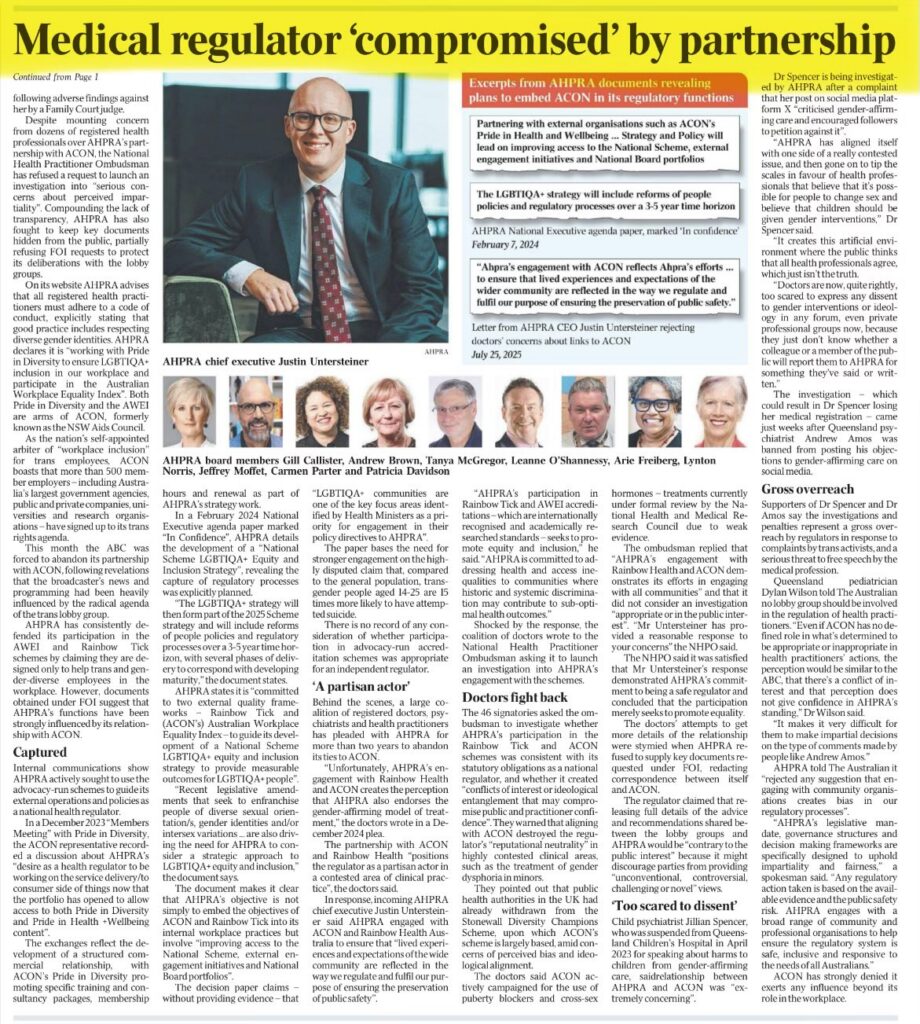
Australia’s peak medical regulator faces claims it has been hopelessly compromised in a string of controversial decisions because it is a signed-up member of Australia’s most powerful trans lobby group, ACON, which promotes gender-affirming medical treatment for children and teenagers.

Documents released under FOI reveal how the Australian Health Practitioner Regulation Agency developed an LGBTIQA+ strategy based on adherence to the gender ideology of ACON, extending to the way it regulates health practitioners.
In correspondence obtained by The Australian, AHPRA boss Justin Untersteiner states that the regulator’s engagement with ACON and accreditation group Rainbow Health Australia guides “the way we regulate and fulfil our purpose of ensuring the preservation of public safety”.
The revelations follow claims Australia’s medical complaints system has been weaponised by gender activists using a compliant regulator to intimidate psychiatrists who speak out against gender-affirming treatment such as puberty blockers, while shielding doctors who promote them.
In recent decisions AHPRA has:
• Gagged Queensland psychiatrist Andrew Amos, banning him from making online statements about gender medicine and barring him from having direct clinical contact with any patients.
• Launched an investigation into prominent child psychiatrist Jillian Spencer for sharing on social media an article from The Australian that quoted her concerns about gender-affirming medical treatment for children.
• Registered as “female” the transgender doctor at the centre of a landmark UK legal dispute over women’s spaces, Beth Upton, allowing the emergency medic to work in two NSW hospitals.
• Dismissed a complaint against Michelle Telfer, chief of medicine at the Royal Children’s Hospital Melbourne, who pioneered the contentious gender-affirming treatment approach in Australia, following adverse findings against her by a Family Court judge.
Despite mounting concern from dozens of registered health professionals over AHPRA’s partnership with ACON, the National Health Practitioner Ombudsman has refused a request to launch an investigation into “serious concerns about perceived impartiality”.
Compounding the lack of transparency, AHPRA has also fought to keep key documents hidden from the public, partially refusing FOI requests to protect its deliberations with the lobby groups.

Code of conduct
On its website AHPRA advises that all registered health practitioners must adhere to a code of conduct, explicitly stating that good practice includes respecting diverse gender identities.
AHPRA declares it is “working with Pride in Diversity to ensure LGBTIQA+ inclusion in our workplace and participate in the Australian Workplace Equality Index”.
Both Pride in Diversity and the AWEI are arms of ACON, formerly known as the NSW Aids Council.
As the nation’s self-appointed arbiter of “workplace inclusion” for trans employees, ACON boasts that more than 500 member employers – including Australia’s largest government agencies, public and private companies, universities and research organisations – have signed up to its trans rights agenda.
This month the ABC was forced to abandon its partnership with ACON, following revelations that the broadcaster’s news and programming had been heavily influenced by the radical agenda of the trans lobby group.
AHPRA has consistently defended its participation in the AWEI and Rainbow Tick schemes by claiming they are designed only to help trans and gender-diverse employees in the workplace.
However, documents obtained under FOI suggest that AHPRA’s functions have been strongly influenced by its relationship with ACON.
Captured
Internal communications show AHPRA actively sought to use the advocacy-run schemes to guide its external operations and policies as a national health regulator.

In a December 2023 “Members Meeting” with Pride in Diversity, the ACON representative recorded a discussion about AHPRA’s “desire as a health regulator to be working on the service delivery/to consumer side of things now that the portfolio has opened to allow access to both Pride in Diversity and Pride in Health +Wellbeing content”.
The exchanges reflect the development of a structured commercial relationship, with ACON’s Pride in Diversity promoting specific training and consultancy packages, membership hours and renewal as part of AHPRA’s strategy work.
In a February 2024 National Executive agenda paper marked “In Confidence”, AHPRA details the development of a “National Scheme LGBTIQA+ Equity and Inclusion Strategy”, revealing the capture of regulatory processes was explicitly planned.

“The LGBTIQA+ strategy will then form part of the 2025 Scheme strategy and will include reforms of people policies and regulatory processes over a 3-5 year time horizon, with several phases of delivery to correspond with developing maturity,” the document states.
AHPRA states it is “committed to two external quality frameworks – Rainbow Tick and (ACON’s) Australian Workplace Equality Index – to guide its development of a National Scheme LGBTIQA+ equity and inclusion strategy to provide measurable outcomes for LGBTIQA+ people”.
“Recent legislative amendments that seek to enfranchise people of diverse sexual orientation/s, gender identities and/or intersex variations … are also driving the need for AHPRA to consider a strategic approach to LGBTIQA+ equity and inclusion,” the document says.

The document makes it clear that AHPRA’s objective is not simply to embed the objectives of ACON and Rainbow Tick into its internal workplace practices but involve “improving access to the National Scheme, external engagement initiatives and National Board portfolios”.
The decision paper claims – without providing evidence – that “LGBTIQA+ communities are one of the key focus areas identified by Health Ministers as a priority for engagement in their policy directives to AHPRA”.
The paper bases the need for stronger engagement on the highly disputed claim that, compared to the general population, transgender people aged 14-25 are 15 times more likely to have attempted suicide.
There is no record of any consideration of whether participation in advocacy-run accreditation schemes was appropriate for an independent regulator.

‘A partisan actor’
Behind the scenes, a large coalition of registered doctors, psychiatrists and health practitioners has pleaded with AHPRA for more than two years to abandon its ties to ACON.
“Unfortunately, AHPRA’s engagement with Rainbow Health and ACON creates the perception that AHPRA also endorses the gender-affirming model of treatment,” the doctors wrote in a December 2024 plea.
The partnership with ACON and Rainbow Health “positions the regulator as a partisan actor in a contested area of clinical practice”, the doctors said.
In response, incoming AHPRA chief executive Justin Untersteiner said AHPRA engaged with ACON and Rainbow Health Australia to ensure that “lived experiences and expectations of the wide community are reflected in the way we regulate and fulfil our purpose of ensuring the preservation of public safety”.
“AHPRA’s participation in Rainbow Tick and AWEI accreditations – which are internationally recognised and academically researched standards – seeks to promote equity and inclusion,” he said.
“AHPRA is committed to addressing health and access inequalities to communities where historic and systemic discrimination may contribute to sub-optimal health outcomes.”

Shocked by the response, the coalition of doctors wrote to the National Health Practitioner Ombudsman asking it to launch an own-motion investigation into AHPRA’s engagement with the schemes.
Doctors fight back
The 46 signatories asked the ombudsman to investigate whether AHPRA’s participation in the Rainbow Tick and ACON schemes was consistent with its statutory obligations as a national regulator, and whether it created “conflicts of interest or ideological entanglement that may compromise public and practitioner confidence”.
They warned that aligning with ACON destroyed the regulator’s “reputational neutrality” in highly contested clinical areas, such as the treatment of gender dysphoria in minors.
They pointed out that public health authorities in the UK had already withdrawn from the Stonewall Diversity Champions Scheme, upon which ACON’s scheme is largely based, amid concerns of perceived bias and ideological alignment.
The doctors said ACON actively campaigned for the use of puberty blockers and cross-sex hormones – treatments currently under formal review by the National Health and Medical Research Council due to weak evidence.
The ombudsman replied that “AHPRA’s engagement with Rainbow Health and ACON demonstrates its efforts in engaging with all communities” and that it did not consider an investigation “appropriate or in the public interest”.
“Mr Untersteiner has provided a reasonable response to your concerns” the ombudsman said.
The NHPO said it was satisfied that Mr Untersteiner’s response demonstrated AHPRA’s commitment to being a safe regulator and concluded that the participation merely seeks to promote equality.
The doctors’ attempts to get more details of the relationship were stymied when AHPRA refused to supply key documents requested under FOI, redacting correspondence between itself and ACON.
The regulator claimed that releasing full details of the advice and recommendations shared between the lobby groups and AHPRA would be “contrary to the public interest” because it might discourage parties from providing “unconventional, controversial, challenging or novel” views.
‘Too scared to dissent’
Child psychiatrist Jillian Spencer, who was suspended from the Queensland Children’s Hospital in April 2023 for speaking about harms to children from gender-affirming care, told The Australian the relationship between AHPRA and ACON was “extremely concerning”.
Dr Spencer is being investigated by AHPRA after a complaint that her post on social media platform X “criticised gender-affirming care and encouraged followers to petition against it”.
“AHPRA has aligned itself with one side of a really contested issue, and then gone on to tip the scales in favour of health professionals that believe that it’s possible for people to change sex and believe that children should be given gender interventions,” Dr Spencer said.
“It creates this artificial environment where the public thinks that all health professionals agree, which just isn’t the truth.
“Doctors are now, quite rightly, too scared to express any dissent to gender interventions or ideology in any forum, even private professional groups now, because they just don’t know whether a colleague or a member of the public will report them to AHPRA for something they’ve said or written.”
The investigation – which could result in Dr Spencer losing her medical registration – came just weeks after Queensland psychiatrist Andrew Amos was banned from posting his objections to gender-affirming care on social media.
Gross overreach
Supporters of Dr Spencer and Dr Amos say the investigations and penalties represent a gross overreach by regulators in response to complaints by trans activists, and a serious threat to free speech by the medical profession.
Queensland pediatrician Dylan Wilson told The Australian no lobby group should be involved in the regulation of health practitioners.

“Even if ACON has no defined role in what’s determined to be appropriate or inappropriate in health practitioners’ actions, the perception would be similar to the ABC, that there’s a conflict of interest and that perception does not give confidence in AHPRA’s standing,” Dr Wilson said.
“It makes it very difficult for them to make impartial decisions on the type of comments made by people like Andrew Amos.”
AHPRA told The Australian it “rejected any suggestion that engaging with community organisations creates bias in our regulatory processes”.
“AHPRA’s legislative mandate, governance structures and decision‑making frameworks are specifically designed to uphold impartiality and fairness,” a spokesman said. “Any regulatory action taken is based on the available evidence and the public safety risk.
“AHPRA engages with a broad range of community and professional organisations to help ensure the regulatory system is safe, inclusive and responsive to the needs of all Australians.”
ACON has strongly denied it exerts any influence beyond its role in the workplace.
by Stephen Rice
Source: The Australian
or archive link:
or printed edition: