
Riittakerttu Kaltiala didn’t know how divisive transgender politics was until she called out the use of puberty blockers
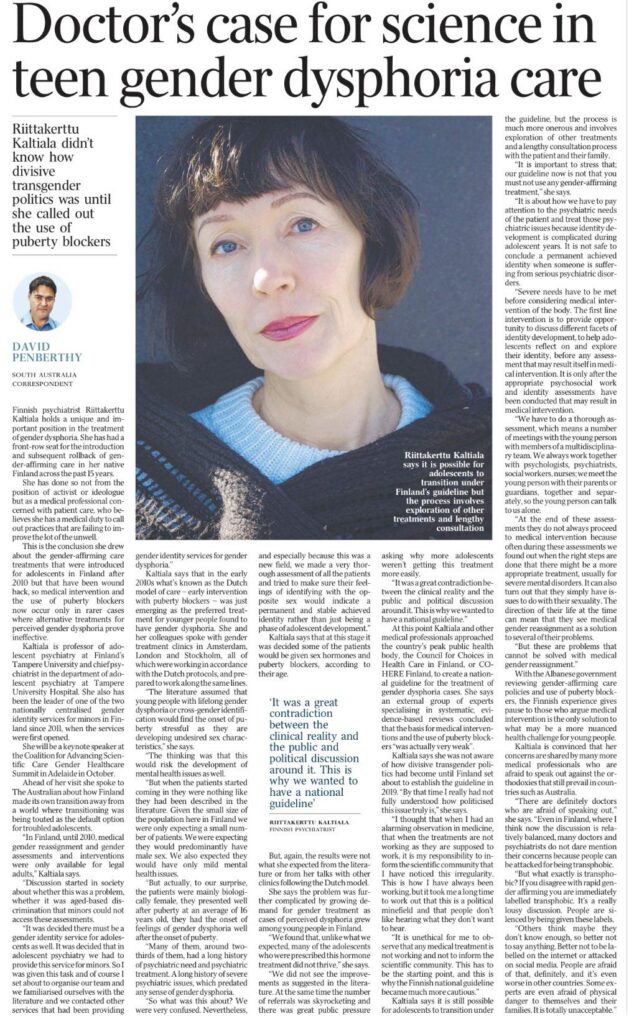
Finnish psychiatrist Riittakerttu Kaltiala holds a unique and important position in the treatment of gender dysphoria. She has had a front-row seat for the introduction and subsequent rollback of gender-affirming care in her native Finland across the past 15 years.
She has done so not from the position of activist or ideologue but as a medical professional concerned with patient care, who believes she has a medical duty to call out practices that are failing to improve the lot of the unwell.
This is the conclusion she drew about the gender- affirming care treatments that were introduced for adolescents in Finland after 2010 but that have been wound back, so medical intervention and the use of puberty blockers now occur only in rarer cases where alternative treatments for perceived gender dysphoria prove ineffective.
Kaltiala is professor of adolescent psychiatry at Finland’s Tampere University and chief psychiatrist in the department of adolescent psychiatry at Tampere University Hospital. She also has been the leader of one of the two national centralized gender identity services for minors in Finland since 2011, when the services were first opened.
She will be a keynote speaker at the Coalition for Advancing Scientific Care Gender Healthcare Summit in Adelaide in October.
Ahead of her visit she spoke to The Australian about how Finland made its own transition away from a world where transitioning was being touted as the default option for troubled adolescents.
“In Finland, until 2010, medical gender reassignment and gender assessments and interventions were only available for legal adults”, Kaltiala says.
“Discussion started in society about whether this was a problem, whether it was age-based discrimination that minors could not access these assessments.
“It was decided there must be a gender identity service for adolescents as well. It was decided that in adolescent psychiatry we had to provide this service for minors. So I was given this task and of course I set about to organise our team and we familiarised ourselves with the literature and we contacted other services that had been providing gender identity services for gender dysphoria”.
Kaltiala says that in the early 2010s what’s known as the Dutch model of care – early intervention with puberty blockers – was just emerging as the preferred treatment for younger people found to have gender dysphoria. She and her colleagues spoke with gender treatment clinics in Amsterdam, London and Stockholm, all of which were working in accordance with the Dutch protocols, and prepared to work along the same lines.
“The literature assumed that young people with lifelong gender dysphoria or cross-gender identification would find the onset of puberty stressful as they are developing undesired sex characteristics.” she says.
“The thinking was that this would risk the development of mental health issues as well.
“But when the patients started coming in they were nothing like they had been described in the literature. Given the small size of the population here in Finland we were only expecting a small number of patients. We were expecting that they would predominantly have male sex. We also expected they would have only mild mental health issues.
“But actually, to our surprise, the patients were mainly biological females, they presented well after puberty at an average of 16 years old, they had the onset of feelings of gender dysphoria well after the onset of puberty.
Many of them, around two thirds of them, had a long history of psychiatric need and psychiatric treatment. A long history of severe psychiatric issues, which predated any sense of gender dysphoria.
“So what was this about? We were very confused. Nevertheless, and especially because this was a new field, we made a very thorough assessment of all the patients and tried to make sure their feelings of identifying with the opposite sex would indicate a permanent and stable achieved identity rather than just being a phase of adolescent development.”
Kaltiala says that at this stage it was decided some of the patients would be given sex hormones and puberty blockers, according to their age.
But, again, the results were not what she expected from the literature or from her talks with other clinics following the Dutch model.
She says the problem was further complicated by growing demand for gender treatment as cases of perceived dysphoria grew among young people in Finland.
“We found that, unlike what we expected, many of the adolescents who were prescribed this hormone treatment did not thrive,” she says.
“We did not see the improvements as suggested in the literature. At the same time the number of referrals was skyrocketing and there was great public pressure asking why more adolescents weren’t getting this treatment more easily.
“It was a great contradiction between the clinical reality and the public and political discussion around it. This is why we wanted a national guideline.”
At this point Kaltiala and other medical professionals approached the country’s peak public health body, the Council for Choices in Health Care in Finland, or COHERE Finland, to create a national guideline for the treatment of gender dysphoria cases. She says an external group of experts specialising in systemic, evidence-based reviews concluded that the basis for medical interventions and the use of puberty blockers “was actually very weak”.
Kaltiala says she was not aware of how divisive transgender politics had become until Finland set about to establish the guideline in 2019. “By that time I really had not fully understood how politicised this issue truly is.” she says.
“I thought that when I had an alarming observation in medicine, that when the treatments are not working as they were supposed to work, it is my responsibility to inform the scientific community that I have noticed this irregularity. This is how I have always been working, but it took me a long time to work out that this is a political minefield and that people don’t like hearing what they don’t want to hear.
“It is unethical for me to observe that any medical treatment is not working and not to inform the scientific community. This has to be the starting point, and this is why the Finnish national guideline became much more cautious.
Kaltiala says it is still possible for adolescents to transition under the guideline, but the process is much more onerous and involves exploration of other treatments and a lengthy consultation process with the patient and their family.
“It is important to stress that our guideline now is not that you must not sue any gender-affirming treatment,” she says
“It is about how we have to pay attention to the psychiatric needs of the patient and treat those psychiatric issues because identity development is complicated during adolescent years. It is not safe to conclude a permanent achieved identity when someone is suffering from serious psychiatric disorders.
“Severe needs have to be met before considering medical intervention of the body. The first line intervention is to provide opportunity to discuss different facets of identity development, to help adolescents reflect on and explore their identity, before any assessment that may result itself in medical intervention. It is only after the appropriate psychosocial work and identity assessments have been conducted that may result in medical intervention.
“We have to do a thorough assessment, which means a number of meetings with the young person with members of a multidisciplinary team. We always work together with psychologists, psychiatrists, social workers, nurses; we meet the young person with their parents, or guardians, together and separately, so the young person can talk to us alone.
“At the end of these assessments, they do not always proceed to medical intervention because often during these assessments we found out when the right steps are done that there might be a more appropriate treatment, usually for severe mental disorders. It can also turn out that they simply have issues to do with their sexuality. The direction of their life at the time can mean that they see medical gender reassignment as a solution to several of their problems.
“But these are problems that cannot be solved with medical gender reassignment.”
With the Albanese government reviewing gender-affirming care, policies and use of puberty blockers, the Finnish experience gives pause to those who argue medical intervention is the only solution to what may be a more nuanced health challenge for young people.
Kaltiala is convinced that her concerns are shared by many more medical professionals, who are afraid to speak out against the orthodoxies that still prevail in countries such as Australia
“There are definitely doctors who are afraid of speaking out”, she says. “Even in Finland, where I think now the discussion is relatively balanced, many doctors and psychiatrists do not dare mention their concerns because people can be attacked for being transphobic
“But what exactly is transphobic? If you disagree with rapid gender affirming you are immediately labelled transphobic. It’s a really lousy discussion. People are silenced by being given these labels.
“Others think maybe they don’t know enough, so better not to say anything. Better not to be labelled on the internet or attacked on social media. People are afraid of that, definitely, and it’s even worse in other countries. Some experts are even afraid of physical danger to themselves and their families. It is totally unacceptable.
By David Penberthy, South Australia Correspondent
Source: Inquirer. The Australian (transcript from printed article)
web link:
archive link: