
Women Speak Tasmania (WST) responded to the Australian Building Codes Board’s (ABCB) public consultation on proposed changes to the National Construction Code (NCC)—specifically, the introduction of “all-gender” sanitary facilities and shifts in terminology from “sex” to “gender.” Our submission highlighted critical concerns about the repercussions of these changes on the safety, privacy, and dignity of women and girls.
Proposed Changes: What is the ABCB Suggesting?
According to consultation documents, the ABCB is considering:
- Replacing “sex” with “gender” throughout the NCC.
- Substituting “unisex” with “accessible” in public facility designations
While presented as a move toward inclusivity, WST’s submission argues this shift undermines the biological realities and needs of female restroom users.
WST’s Position: Why Proper Labeling Matters
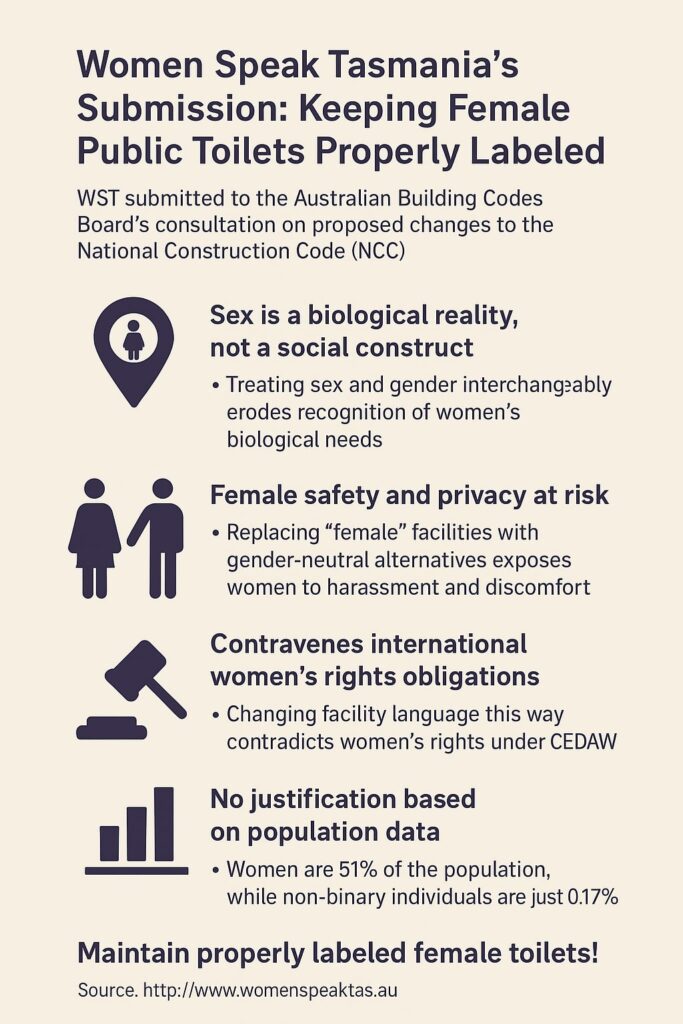
1. Sex Is a Biological Reality, Not a Social Construct
WST emphasized that “sex is immutable and biological,” whereas gender is fluid and shaped by identity. Treating them as interchangeable erodes recognition of women’s inherent biological needs.
2. Female Safety and Privacy at Risk
Replacing “female” facilities with gender-neutral alternatives exposes women and girls to increased risk of harassment and discomfort. WST cited growing evidence—including emerging global reporting—demonstrating real safety concerns in such spaces.
3. Contravenes International Women’s Rights Obligations
WST pointed out that changing facility language in this manner contradicts Article 2 of the Convention on the Elimination of all Forms of Discrimination Against Women (CEDAW), which prohibits distinctions based on sex that impair women’s rights.
4. No Justification Based on Population Data
The submission highlighted current Australian census figures—women constitute 51% of the population, while non-binary individuals represent only 0.17%—indicating no sufficient demographic justification for sweeping facility changes
5. Multicultural and Diverse Voices Oppose the Shift
Many Australians across cultural and ethnic backgrounds reject gender-neutral restroom policies, favoring clearly sex-based facilities that reflect biological and cultural needs. WST stressed that policy-making must reflect this diversity.
Why This Matters
- Safety first: Sex-designated facilities offer essential privacy and security.
- Legal integrity: Maintaining accurate, biologically grounded language supports anti-discrimination protections.
- Cultural consideration: Respecting diverse perspectives ensures community trust in public infrastructure.
WST has joined a crucial national conversation on how we define and design public spaces—and for whose benefit. The integrity of female-safe spaces is at stake, and so is the broader principle of evidence-based, rights-aligned policy-making.