
At Women Speak Tasmania, we believe transparency is essential when it comes to healthcare services that impact children and young people. That’s why we lodged a Right to Information (RTI) request to the Department of Health seeking detailed data about the Tasmanian Gender Service (TGS).
The RTI has now been decided, and here’s what we found.
A Very New Service
Although we asked for information from 2014 to 2024, the TGS has only operated in its current form since 2021–2022. Before that, Tasmanian patients were referred to the Royal Children’s Hospital (RCH) in Melbourne. This means there is no local data before 2021.
Referrals Since 2021
Since the new referral system began:
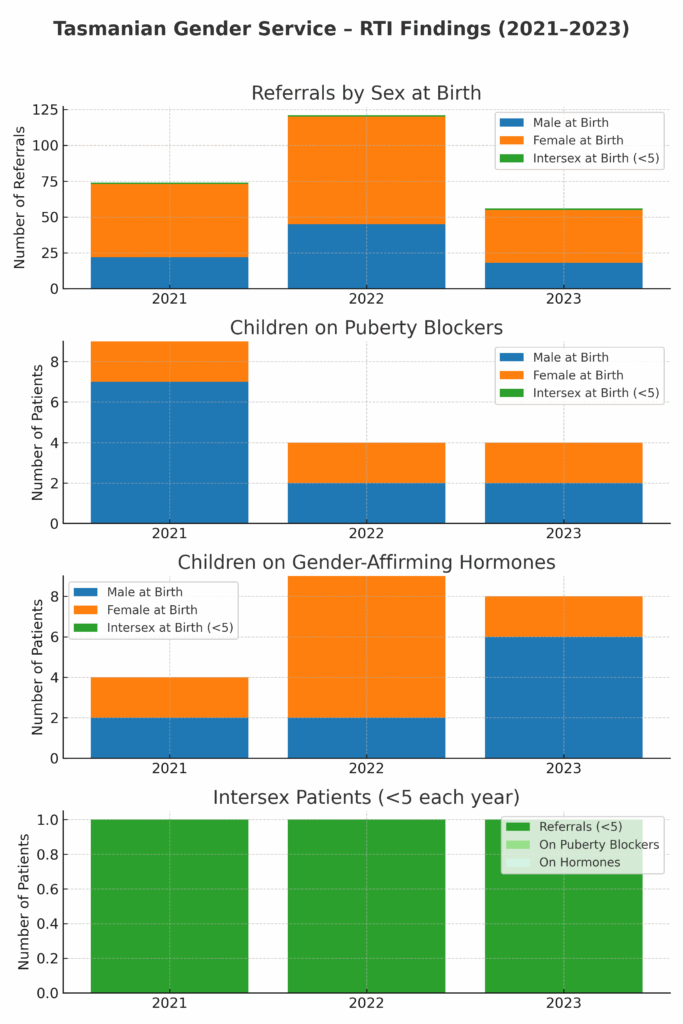
- Around 260 patients have been referred.
- Approximately 170 were female at birth and 90 were male at birth.
- Annual referral numbers have dropped since 2022.
Puberty Blockers and Hormones
The only puberty blocker named in the RTI response is Leuprorelin acetate 30mg.
- Numbers of children starting puberty blockers each year are very small—often fewer than five in each sex category.
- Hormone treatment numbers are also low, typically under 10 per year.
Collaboration and Guidelines
The TGS works with public hospital gender clinics across Australia and primarily follows the Royal Children’s Hospital Australian Standards of Care. They also refer to WPATH Standards of Care Version 8, but note differences in Australian practice—such as Tasmania’s requirement for consent from all legal guardians before starting puberty blockers or hormones.
Referrals to RCH Melbourne
Since 2021, small numbers of Tasmanian children (under five per year in each sex category) have been referred to the RCH Melbourne for gender-affirming treatment.
Intersex Patients
From the RTI decision, the reporting on intersex patients was extremely limited.
Here’s what was disclosed:
- Referrals: In 2021, 2022, and 2023, the number of referrals for patients recorded as intersex at birth was listed as “<5” each year.
- Puberty Blockers: No intersex patients received puberty blockers in any reported year (2021–2023).
- Hormones: No intersex patients were recorded as receiving gender-affirming hormones in 2021–2023.
- Referrals to Royal Children’s Hospital Melbourne: Intersex patient referrals were also reported as “<5” per year for 2021–2023.
The “<5” reporting means the exact figure is suppressed to protect privacy when small numbers are involved—so it could be anywhere between 0 and 4.
What We Couldn’t Learn
Some of the most important information—treatment monitoring, outcomes, and follow-up data—was refused. The Department claimed this information is stored in a way that would require more than five full working days of manual searching, which they said would be an “unreasonable diversion of resources.”
We were also told the Department does not hold information on:
- International changes in youth gender medicine (such as restrictions in the UK, Sweden, or Finland).
- The recently leaked WPATH Files.
- A TGS Annual Report (which is not produced).
Why This Matters
This RTI confirms that Tasmania’s gender clinic is very new, small in patient numbers, and heavily reliant on guidelines from interstate. However, it also highlights a serious gap: there is no accessible, systematic reporting on patient outcomes.
Given international concerns about the safety and evidence base for puberty blockers and hormones in minors, Tasmania needs better transparency, routine data collection, and active monitoring of global medical developments. Without these, it is impossible to fully evaluate whether the service is safe, effective, and in line with best practice.